Mobini Kesheh Mina, Keyvani Hossein
Student Research Committee, Department of Virology, School of Medicine, Iran University of Medical Science, Tehran, Iran.
Department of Virology, School of Medicine, Iran University of Medical Science, Tehran, Iran.
Iran J Pathol. 2019 Summer;14(3):197-205. doi: 10.30699/ijp.2019.90356.1861.
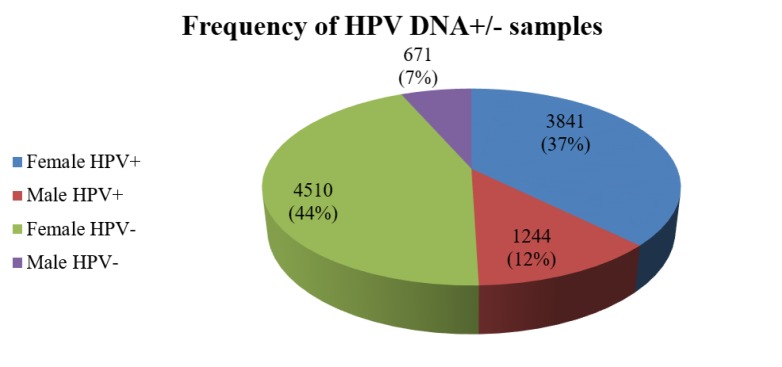
BACKGROUND & OBJECTIVE: (HPV) is the main cause of genital warts and some anogenital cancers in male and female subjects which is commonly transmitted by sexual contacts. The objective of this cross-sectional study was to examine the prevalence of HPV genotypes in 10,266 Iranian male and female population, according to their age.
Samples were collected from the penile and anal sites of male subjects and the vagina and cervix of female subjects in a time period between 2011 and 2016. HPV DNA was detected in PCR using the MY09 and MY11 primers, and the INNO-LiPA assay was applied for HPV genotyping. To investigate the relevance of HPV infection and age, the samples were classified into 4 age groups (13-29, 30-44, 45-59, and 60-74).
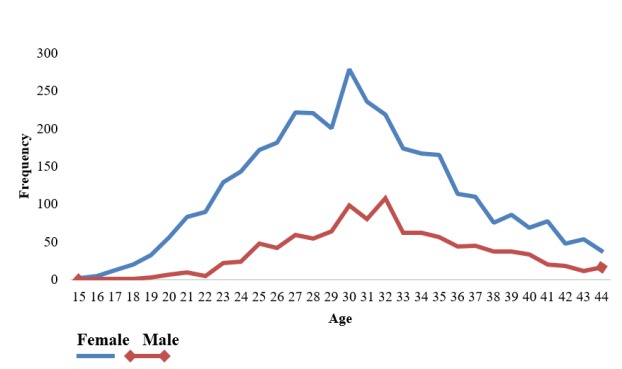
Totally, the most common low risk HPV genotypes detected in the studied male and female subjects were HPV-6 (77.7% and 43.3%) and HPV-11 (13.7% and 11.4%), and more frequent high risk HPV genotypes were HPV-16 (5.5% and 16.6%) and HPV-52 (3.2% and 9.6%), respectively. High burden of the HPV infection was observed at ranges of 30 and 44 years (51.8%) with a peak at ranges between 30 and 32 years. No considerable statistically significant correlation was found between HPV infection and age (=1).
This study gave an epidemiological overview of circulating HPV genotypes in Iranian population to develop future vaccination policies, though the findings of prevalent HPV genotypes in female subjects were inconsistent with the previous studies reported in Iran.
人乳头瘤病毒(HPV)是男性和女性尖锐湿疣及部分肛门生殖器癌的主要病因,通常通过性接触传播。这项横断面研究的目的是根据年龄调查10266名伊朗男性和女性人群中HPV基因型的流行情况。
在2011年至2016年期间,从男性受试者的阴茎和肛门部位以及女性受试者的阴道和子宫颈采集样本。使用MY09和MY11引物通过聚合酶链反应(PCR)检测HPV DNA,并应用INNO-LiPA检测法进行HPV基因分型。为了研究HPV感染与年龄的相关性,将样本分为4个年龄组(13 - 29岁、30 - 44岁、45 - 59岁和60 - 74岁)。
总体而言,在研究的男性和女性受试者中检测到的最常见低风险HPV基因型分别是HPV - 6(77.7%和43.3%)和HPV - 11(13.7%和11.4%),更常见的高风险HPV基因型分别是HPV - 16(5.5%和16.6%)和HPV - 52(3.2%和9.6%)。在30至44岁年龄段观察到HPV感染负担较高(51.8%),在30至32岁之间达到峰值。未发现HPV感染与年龄之间存在显著的统计学相关性(=1)。
本研究对伊朗人群中流行的HPV基因型进行了流行病学概述,以制定未来的疫苗接种政策,尽管女性受试者中流行的HPV基因型的研究结果与伊朗此前报道的研究不一致。