Faculty of Engineering, Department of Biomedical Engineering, National University of Singapore, Singapore, 117583, Singapore.
NUS Graduate School for Integrative Sciences and Engineering, National University of Singapore, Singapore, 117456, Singapore.
Nat Commun. 2019 Oct 8;10(1):4586. doi: 10.1038/s41467-019-12506-w.
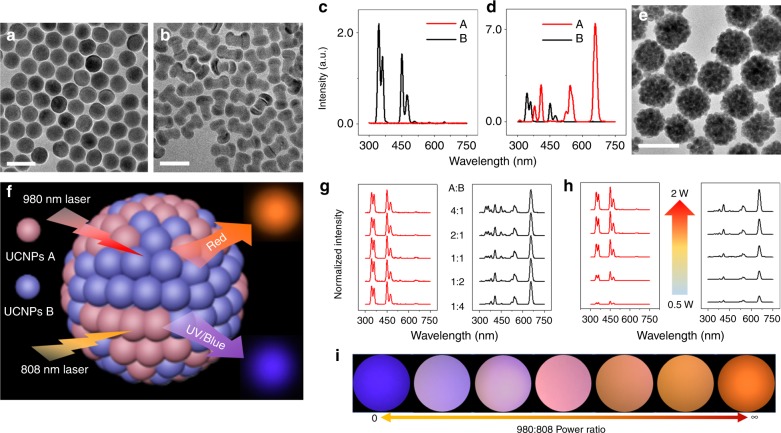
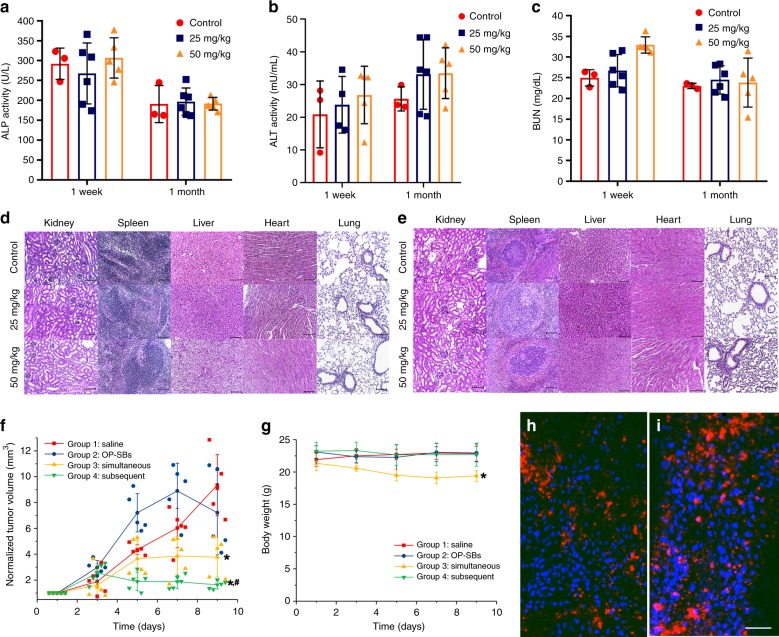
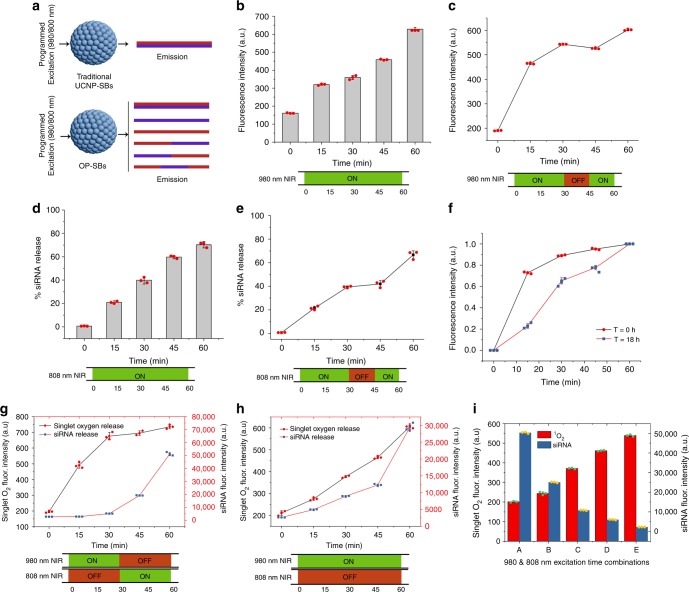
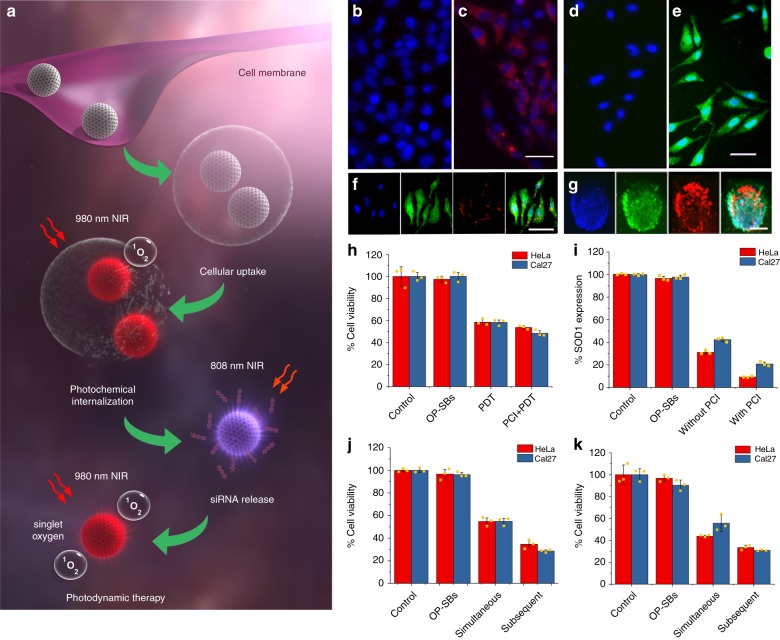
Upconversion nanoparticles (UCNPs) are the preferred choice for deep-tissue photoactivation, owing to their unique capability of converting deep tissue-penetrating near-infrared light to UV/visible light for photoactivation. Programmed photoactivation of multiple molecules is critical for controlling many biological processes. However, syntheses of such UCNPs require epitaxial growth of multiple shells on the core nanocrystals and are highly complex/time-consuming. To overcome this bottleneck, we have modularly assembled two distinct UCNPs which can individually be excited by 980/808 nm light, but not both. These orthogonal photoactivable UCNPs superballs are used for programmed photoactivation of multiple therapeutic processes for enhanced efficacy. These include sequential activation of endosomal escape through photochemical-internalization for enhanced cellular uptake, followed by photocontrolled gene knockdown of superoxide dismutase-1 to increase sensitivity to reactive oxygen species and finally, photodynamic therapy under these favorable conditions. Such programmed activation translated to significantly higher therapeutic efficacy in vitro and in vivo in comparison to conventional, non-programmed activation.
上转换纳米粒子(UCNPs)是用于深层组织光激活的首选材料,因为它们具有将深层组织穿透的近红外光转换为用于光激活的紫外/可见光的独特能力。多个分子的编程光激活对于控制许多生物过程至关重要。然而,这种 UCNPs 的合成需要在核心纳米晶体上外延生长多个壳层,这是非常复杂和耗时的。为了克服这一瓶颈,我们已经将两个不同的 UCNPs 进行了模块化组装,它们可以分别被 980/808nm 光激发,但不能同时被激发。这些正交光可激活的 UCNPs 超球可用于对多个治疗过程进行编程光激活,以提高疗效。这些过程包括通过光化学内化顺序激活内体逃逸以增强细胞摄取,然后用光控制超氧化物歧化酶-1 的基因敲低来增加对活性氧的敏感性,最后在这些有利条件下进行光动力治疗。与传统的非编程激活相比,这种编程激活在体外和体内都显著提高了治疗效果。