Department of Psychiatry & Addiction Center, Michigan Medicine, Ann Arbor, Michigan.
Johns Hopkins Bloomberg School of Public Health, Baltimore, Maryland.
Alcohol Clin Exp Res. 2019 Nov;43(11):2431-2437. doi: 10.1111/acer.14194. Epub 2019 Oct 9.
Alcohol can lead to fatal and nonfatal overdose (OD) through its neurobiological inhibitory effects when used alone or with other drugs. Little research has examined alcohol OD characteristics in the context of concomitant drug use.
This study utilized alcohol OD data (defined as alcohol poisoning, passing out, or blacking out) collected in a large residential addiction treatment facility (N = 660). Latent class analysis identified classes of alcohol OD events based on concomitant drug use at the time of OD. We evaluated correlates of alcohol OD classes, including depression, emergency medical services, and hospitalization, using latent class regression.
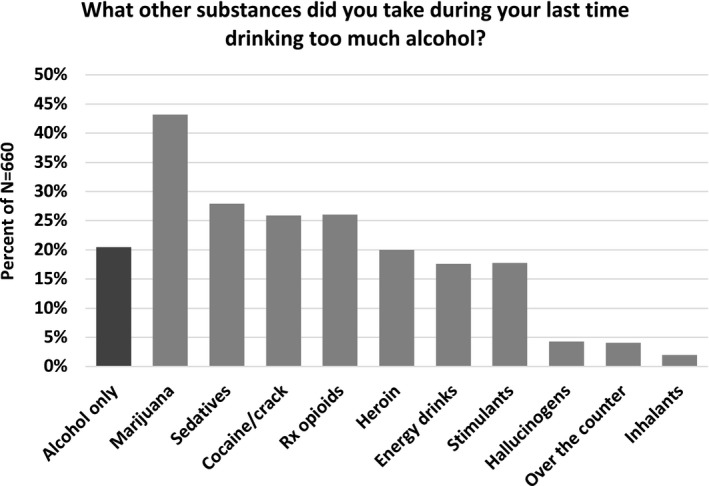
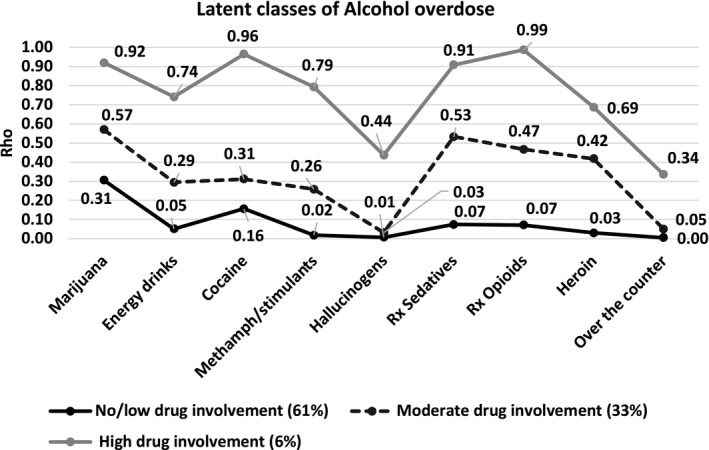
Only 20% of alcohol ODs involved alcohol alone. Marijuana was the most commonly used drug during the most recent alcohol OD (43.2%), followed by sedatives (27.9%), cocaine or crack (25.9%), prescription opioids (26.1%), and heroin (20%). The final latent class model included 3 classes: no/low drug involvement (61%), moderate drug involvement (33%), and high drug involvement (6%). Relative to the no/low drug involvement class, participants admitted to the hospital were 6.4-fold more likely to be in the high drug involvement class (95% CI: 2.4 to 16.6) and 2.9-fold more likely to be in the moderate drug involvement class (95% CI: 1.2 to 7.2). Participants receiving emergency medical services were more likely to be in the high drug involvement class (aOR: 2.2, 95% CI: 2.2, 1.1 to 4.5) and less likely to be in the moderate drug involvement class (aOR 0.39, 95% CI: 0.2 to 0.96).
Combining drug classes with alcohol prior to OD was common and associated with a higher likelihood of hospitalization. Overdose prevention efforts should address acute risks of alcohol ingestion with other drugs.
酒精具有神经生物学抑制作用,单独使用或与其他药物同时使用都会导致致命和非致命的药物过量(OD)。很少有研究在同时使用其他药物的情况下检查酒精 OD 的特征。
本研究利用在一家大型住宅戒毒治疗机构(N=660)收集的酒精 OD 数据(定义为酒精中毒、昏倒或昏厥)。基于 OD 时同时使用的药物,潜在类别分析确定了酒精 OD 事件的类别。我们使用潜在类别回归评估了酒精 OD 类别的相关因素,包括抑郁、紧急医疗服务和住院治疗。
只有 20%的酒精 OD 涉及单独的酒精。在最近一次酒精 OD 中,大麻是最常使用的药物(43.2%),其次是镇静剂(27.9%)、可卡因或快克(25.9%)、处方类阿片类药物(26.1%)和海洛因(20%)。最终的潜在类别模型包括 3 个类别:无/低药物参与(61%)、中度药物参与(33%)和高药物参与(6%)。与无/低药物参与类别相比,住院患者更有可能属于高药物参与类别(95%CI:2.4 至 16.6),而中度药物参与类别则更有可能属于中度药物参与类别(95%CI:1.2 至 7.2)。接受紧急医疗服务的患者更有可能属于高药物参与类别(aOR:2.2,95%CI:2.2,1.1 至 4.5),而不太可能属于中度药物参与类别(aOR 0.39,95%CI:0.2 至 0.96)。
在 OD 之前将药物类别与酒精混合使用很常见,并且与更高的住院可能性相关。过量预防工作应针对酒精摄入与其他药物同时使用的急性风险。