Department of Pathology, School of Medicine, Kyungpook National University, Daegu, South Korea.
Department of Pathology, Kyungpook National University Chilgok Hospital, Daegu, South Korea.
PLoS One. 2019 Oct 9;14(10):e0223608. doi: 10.1371/journal.pone.0223608. eCollection 2019.
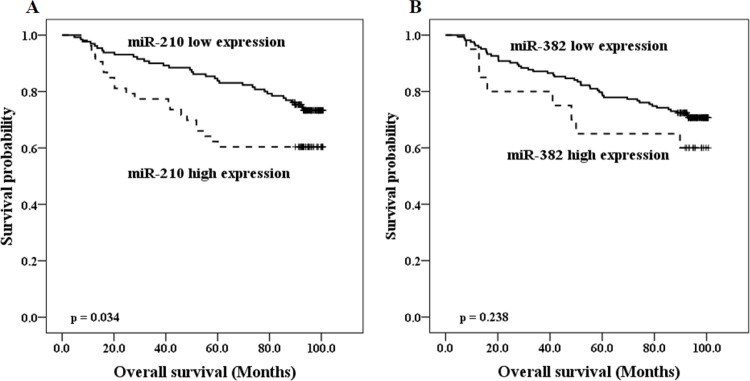
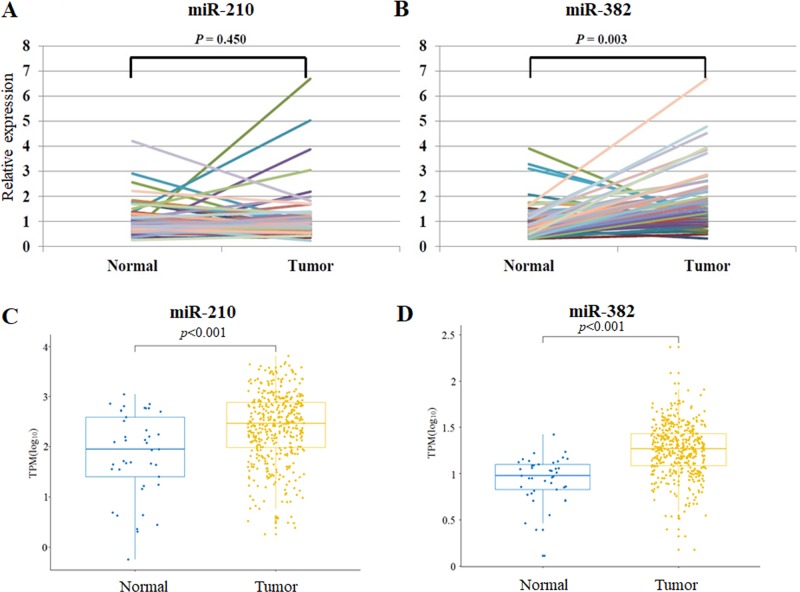
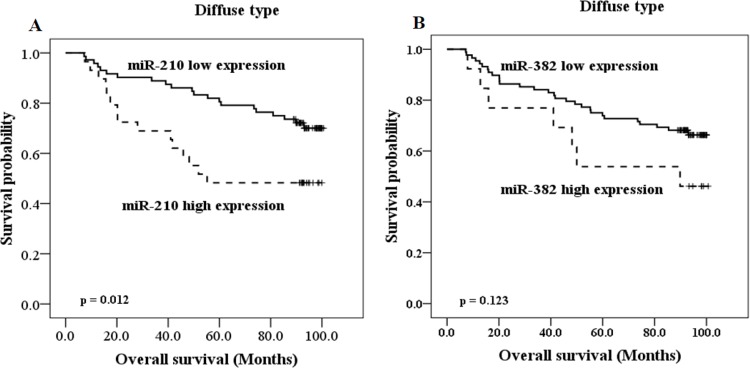
Hypoxia and angiogenesis are critical components in the progression of solid cancer, including gastric cancers (GCs). miR-382 has been identified as a hypoxia-induced miR (hypoxamiR), but the clinical significance in GCs has not been identified yet. To explore the clinical and prognostic importance of miR-382 in GCs, the surgical specimens of 398 patients with GCs in KNU hospital in Korea, the total of 183 patients was randomly selected using simple sampling methods and big data with 446 GCs and 45 normal tissues from the data portal (https://portal.gdc.cancer.gov/) were analysed. Expression of miR-382 as well as miR-210, as a positive control hypoxamiR by qRT-PCR in histologically malignant region of GCs showed significantly positive correlation (R = 0.516, p<0.001). High miR-210 and miR-382 expression was significantly correlated with unfavorable prognosis including advanced GCs (AGC), higher T category, N category, pathologic TNM stage, lymphovascular invasion, venous invasion, and perinueral invasion, respectively (all p<0.05). In univariate analysis, high miR-210 expression was significantly associated with worse overall survival (OS) (p = 0.036) but not high miR-382. In paired 60 gastric normal and cancer tissues, miR-382 expression in cancer tissues was significantly higher than normal counterpart (p = 0.003), but not miR-210 expression. However, by increasing the patient number from the big data analysis, miR-210 as well as miR-382 expression in tumor tissues was significantly higher than the normal tissues. Our results suggest that miR-382, as novel hypoxamiR, can be a prognostic marker for advanced GCs and might be correlated with metastatic potential. miR-382 might play important roles in the aggressiveness, progression and prognosis of GCs. In addition, miR-382 give a predictive marker for progression of GCs compared to the normal or preneoplastic lesion.
缺氧和血管生成是实体瘤进展的关键组成部分,包括胃癌(GCs)。miR-382 已被鉴定为一种缺氧诱导的 miR(hypoxamiR),但在 GCs 中的临床意义尚未确定。为了探讨 miR-382 在 GCs 中的临床和预后意义,我们对韩国 KNU 医院的 398 例 GCs 手术标本进行了研究,采用简单抽样方法和大数据分析,从数据门户(https://portal.gdc.cancer.gov/)中选择了 446 例 GCs 和 45 例正常组织,分析了 miR-382 的表达情况,以及 miR-210 的表达情况,miR-210 是一种阳性对照 hypoxamiR,通过 qRT-PCR 在 GCs 的组织学恶性区域显示出显著的正相关(R = 0.516,p<0.001)。miR-210 和 miR-382 的高表达与不良预后显著相关,包括晚期 GCs(AGC)、更高的 T 分期、N 分期、病理 TNM 分期、淋巴管侵犯、静脉侵犯和神经周围侵犯(均 p<0.05)。在单因素分析中,miR-210 高表达与总生存期(OS)较差显著相关(p=0.036),但 miR-382 无显著相关。在配对的 60 例胃正常和癌症组织中,癌症组织中 miR-382 的表达明显高于正常对照(p=0.003),但 miR-210 的表达无明显差异。然而,通过增加大数据分析中的患者数量,肿瘤组织中 miR-210 和 miR-382 的表达明显高于正常组织。我们的结果表明,miR-382 作为一种新型的 hypoxamiR,可能是晚期 GCs 的预后标志物,并且可能与转移潜力相关。miR-382 可能在 GCs 的侵袭性、进展和预后中发挥重要作用。此外,与正常或癌前病变相比,miR-382 为 GCs 的进展提供了预测性标志物。