Cho Yongin, Hong Namki, Kim Kyung-Won, Cho Sung Joon, Lee Minyoung, Lee Yeon-Hee, Lee Yong-Ho, Kang Eun Seok, Cha Bong-Soo, Lee Byung-Wan
Department of Endocrinology and Metabolism, Inha University School of Medicine, Incheon 22332, Korea.
Graduate School, Yonsei University College of Medicine, Seoul 03722, Korea.
J Clin Med. 2019 Oct 9;8(10):1645. doi: 10.3390/jcm8101645.
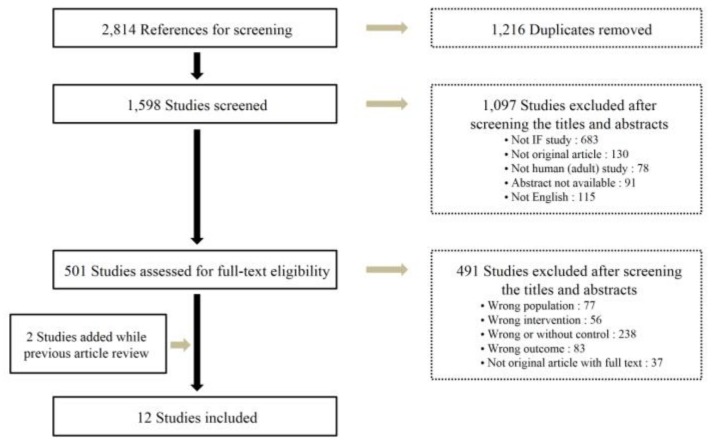
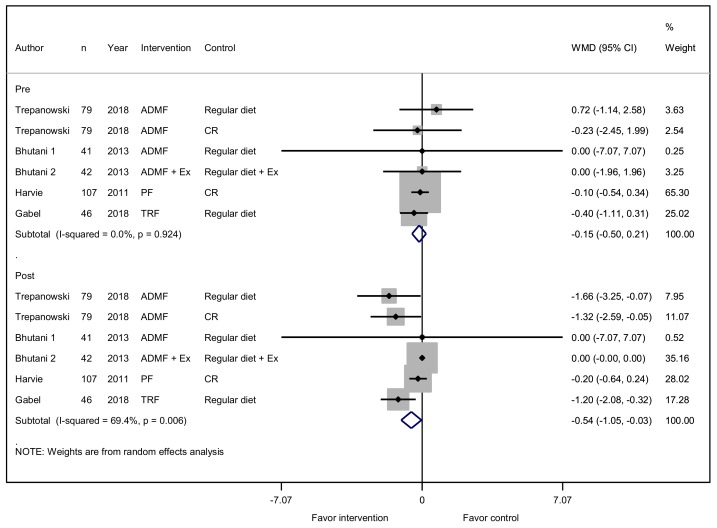
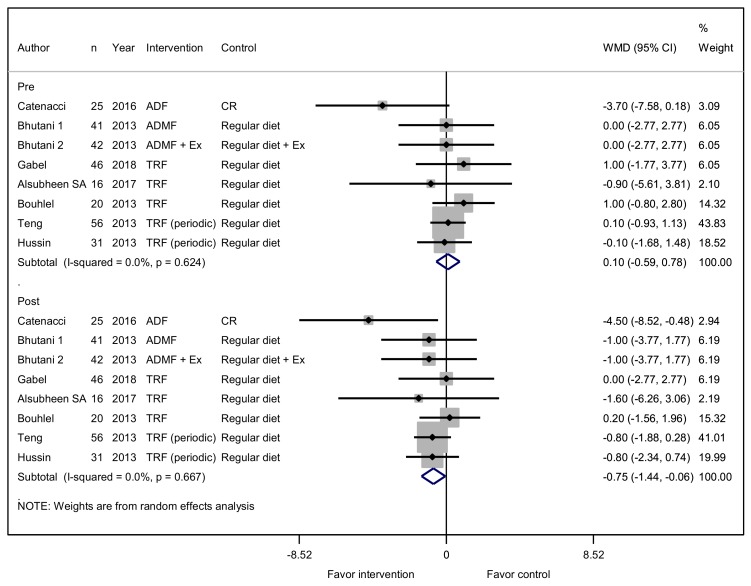
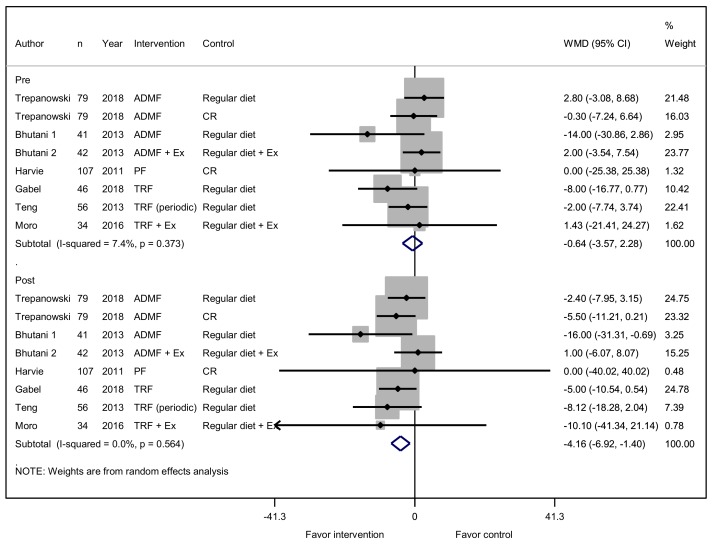
The effects of an intermittent fasting diet (IFD) in the general population are still controversial. In this study, we aimed to systematically evaluate the effectiveness of an IFD to reduce body mass index and glucose metabolism in the general population without diabetes mellitus. Cochrane, PubMed, and Embase databases were searched to identify randomized controlled trials and controlled clinical trials that compared an IFD with a regular diet or a continuous calorie restriction diet. The effectiveness of an IFD was estimated by the weighted mean difference (WMD) for several variables associated with glucometabolic parameters including body mass index (BMI) and fasting glucose. The pooled mean differences of outcomes were calculated using a random effects model. From 2814 studies identified through a literature search, we finally selected 12 articles (545 participants). Compared with a control diet, an IFD was associated with a significant decline in BMI (WMD, -0.75 kg/m; 95% CI, -1.44 to -0.06), fasting glucose level (WMD, -4.16 mg/dL; 95% CI, -6.92 to -1.40), and homeostatic model assessment of insulin resistance (WMD, -0.54; 95% CI, -1.05 to -0.03). Fat mass (WMD, -0.98 kg; 95% CI, -2.32 to 0.36) tended to decrease in the IFD group with a significant increase in adiponectin (WMD, 1008.9 ng/mL; 95% CI, 140.5 to 1877.3) and a decrease in leptin (WMD, -0.51 ng/mL; 95% CI, -0.77 to -0.24) levels. An IFD may provide a significant metabolic benefit by improving glycemic control, insulin resistance, and adipokine concentration with a reduction of BMI in adults.
间歇性禁食饮食(IFD)对普通人群的影响仍存在争议。在本研究中,我们旨在系统评估IFD在无糖尿病的普通人群中降低体重指数和改善糖代谢的有效性。检索了Cochrane、PubMed和Embase数据库,以识别将IFD与常规饮食或持续热量限制饮食进行比较的随机对照试验和对照临床试验。通过加权平均差(WMD)评估IFD对包括体重指数(BMI)和空腹血糖在内的多个与糖代谢参数相关变量的有效性。使用随机效应模型计算结果的合并平均差。通过文献检索确定的2814项研究中,我们最终选择了12篇文章(545名参与者)。与对照饮食相比,IFD与BMI显著下降(WMD,-0.75 kg/m²;95%CI,-1.44至-0.06)、空腹血糖水平(WMD,-4.16 mg/dL;95%CI,-6.92至-1.40)以及胰岛素抵抗的稳态模型评估(WMD,-0.54;95%CI,-1.05至-0.03)相关。IFD组的脂肪量(WMD,-0.98 kg;95%CI,-2.32至0.36)有下降趋势,脂联素显著增加(WMD,1008.9 ng/mL;95%CI,140.5至1877.3),瘦素水平下降(WMD,-0.51 ng/mL;95%CI,-0.77至-0.24)。IFD可能通过改善血糖控制、胰岛素抵抗和脂肪因子浓度并降低成年人的BMI提供显著的代谢益处。