Institut für Biologie, Fachinstitut für Theoretische Biologie, Humboldt-Universität zu Berlin, Invalidenstr. 110, 10115, Berlin, Germany.
Microb Cell Fact. 2019 Oct 10;18(1):165. doi: 10.1186/s12934-019-1209-7.
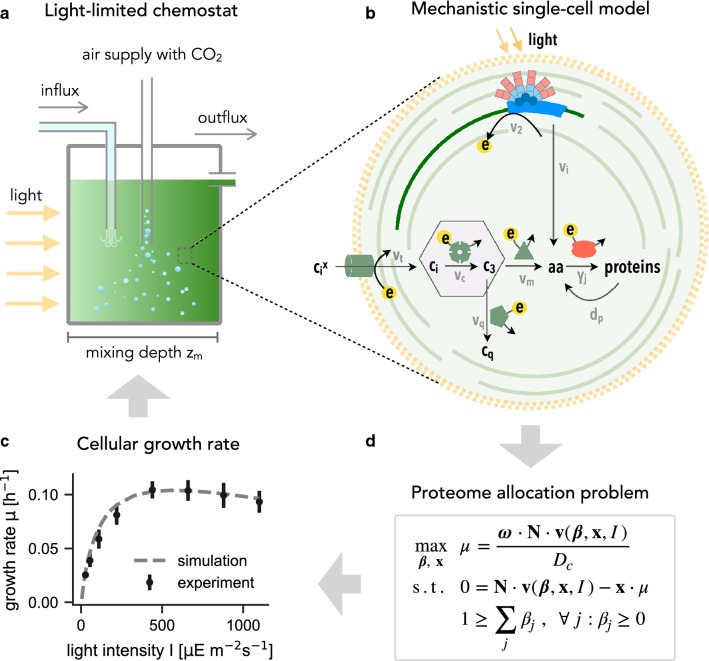
Cyanobacteria and other phototrophic microorganisms allow to couple the light-driven assimilation of atmospheric [Formula: see text] directly to the synthesis of carbon-based products, and are therefore attractive platforms for microbial cell factories. While most current engineering efforts are performed using small-scale laboratory cultivation, the economic viability of phototrophic cultivation also crucially depends on photobioreactor design and culture parameters, such as the maximal areal and volumetric productivities. Based on recent insights into the cyanobacterial cell physiology and the resulting computational models of cyanobacterial growth, the aim of this study is to investigate the limits of cyanobacterial productivity in continuous culture with light as the limiting nutrient.
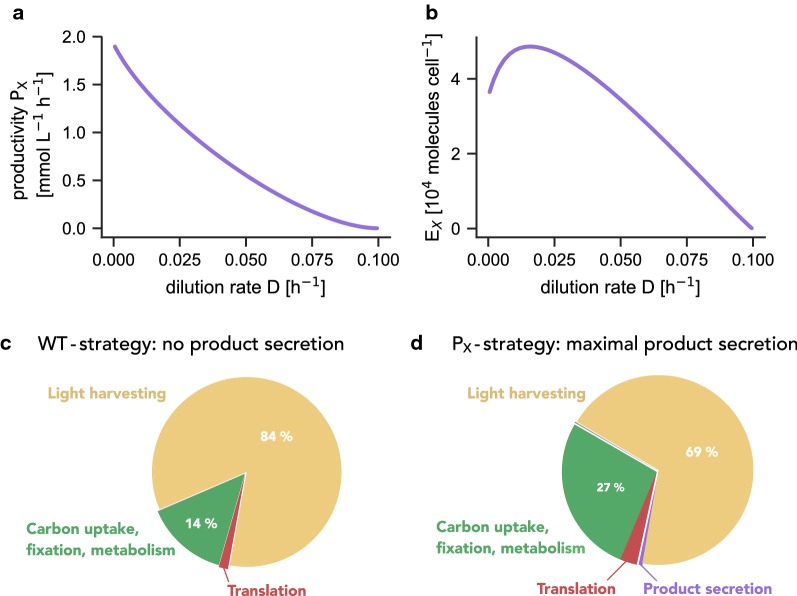
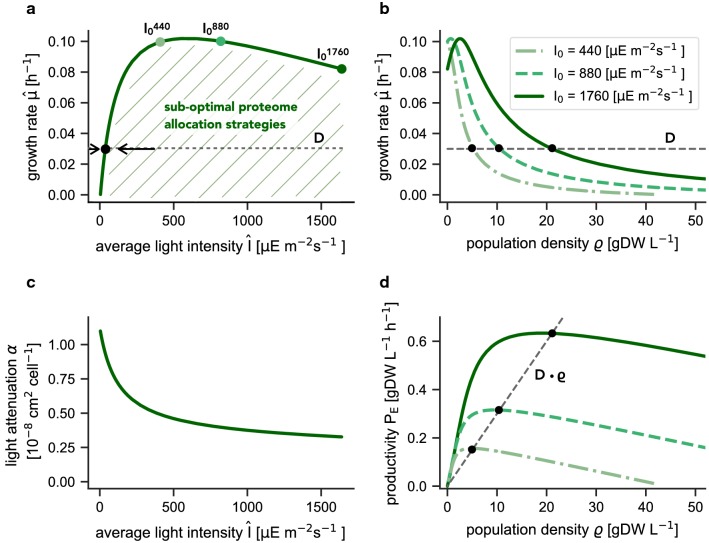
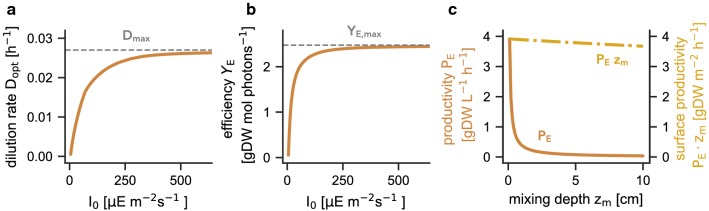
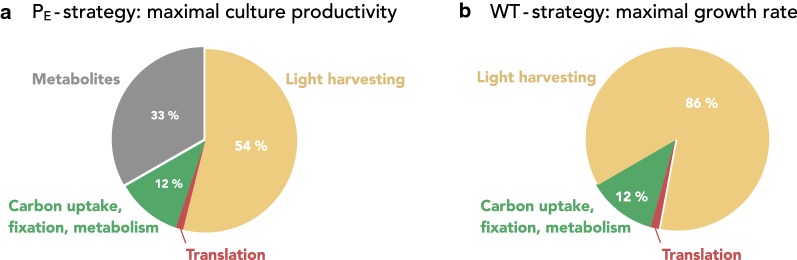
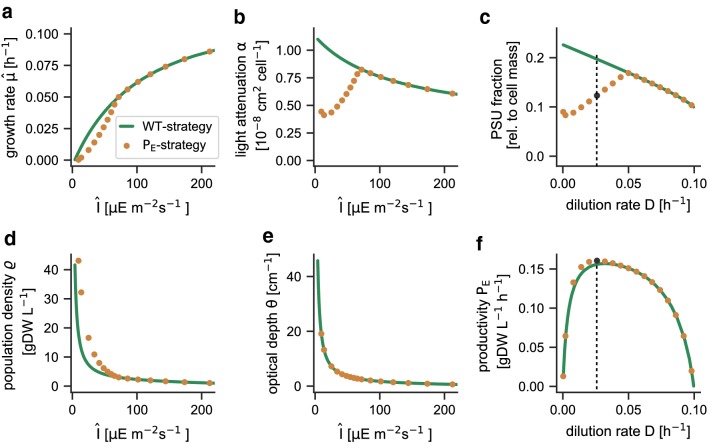
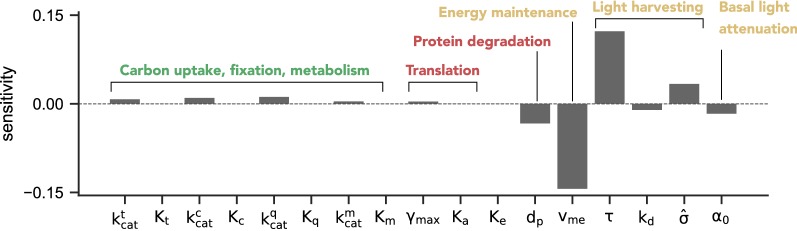
We integrate a coarse-grained model of cyanobacterial growth into a light-limited chemostat and its heterogeneous light gradient induced by self-shading of cells. We show that phototrophic growth in the light-limited chemostat can be described using the concept of an average light intensity. Different from previous models based on phenomenological growth equations, our model provides a mechanistic link between intracellular protein allocation, population growth and the resulting reactor productivity. Our computational framework thereby provides a novel approach to investigate and predict the maximal productivity of phototrophic cultivation, and identifies optimal proteome allocation strategies for developing maximally productive strains.
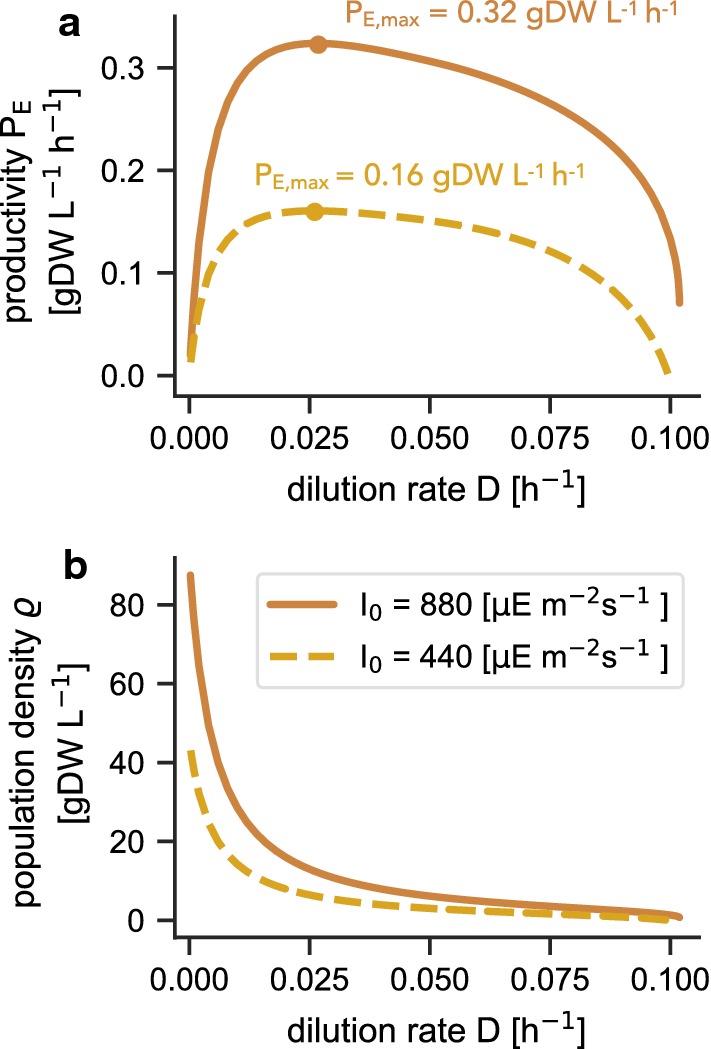
Our results have implications for efficient phototrophic cultivation and the design of maximally productive phototrophic cell factories. The model predicts that the use of dense cultures in well-mixed photobioreactors with short light-paths acts as an effective light dilution mechanism and alleviates the detrimental effects of photoinhibition even under very high light intensities. We recover the well-known trade-offs between a reduced light-harvesting apparatus and increased population density. Our results are discussed in the context of recent experimental efforts to increase the yield of phototrophic cultivation.
蓝细菌和其他光合微生物能够将大气[Formula: see text]的光驱动同化直接与碳基产物的合成相耦合,因此是微生物细胞工厂的有吸引力的平台。虽然大多数当前的工程努力都是使用小规模实验室培养来进行的,但光合培养的经济可行性也取决于光生物反应器的设计和培养参数,例如最大的面积和体积生产力。基于最近对蓝细菌细胞生理学的深入了解,以及由此产生的蓝细菌生长的计算模型,本研究旨在研究以光为限制营养的连续培养中蓝细菌生产力的极限。
我们将蓝细菌生长的粗粒度模型集成到光限制的恒化器及其由细胞自遮光引起的不均匀光梯度中。我们表明,光限制恒化器中的光养生长可以使用平均光强的概念来描述。与基于现象学生长方程的先前模型不同,我们的模型提供了细胞内蛋白质分配、种群生长和由此产生的反应器生产力之间的机制联系。我们的计算框架从而提供了一种新的方法来研究和预测光养培养的最大生产力,并确定开发最大生产力菌株的最佳蛋白质组分配策略。
我们的结果对高效光养培养和最有生产力的光养细胞工厂的设计具有重要意义。该模型预测,在具有短光程的充分混合光生物反应器中使用密集培养作为一种有效的光稀释机制,可以减轻甚至在非常高的光强度下光抑制的有害影响。我们恢复了众所周知的减少光捕获装置和增加种群密度之间的权衡。我们的结果在最近为提高光养培养产量而进行的实验努力的背景下进行了讨论。