Oxford Stone Group, Nuffield Department of Surgical Sciences, University of Oxford, Oxford, United Kingdom.
University of Lisbon, Faculty of Sciences, Lisbon, Portugal.
Sci Rep. 2019 Oct 11;9(1):14674. doi: 10.1038/s41598-019-51026-x.
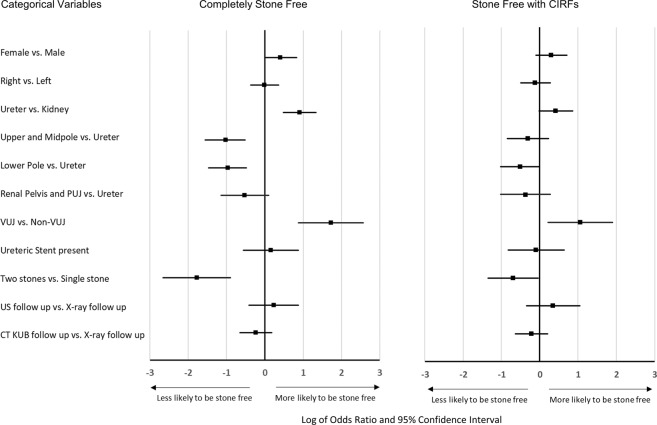
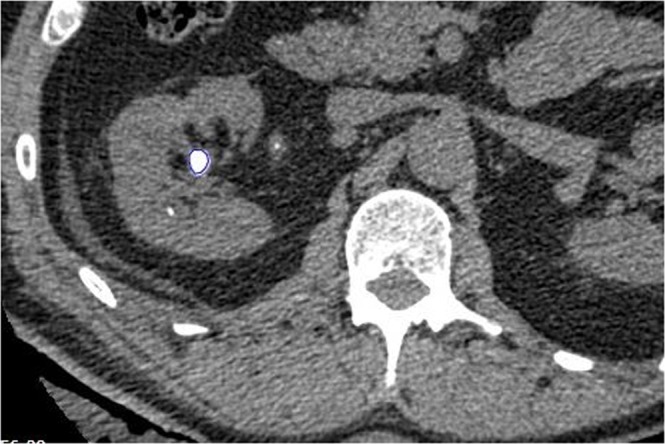
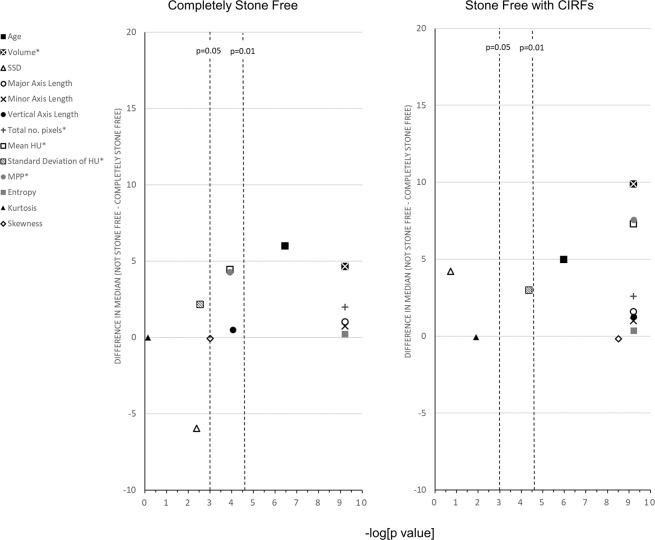
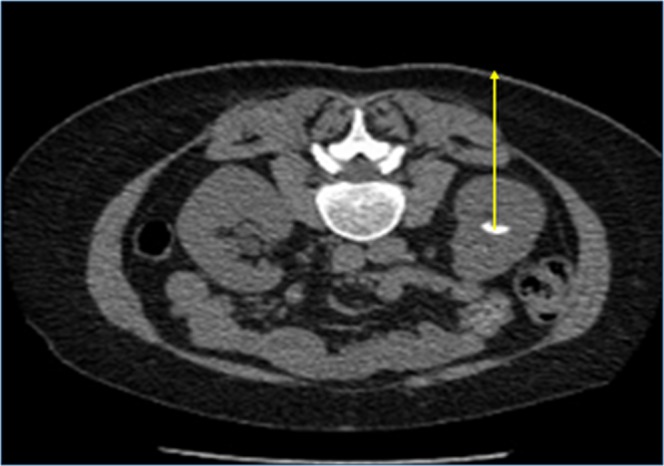
We aimed to develop and evaluate a statistical model, which included known pre-treatment factors and new computed tomography texture analysis (CTTA) variables, for its ability to predict the likelihood of a successful outcome after extracorporeal shockwave lithotripsy (SWL) treatment for renal and ureteric stones. Up to half of patients undergoing SWL may fail treatment. Better prediction of which cases will likely succeed SWL will help patients to make an informed decision on the most effective treatment modality for their stone. 19 pre-treatment factors for SWL success, including 6 CTTA variables, were collected from 459 SWL cases at a single centre. Univariate and multivariable analyses were performed by independent statisticians to predict the probability of a stone free (both with and without residual fragments) outcome after SWL. A multivariable model had an overall accuracy of 66% on Receiver Operator Curve (ROC) analysis to predict for successful SWL outcome. The variables most frequently chosen for the model were those which represented stone size. Although previous studies have suggested SWL can be reliably predicted using pre-treatment factors and that analysis of CT stone images may improve outcome prediction, the results from this study have not produced a useful model for SWL outcome prediction.
我们旨在开发和评估一个统计模型,该模型包含已知的治疗前因素和新的计算机断层扫描纹理分析(CTTA)变量,以预测体外冲击波碎石术(SWL)治疗肾和输尿管结石后成功的可能性。多达一半的接受 SWL 治疗的患者可能会失败。更好地预测哪些病例可能成功接受 SWL 治疗将有助于患者对其结石最有效的治疗方式做出明智的决定。从单一中心的 459 例 SWL 病例中收集了 19 个 SWL 成功的治疗前因素,包括 6 个 CTTA 变量。由独立统计学家进行单变量和多变量分析,以预测 SWL 后结石(无残余碎片和有残余碎片)的可能性。多变量模型在接受者操作特征曲线(ROC)分析中对成功 SWL 结果的总体准确性为 66%。模型中最常选择的变量是代表结石大小的变量。尽管之前的研究表明可以使用治疗前因素可靠地预测 SWL,并且分析 CT 结石图像可能会改善结果预测,但这项研究的结果并未产生用于 SWL 结果预测的有用模型。