Institute of Basic Research in Clinical Medicine, China Academy of Chinese Medical Sciences, Beijing, China.
Department of Pediatrics, The Queen Silvia Children's Hospital, Institute of Clinical Sciences, Sahlgrenska Academy, University of Gothenburg, 416 85, Gothenburg, Sweden.
Qual Life Res. 2020 Jan;29(1):19-36. doi: 10.1007/s11136-019-02326-2. Epub 2019 Oct 16.
To systematically review studies investigating health-related quality-of-life (HrQoL) in patients with premature ovarian insufficiency (POI), to examine questionnaires used and to conduct a meta-analysis of control studies with normal ovarian function.
Data sources: PubMed, Embase, Web of science, CNKI, and CQVIP, searched from inception until June 2018. The search strategy was a combination of medical (e.g. POI), subjective (e.g. well-being) and methodological (e.g. questionnaires) keywords. PRISMA guidelines were used to assess outcome data quality/validity by one reviewer, verified by a second reviewer. Risk of bias within studies was evaluated. A meta-analysis compared HrQoL in patients and non-patients. Due to measurement differences in the studies, the effect size was calculated as standard mean difference.
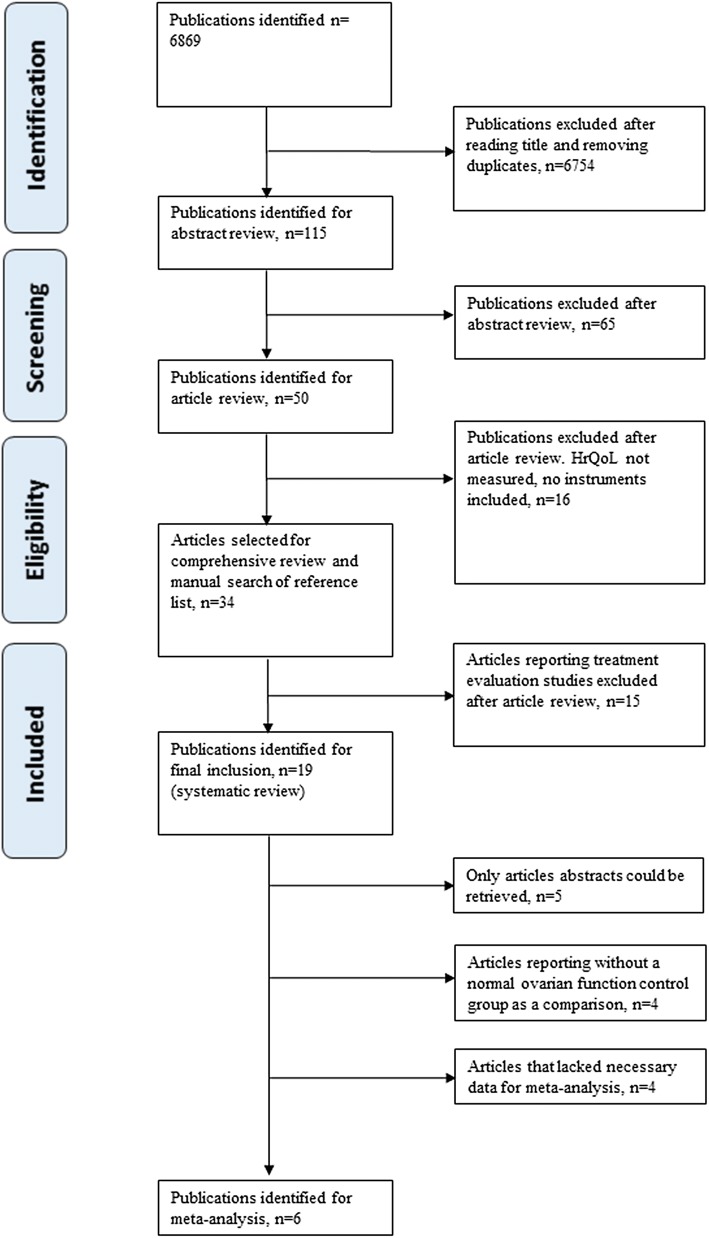
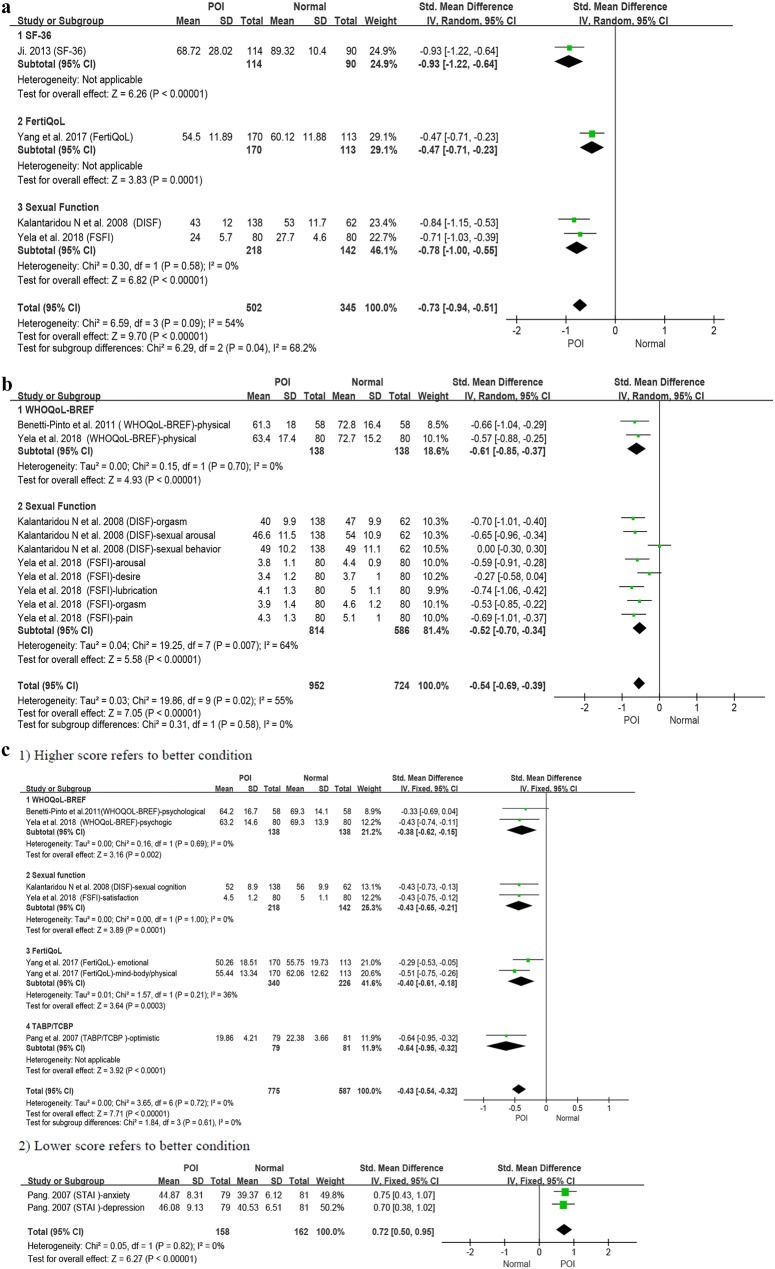
We identified 6869 HrQoL studies. Nineteen geographically diverse studies met inclusion criteria, dated from 2006, using 23 questionnaires. The meta-analysis included six studies with 645 POI participants (age 33.3 ± 5.47) and 492 normal-ovarian control subjects (age 32.87 ± 5.61). Medium effect sizes were found for lower overall HrQoL (pooled SMD = - 0.73, 95% CI - 0.94, - 0.51; I = 54%) and physical function (pooled SMD = - 0.54, 95% CI - 0.69, - 0.39; I = 55%). Heterogeneity was investigated. Effect sizes varied for sexual function depending on the measure (SMD = - 0.27 to - 0.74), overall HrQoL (SF-36) had the largest effect size (- 0.93) in one study. The effect sizes for psychological and social HrQoL were small.
POI is associated with low-to-medium effect size on HrQoL compared to normal ovarian controls. The greatest effects are found in general HrQoL and most sexual function areas. Condition-specific questionnaires and RCTs are recommended for further investigation.
系统回顾研究调查与健康相关的生活质量(HRQoL)在患有卵巢早衰(POI)的患者,检查使用的问卷,并进行荟萃分析与正常卵巢功能的对照研究。
数据来源:PubMed,Embase,Web of science,CNKI 和 CQVIP,从成立到 2018 年 6 月进行搜索。搜索策略是结合医学(如 POI),主观(如幸福感)和方法学(如问卷)关键词。通过一名审查员使用 PRISMA 指南评估结果数据质量/有效性,并由第二名审查员验证。评估研究内的偏倚风险。荟萃分析比较了患者和非患者的 HRQoL。由于研究中的测量差异,效应大小计算为标准均数差。
我们确定了 6869 项 HRQoL 研究。19 项地理位置不同的研究符合纳入标准,研究日期为 2006 年,使用了 23 个问卷。荟萃分析包括六项研究,共 645 名 POI 参与者(年龄 33.3 ± 5.47)和 492 名正常卵巢对照受试者(年龄 32.87 ± 5.61)。发现总体 HRQoL 较低的中等效应大小(合并 SMD = -0.73,95%CI -0.94,-0.51;I = 54%)和身体功能(合并 SMD = -0.54,95%CI -0.69,-0.39;I = 55%)。研究了异质性。性功能的效应大小取决于措施(SMD = -0.27 至 -0.74),一项研究中 SF-36 的总体 HRQoL 具有最大的效应大小(-0.93)。心理和社会 HRQoL 的效应大小较小。
与正常卵巢对照相比,POI 与低至中等效应大小相关的 HRQoL。最大的影响是在一般 HRQoL 和大多数性功能领域发现的。建议使用特定于疾病的问卷和 RCT 进行进一步调查。