Centre for Ecological and Evolutionary Synthesis (CEES), Department of Biosciences, University of Oslo, PO Box 1066, Blindern, N-0316, Oslo, Norway.
Institut de Recherche pour le Développement (IRD), UMR248 MARBEC, IRD/CNRS/IFREMER/UM, Sète Cedex, France.
Sci Rep. 2019 Oct 23;9(1):15213. doi: 10.1038/s41598-019-51607-w.
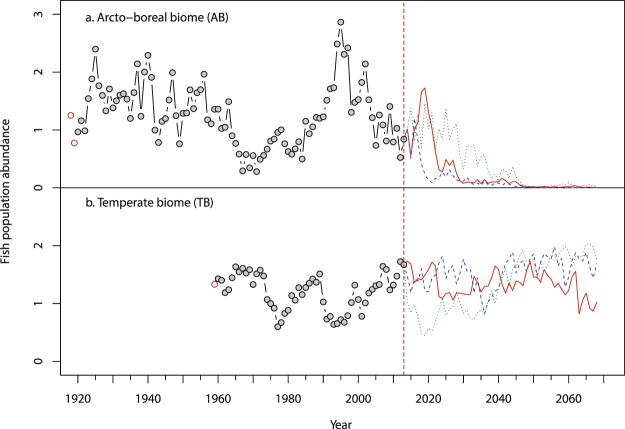
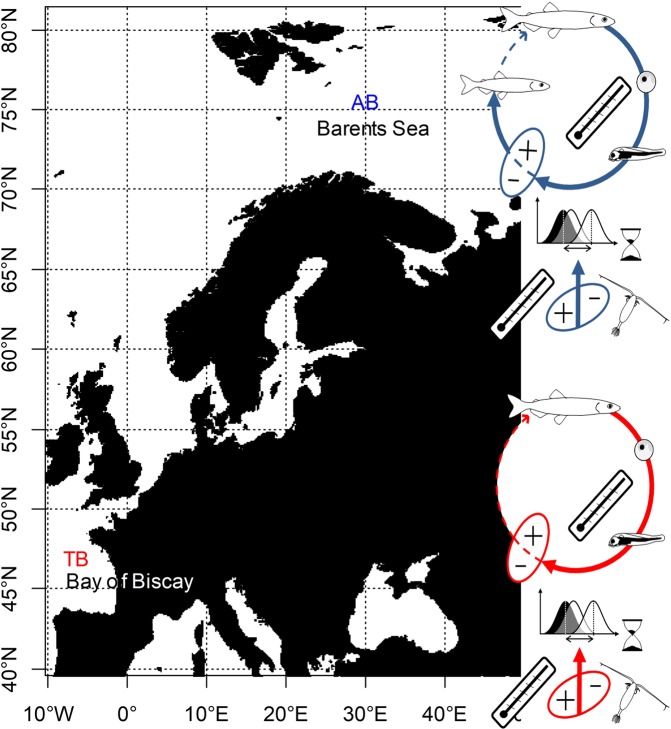
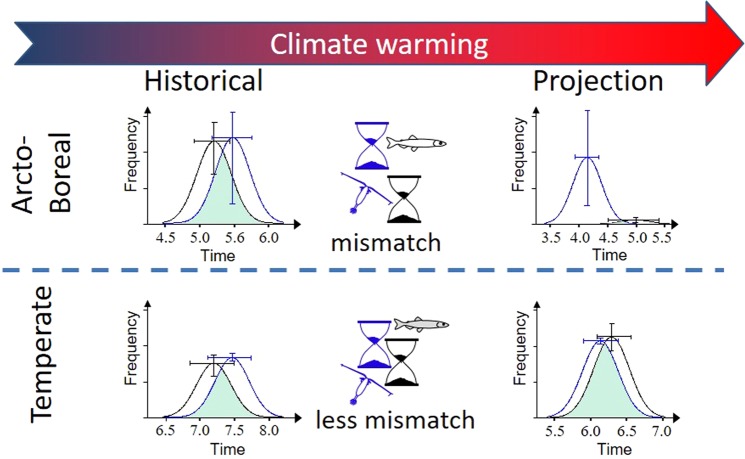
In high-latitude marine environments, primary producers and their consumers show seasonal peaks of abundance in response to annual light cycle, water column stability and nutrient availability. Predatory species have adapted to this pattern by synchronising life-history events such as reproduction with prey availability. However, changing temperatures may pose unprecedented challenges by decoupling the predator-prey interactions. Here we build a predator-prey model accounting for the full life-cycle of fish and zooplankton including their phenology. The model assumes that fish production is bottom-up controlled by zooplankton prey abundance and match or mismatch between predator and prey phenology, and is parameterised based on empirical findings of how climate influences phenology and prey abundance. With this model, we project possible climate-warming effects on match-mismatch dynamics in Arcto-boreal and temperate biomes. We find a strong dependence on synchrony with zooplankton prey in the Arcto-boreal fish population, pointing towards a possible pronounced population decline with warming because of frequent desynchronization with its zooplankton prey. In contrast, the temperate fish population appears better able to track changes in prey timing and hence avoid strong population decline. These results underline that climate change may enhance the risks of predator-prey seasonal asynchrony and fish population declines at higher latitudes.
在高纬度海洋环境中,初级生产者及其消费者会根据年度光周期、水柱稳定性和营养物质可用性,出现丰度的季节性高峰。捕食性物种通过将生殖等生命史事件与猎物的可利用性同步,适应了这种模式。然而,不断变化的温度可能会通过使捕食者-猎物相互作用脱钩,带来前所未有的挑战。在这里,我们构建了一个考虑到鱼类和浮游动物整个生命周期的捕食者-被捕食者模型,包括它们的物候学。该模型假设鱼类的产量受到浮游动物猎物丰度的自上而下的控制,以及捕食者和猎物物候学的匹配或不匹配,其参数是根据气候如何影响物候学和猎物丰度的经验发现确定的。通过这个模型,我们预测了气候变暖对北极-北方和温带生物群落的匹配-不匹配动态的可能影响。我们发现,北极-北方鱼类种群与浮游动物猎物的同步性很强,这表明由于与浮游动物猎物经常不同步,鱼类种群可能会因变暖而出现明显的衰退。相比之下,温带鱼类种群似乎更能够跟踪猎物时间变化,从而避免种群的强烈衰退。这些结果表明,气候变化可能会增加高纬度地区捕食者-猎物季节性不同步和鱼类种群衰退的风险。