Department of Clinical and Experimental Medicine, University of Catania, 95123 Catania, Italy.
Int J Mol Sci. 2019 Oct 24;20(21):5275. doi: 10.3390/ijms20215275.
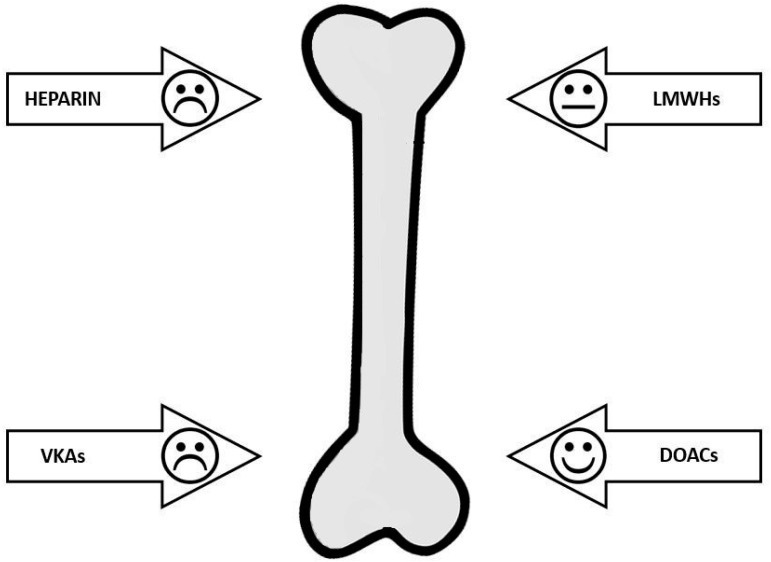
Anticoagulant agents are widely used in the treatment of thromboembolic events and in stroke prevention. Data about their effects on bone tissue are in some cases limited or inconsistent (oral anti-vitamin K agents), and in others are sufficiently strong (heparins) to suggest caution in their use in subjects at risk of osteoporosis. This review analyses the effects of this group of drugs on bone metabolism, on bone mineral density, and on fragility fractures. A literature search strategy was developed by an experienced team of specialists by consulting the MEDLINE platform, including published papers and reviews updated to March 2019. Literature supports a detrimental effect of heparin on bone, with an increase in fracture rate. Low molecular weight heparins (LMWHs) seem to be safer than heparin. Although anti-vitamin K agents (VKAs) have a significant impact on bone metabolism, and in particular, on osteocalcin, data on bone mineral density (BMD) and fractures are contrasting. To date, the new direct oral anticoagulants (DOACs) are found to safe for bone health.
抗凝剂被广泛用于治疗血栓栓塞事件和预防中风。关于它们对骨组织的影响,在某些情况下数据有限或不一致(口服维生素 K 拮抗剂),而在其他情况下则足够强烈(肝素),这表明在有骨质疏松风险的患者中使用时需要谨慎。这篇综述分析了这类药物对骨代谢、骨密度和脆性骨折的影响。一个经验丰富的专家团队通过咨询 MEDLINE 平台制定了文献检索策略,包括更新至 2019 年 3 月的已发表论文和综述。文献支持肝素对骨骼有不利影响,骨折发生率增加。低分子量肝素 (LMWH) 似乎比肝素更安全。尽管维生素 K 拮抗剂 (VKAs) 对骨代谢有显著影响,特别是对骨钙素,但关于骨密度 (BMD) 和骨折的数据则相互矛盾。迄今为止,新型直接口服抗凝剂 (DOACs) 被认为对骨骼健康是安全的。