Department of Physiology and Biophysics, Weill Cornell Medical College of Cornell University, New York, NY, 10065, USA.
Institute for Computational Biomedicine, Weill Cornell Medical College of Cornell University, New York, NY, 10065, USA.
Nat Commun. 2019 Oct 31;10(1):4972. doi: 10.1038/s41467-019-12865-4.
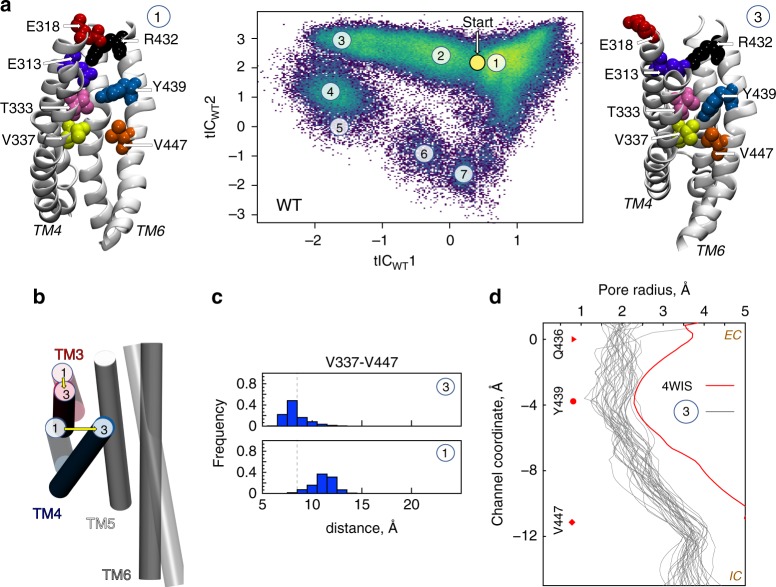
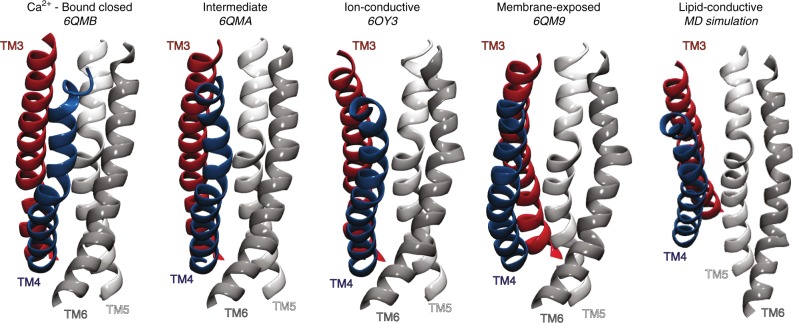
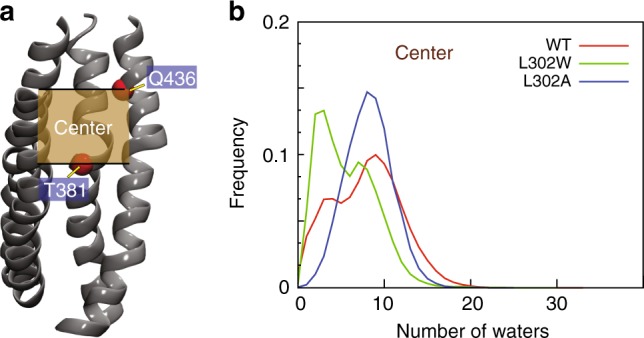
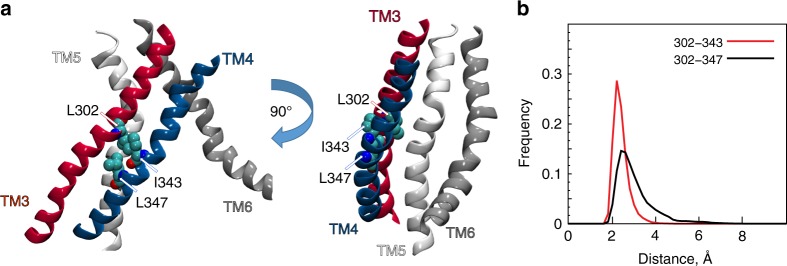
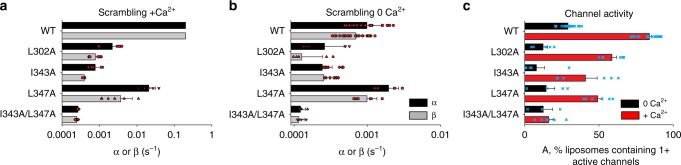
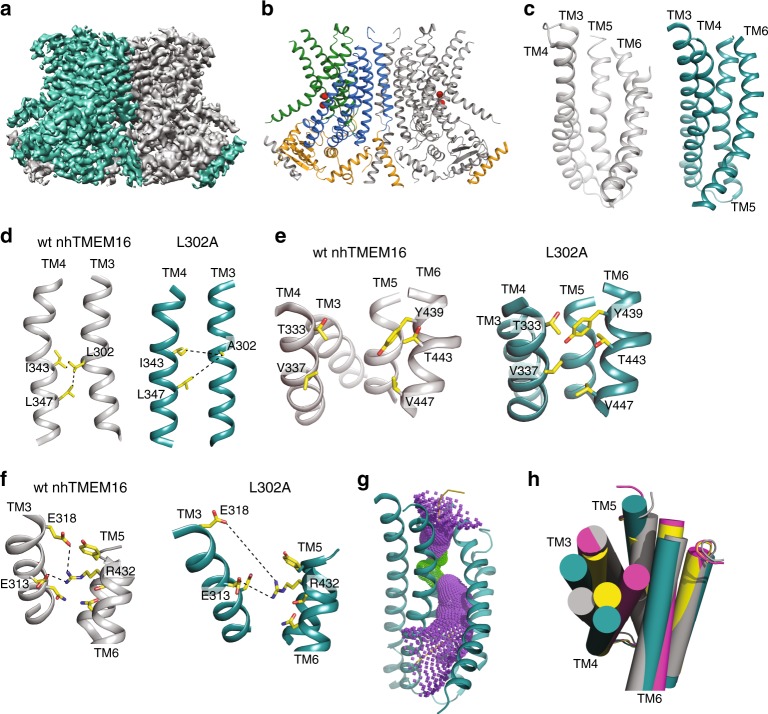
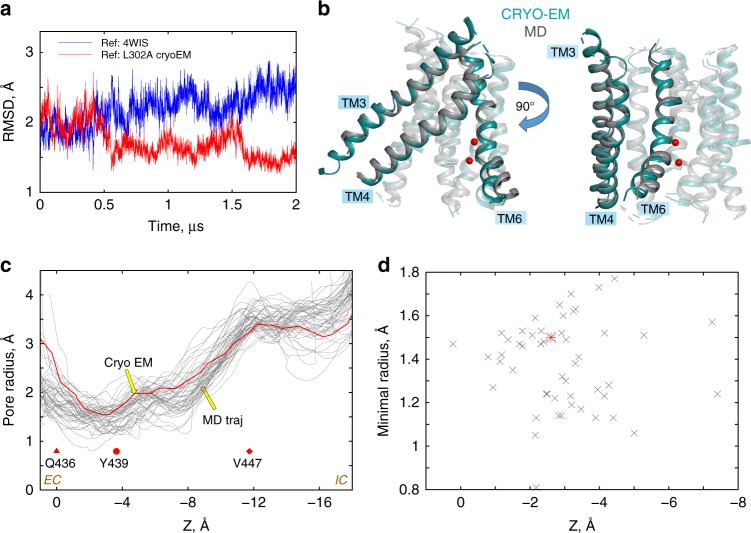
Both lipid and ion translocation by Ca-regulated TMEM16 transmembrane proteins utilizes a membrane-exposed hydrophilic groove. Several conformations of the groove are observed in TMEM16 protein structures, but how these conformations form, and what functions they support, remains unknown. From analyses of atomistic molecular dynamics simulations of Ca-bound nhTMEM16 we find that the mechanism of a conformational transition of the groove from membrane-exposed to occluded from the membrane involves the repositioning of transmembrane helix 4 (TM4) following its disengagement from a TM3/TM4 interaction interface. Residue L302 is a key element in the hydrophobic TM3/TM4 interaction patch that braces the open-groove conformation, which should be changed by an L302A mutation. The structure of the L302A mutant determined by cryogenic electron microscopy (cryo-EM) reveals a partially closed groove that could translocate ions, but not lipids. This is corroborated with functional assays showing severely impaired lipid scrambling, but robust channel activity by L302A.
Ca 调节的 TMEM16 跨膜蛋白的脂质和离子易位都利用了暴露于膜的亲水区槽。在 TMEM16 蛋白结构中观察到了槽的几种构象,但这些构象是如何形成的,以及它们支持什么功能,仍然未知。通过对 Ca 结合的 nhTMEM16 的原子分子动力学模拟的分析,我们发现槽从暴露于膜的构象到与膜隔绝的构象的构象转变的机制涉及跨膜螺旋 4 (TM4) 的重新定位,紧随其后的是 TM4 与其 TM3/TM4 相互作用界面的脱离。残基 L302 是支撑开口槽构象的 TM3/TM4 相互作用斑块中的关键元素,该构象应该被 L302A 突变所改变。低温电子显微镜 (cryo-EM) 确定的 L302A 突变体结构揭示了部分封闭的槽,该槽可以转运离子,但不能转运脂质。这与功能测定结果相符,功能测定结果表明 L302A 严重损害了脂质翻转,但保持了强大的通道活性。