Department of Plant Biology, Uppsala BioCenter, Linnéan Center for Plant Biology, Swedish University of Agricultural Sciences, P.O. Box 7080, SE-75007, Uppsala, Sweden.
Uppsala Genome Center, Science for Life Laboratory, Department of Immunology, Genetics and Pathology, Uppsala University, BMC, Box 815, SE-751 08, Uppsala, Sweden.
Sci Rep. 2019 Oct 31;9(1):15753. doi: 10.1038/s41598-019-52274-7.
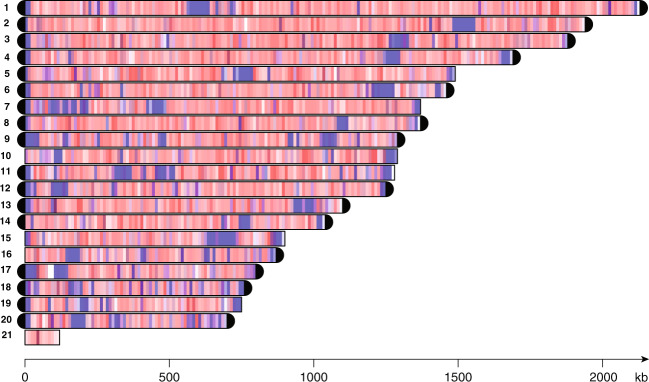
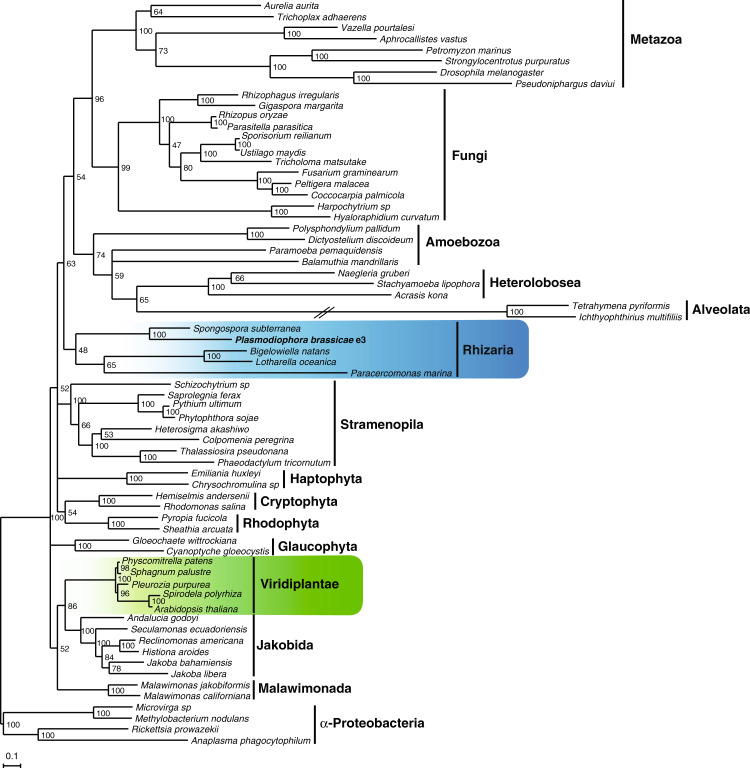
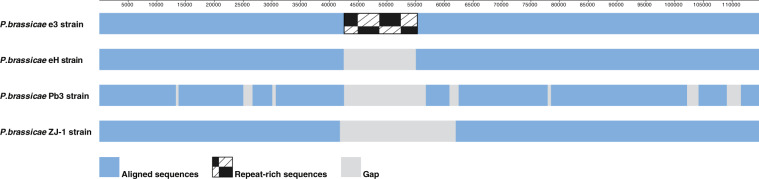
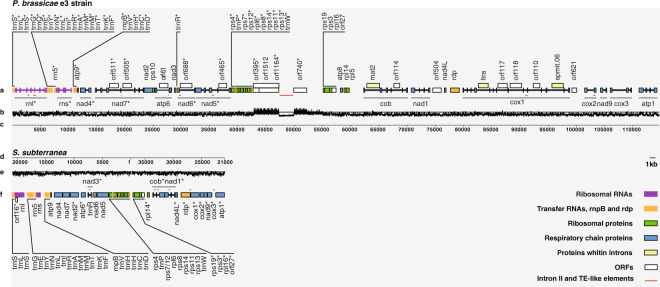
Plasmodiophora brassicae is a soil-borne pathogen that attacks roots of cruciferous plants causing clubroot disease. The pathogen belongs to the Plasmodiophorida order in Phytomyxea. Here we used long-read SMRT technology to clarify the P. brassicae e3 genomic constituents along with comparative and phylogenetic analyses. Twenty contigs representing the nuclear genome and one mitochondrial (mt) contig were generated, together comprising 25.1 Mbp. Thirteen of the 20 nuclear contigs represented chromosomes from telomere to telomere characterized by [TTTTAGGG] sequences. Seven active gene candidates encoding synaptonemal complex-associated and meiotic-related protein homologs were identified, a finding that argues for possible genetic recombination events. The circular mt genome is large (114,663 bp), gene dense and intron rich. It shares high synteny with the mt genome of Spongospora subterranea, except in a unique 12 kb region delimited by shifts in GC content and containing tandem minisatellite- and microsatellite repeats with partially palindromic sequences. De novo annotation identified 32 protein-coding genes, 28 structural RNA genes and 19 ORFs. ORFs predicted in the repeat-rich region showed similarities to diverse organisms suggesting possible evolutionary connections. The data generated here form a refined platform for the next step involving functional analysis, all to clarify the complex biology of P. brassicae.
根肿菌是一种土壤传播病原体,会攻击十字花科植物的根部,导致根肿病。该病原体属于根肿菌门的原生动物。在这里,我们使用长读 SMRT 技术阐明了根肿菌 e3 的基因组组成,并进行了比较和系统发育分析。共生成了 20 个代表核基因组的序列和 1 个线粒体 (mt) 序列,共计 25.1 Mbp。这 20 个核序列中的 13 个代表了从端粒到端粒的染色体,其特征是[TTTTAGGG]序列。鉴定出了 7 个候选活性基因,它们编码联会复合体相关和减数分裂相关蛋白同源物,这一发现表明可能存在遗传重组事件。圆形 mt 基因组较大(114663 bp),基因密度高,内含子丰富。它与地下茎线虫的 mt 基因组具有高度的同线性,除了在 GC 含量变化和包含串联微卫星和小卫星重复序列的独特 12 kb 区域之外,这些重复序列具有部分回文序列。从头注释鉴定出 32 个编码蛋白的基因、28 个结构 RNA 基因和 19 个 ORF。在富含重复序列的区域预测的 ORF 与多种生物体具有相似性,表明可能存在进化联系。这里生成的数据为下一步的功能分析提供了一个精细化的平台,所有这些都是为了阐明根肿菌的复杂生物学。