Geballe Laboratory for Advanced Materials, Stanford University, Stanford, CA, USA.
CREOL, The College of Optics and Photonics, University of Central Florida, Orlando, FL, USA.
Nat Commun. 2019 Nov 1;10(1):4982. doi: 10.1038/s41467-019-12899-8.
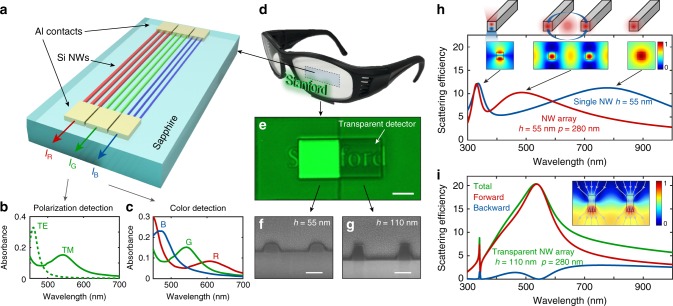
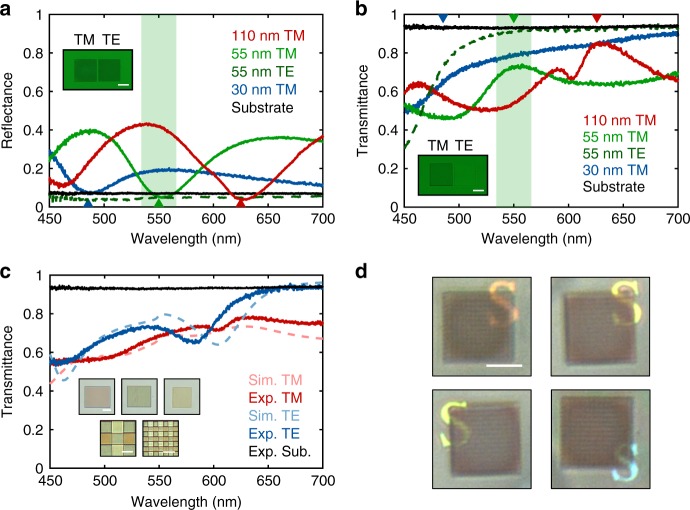
Compact and lightweight photodetection elements play a critical role in the newly emerging augmented reality, wearable and sensing technologies. In these technologies, devices are preferred to be transparent to form an optical interface between a viewer and the outside world. For this reason, it is of great value to create detection platforms that are imperceptible to the human eye directly onto transparent substrates. Semiconductor nanowires (NWs) make ideal photodetectors as their optical resonances enable parsing of the multi-dimensional information carried by light. Unfortunately, these optical resonances also give rise to strong, undesired light scattering. In this work, we illustrate how a new optical resonance arising from the radiative coupling between arrayed silicon NWs can be harnessed to remove reflections from dielectric interfaces while affording spectro-polarimetric detection. The demonstrated transparent photodetector concept opens up promising platforms for transparent substrates as the base for opto-electronic devices and in situ optical measurement systems.
紧凑型、轻量化的光电探测元件在新兴的增强现实、可穿戴和传感技术中起着至关重要的作用。在这些技术中,人们希望设备是透明的,以便在观察者和外部世界之间形成光学接口。出于这个原因,创造直接在透明衬底上的人眼不可见的检测平台具有重要价值。半导体纳米线 (NWs) 作为光电探测器非常理想,因为它们的光学共振使人们能够解析光所携带的多维信息。不幸的是,这些光学共振也会引起强烈的、不需要的光散射。在这项工作中,我们展示了如何利用阵列硅 NWs 之间的辐射耦合产生的新光学共振来消除介电界面的反射,同时提供光谱偏振检测。所展示的透明光电探测器概念为透明衬底作为光电设备和原位光学测量系统的基础提供了有前途的平台。