ISEM, UMR226, CNRS, Université de Montpellier, IRD, EPHE, 34090, Montpellier, France.
Equipe EPAT 3593 Ecosystèmes amazoniens et pathologie tropicale, Université de Guyane, Cayenne, French Guiana.
Int J Health Geogr. 2019 Nov 6;18(1):23. doi: 10.1186/s12942-019-0188-6.
With the increase in unprecedented and unpredictable disease outbreaks due to human-driven environmental changes in recent years, we need new analytical tools to map and predict the spatial distribution of emerging infectious diseases and identify the biogeographic drivers underpinning their emergence. The aim of the study was to identify and compare the local and global biogeographic predictors such as landscape and climate that determine the spatial structure of leptospirosis and Buruli Ulcer (BU).
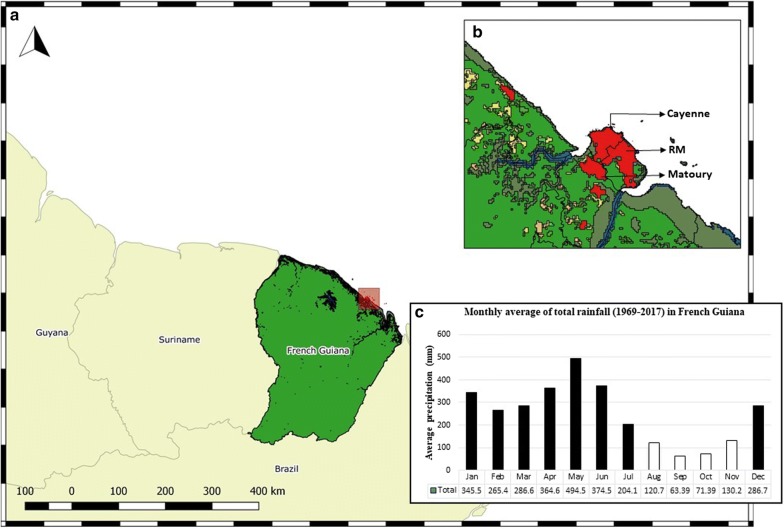
We obtained 232 hospital-confirmed leptospirosis (2007-2017) cases and 236 BU cases (1969-2017) in French Guiana. We performed non-spatial and spatial Bayesian regression modeling with landscape and climate predictor variables to characterize the spatial structure and the environmental drivers influencing the distribution of the two diseases.
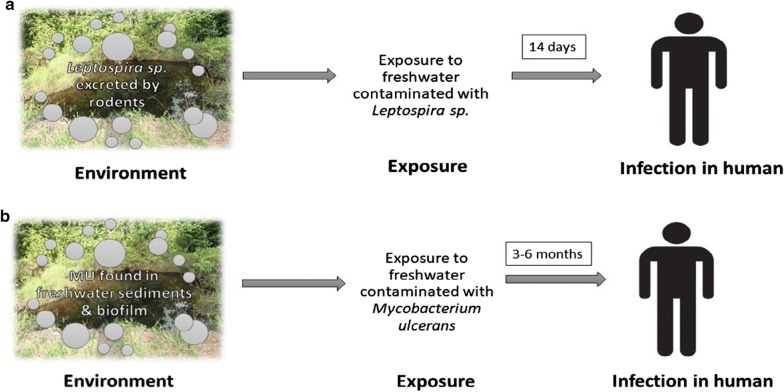
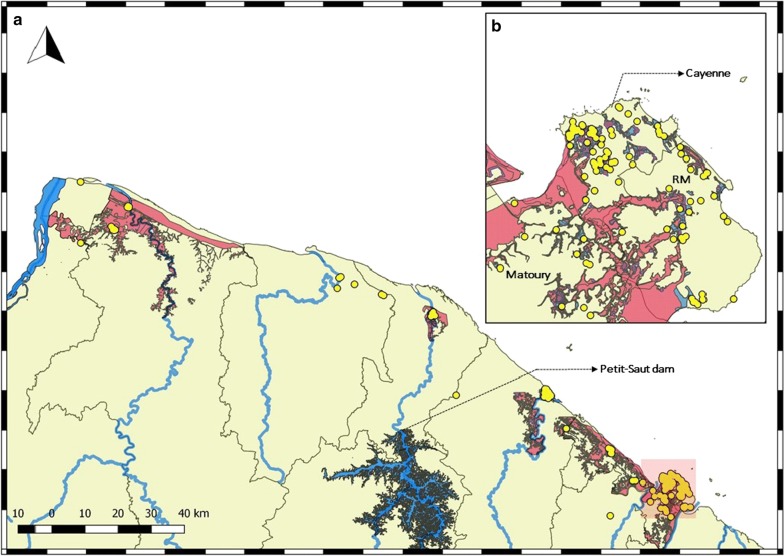
Our results show that the distribution of both diseases is spatially dependent on environmental predictors such as elevation, topological wetness index, proximity to cropland and increasing minimum temperature at the month of potential infection. However, the spatial structure of the two diseases caused by bacterial pathogens occupying similar aquatic niche was different. Leptospirosis was widely distributed across the territory while BU was restricted to the coastal riverbeds.
Our study shows that a biogeographic approach is an effective tool to identify, compare and predict the geographic distribution of emerging diseases at an ecological scale which are spatially dependent to environmental factors such as topography, land cover and climate.
近年来,由于人类驱动的环境变化导致前所未有的不可预测的疾病爆发增加,我们需要新的分析工具来绘制和预测新发传染病的空间分布,并确定支持其出现的生物地理驱动因素。本研究的目的是确定和比较局部和全球生物地理预测因子,如景观和气候,这些因子决定了钩端螺旋体病和布鲁里溃疡(BU)的空间结构。
我们在法属圭亚那获得了 232 例医院确诊的钩端螺旋体病(2007-2017 年)病例和 236 例 BU 病例(1969-2017 年)。我们使用景观和气候预测变量进行非空间和空间贝叶斯回归建模,以描述两种疾病的空间结构和影响其分布的环境驱动因素。
我们的结果表明,这两种疾病的分布在空间上依赖于环境预测因子,如海拔、拓扑湿润指数、与耕地的接近程度以及潜在感染月份的最低温度升高。然而,两种由占据相似水生小生境的细菌病原体引起的疾病的空间结构不同。钩端螺旋体病在整个领土广泛分布,而 BU 则局限于沿海河床。
我们的研究表明,生物地理方法是一种有效的工具,可以在生态尺度上识别、比较和预测新兴疾病的地理分布,这些疾病的空间分布依赖于地形、土地覆盖和气候等环境因素。