Landig A J, Koski J V, Scarlino P, Müller C, Abadillo-Uriel J C, Kratochwil B, Reichl C, Wegscheider W, Coppersmith S N, Friesen Mark, Wallraff A, Ihn T, Ensslin K
Department of Physics, ETH Zürich, CH-8093, Zürich, Switzerland.
IBM Research Zurich, CH-8803, Rüschlikon, Switzerland.
Nat Commun. 2019 Nov 6;10(1):5037. doi: 10.1038/s41467-019-13000-z.
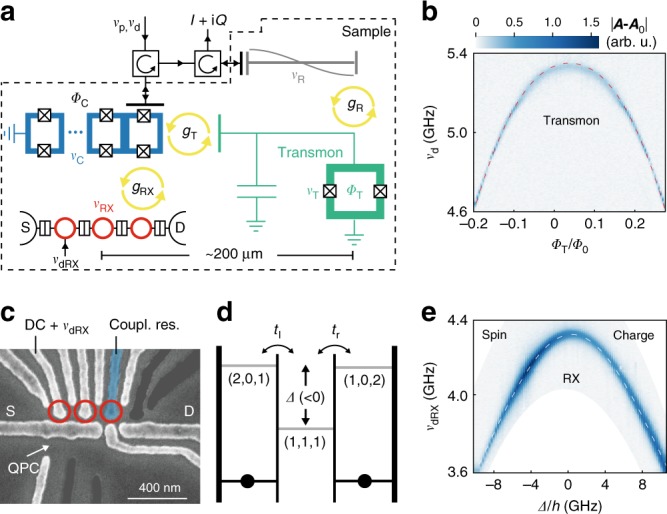
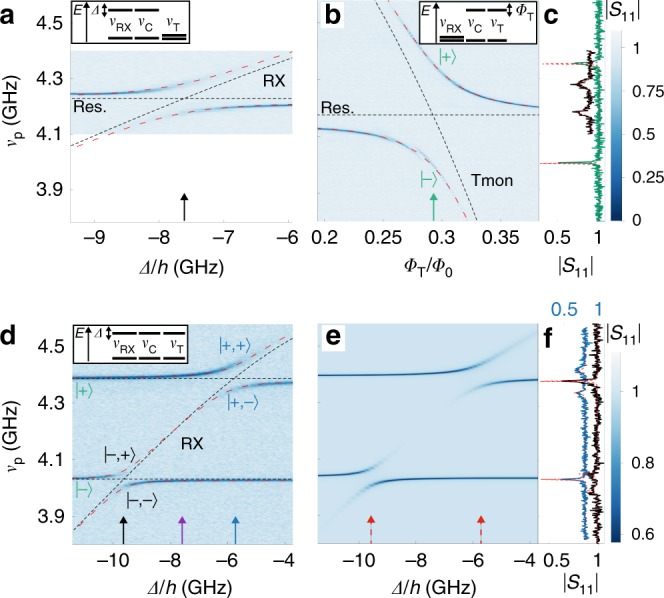
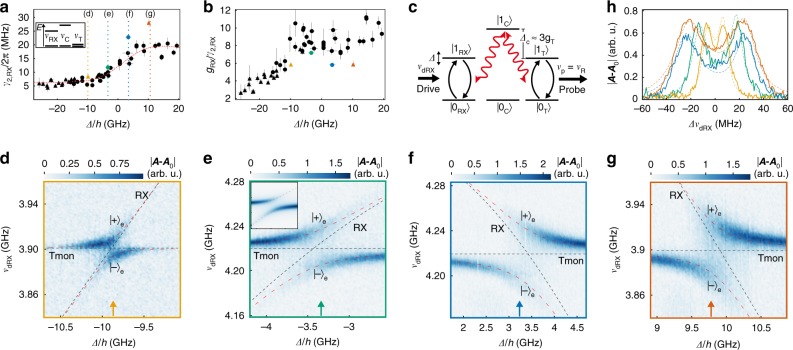
Spin qubits and superconducting qubits are among the promising candidates for realizing a solid state quantum computer. For the implementation of a hybrid architecture which can profit from the advantages of either approach, a coherent link is necessary that integrates and controllably couples both qubit types on the same chip over a distance that is several orders of magnitude longer than the physical size of the spin qubit. We realize such a link with a frequency-tunable high impedance SQUID array resonator. The spin qubit is a resonant exchange qubit hosted in a GaAs triple quantum dot. It can be operated at zero magnetic field, allowing it to coexist with superconducting qubits on the same chip. We spectroscopically observe coherent interaction between the resonant exchange qubit and a transmon qubit in both resonant and dispersive regimes, where the interaction is mediated either by real or virtual resonator photons.
自旋量子比特和超导量子比特是实现固态量子计算机的有前途的候选者。为了实现一种能够利用两种方法优势的混合架构,需要一个相干链路,该链路在比自旋量子比特物理尺寸长几个数量级的距离上,在同一芯片上集成并可控地耦合这两种量子比特类型。我们用一个频率可调的高阻抗超导量子干涉装置(SQUID)阵列谐振器实现了这样一个链路。自旋量子比特是一个位于砷化镓三量子点中的谐振交换量子比特。它可以在零磁场下运行,从而使其能够与同一芯片上的超导量子比特共存。我们通过光谱观察到谐振交换量子比特与一个跨导量子比特在谐振和色散区域的相干相互作用,其中相互作用是由实的或虚的谐振器光子介导的。