Oyibo Kiemute, Vassileva Julita
University of Saskatchewan, Saskatoon, Canada.
Digit Health. 2019 Nov 1;5:2055207619878601. doi: 10.1177/2055207619878601. eCollection 2019 Jan-Dec.
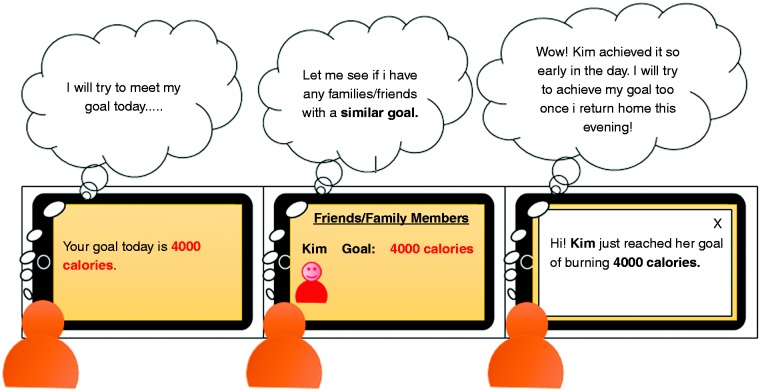
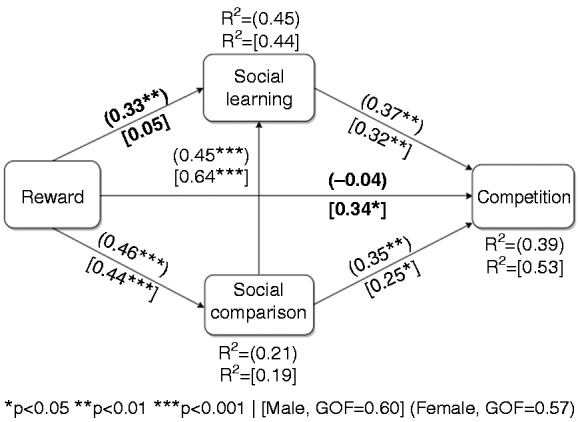
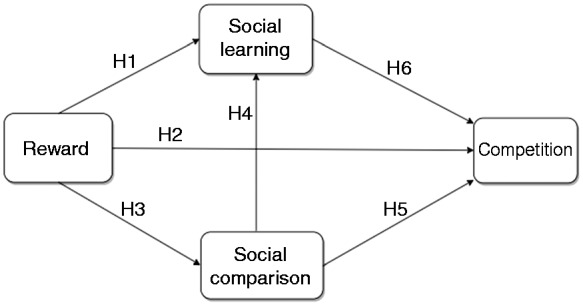
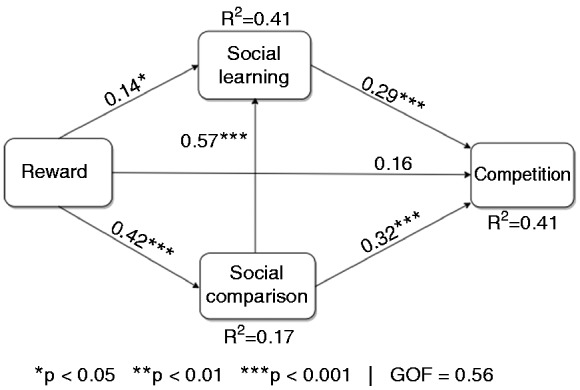
Fitness applications aimed at behavior change are becoming increasingly popular due to the global prevalence of sedentary lifestyles and physical inactivity, causing countless non-communicable diseases. Competition is one of the most common persuasive strategies employed in such applications to motivate users to engage in physical activity in a social context. However, there is limited research on the persuasive system design predictors of users' susceptibility to competition as a persuasive strategy for motivating behavior change in a social context. To bridge this gap, we designed storyboards illustrating four of the commonly employed persuasive strategies (reward, social learning, social comparison, and competition) in fitness applications and asked potential users to evaluate their perceived persuasiveness. The result of our path analysis showed that, overall, users' susceptibilities to social comparison (β = 0.48, < 0.001), reward (β = 0.42, < 0.001), and social learning (β = 0.29, < 0.01) predicted their susceptibility to competition, with our model accounting for 41% of its variance. Social comparison partially mediated the relationship between reward and competition, while social learning partially mediated the relationship between social comparison and competition. Comparatively, the relationship between reward and social learning was stronger for females than for males, whereas the relationship between reward and competition was stronger for males than for females. Overall, our findings underscore the compatibility of all four persuasive strategies in a one-size-fits-all fitness application. We discuss our findings, drawing insight from the comments provided by participants.
由于久坐不动的生活方式和缺乏身体活动在全球普遍存在,导致了无数的非传染性疾病,旨在改变行为的健身应用程序越来越受欢迎。竞争是此类应用程序中最常用的说服策略之一,用于激励用户在社交环境中进行体育活动。然而,关于说服系统设计预测因素的研究有限,这些因素影响用户对竞争作为一种在社交环境中促进行为改变的说服策略的易感性。为了弥补这一差距,我们设计了故事板,展示了健身应用程序中常用的四种说服策略(奖励、社会学习、社会比较和竞争),并要求潜在用户评估他们感知到的说服力。我们的路径分析结果表明,总体而言,用户对社会比较(β = 0.48,< 0.001)、奖励(β = 0.42,< 0.001)和社会学习(β = 0.29,< 0.01)的易感性预测了他们对竞争的易感性,我们的模型解释了其方差的41%。社会比较部分中介了奖励与竞争之间的关系,而社会学习部分中介了社会比较与竞争之间的关系。相比之下,奖励与社会学习之间的关系对女性比对男性更强,而奖励与竞争之间的关系对男性比对女性更强。总体而言,我们的研究结果强调了这四种说服策略在通用健身应用程序中的兼容性。我们讨论了我们的研究结果,并从参与者提供的评论中获得了见解。