School of Biological Sciences, Georgia Institute of Technology, Atlanta, GA, USA.
School of Earth and Atmospheric Sciences, Georgia Institute of Technology, Atlanta, GA, USA.
Environ Microbiol Rep. 2020 Feb;12(1):49-57. doi: 10.1111/1758-2229.12809. Epub 2019 Nov 21.
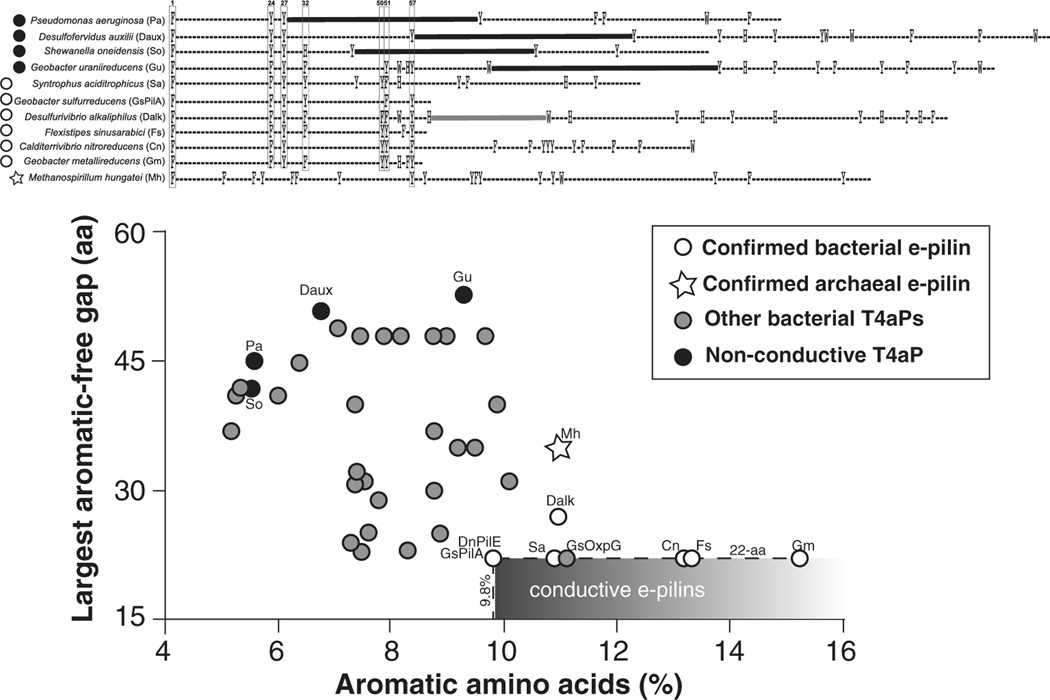
Electroactive type IV pili, or e-pili, are used by some microbial species for extracellular electron transfer. Recent studies suggest that e-pili may be more phylogenetically and structurally diverse than previously assumed. Here, we used updated aromatic density thresholds (≥9.8% aromatic amino acids, ≤22-aa aromatic gaps and aromatic amino acids at residues 1, 24, 27, 50 and/or 51, and 32 and/or 57) to search for putative e-pilin genes in metagenomes from diverse ecosystems with active microbial metal cycling. Environmental putative e-pilins were diverse in length and phylogeny, and included truncated e-pilins in Geobacter spp., as well as longer putative e-pilins in Fe(II)-oxidizing Betaproteobacteria and Zetaproteobacteria.
电活性 IV 型菌毛(e-pili)被一些微生物物种用于细胞外电子转移。最近的研究表明,e-pili 在系统发育和结构上可能比以前认为的更加多样化。在这里,我们使用更新的芳香密度阈值(≥9.8%芳香族氨基酸,≤22-aa 芳香族间隙和残基 1、24、27、50 和/或 51 以及 32 和/或 57 处的芳香族氨基酸),在具有活跃微生物金属循环的不同生态系统的宏基因组中搜索潜在的 e-pilin 基因。环境潜在的 e-pilins 在长度和系统发育上具有多样性,包括 Geobacter spp. 中的截断 e-pilins,以及 Fe(II)-氧化的 Betaproteobacteria 和 Zetaproteobacteria 中的更长的潜在 e-pilins。