Department of Chemical and Biological Engineering, Northwestern University, Evanston, 60208, IL, USA.
Department of Chemistry, University of Illinois at Urbana-Champaign, Urbana, 61801, IL, USA.
Nat Commun. 2019 Nov 8;10(1):5097. doi: 10.1038/s41467-019-12916-w.
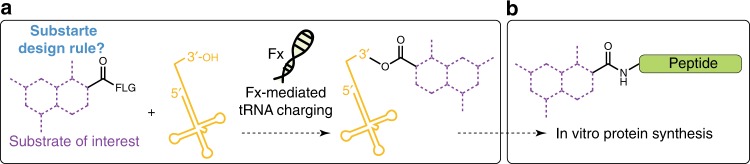
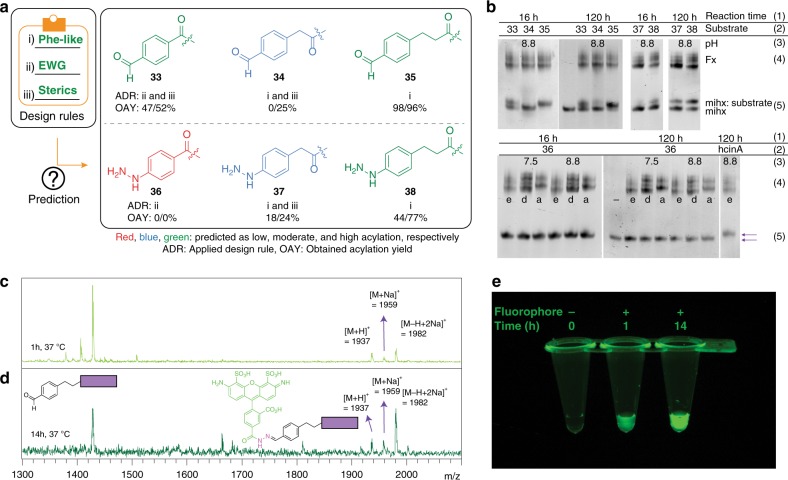
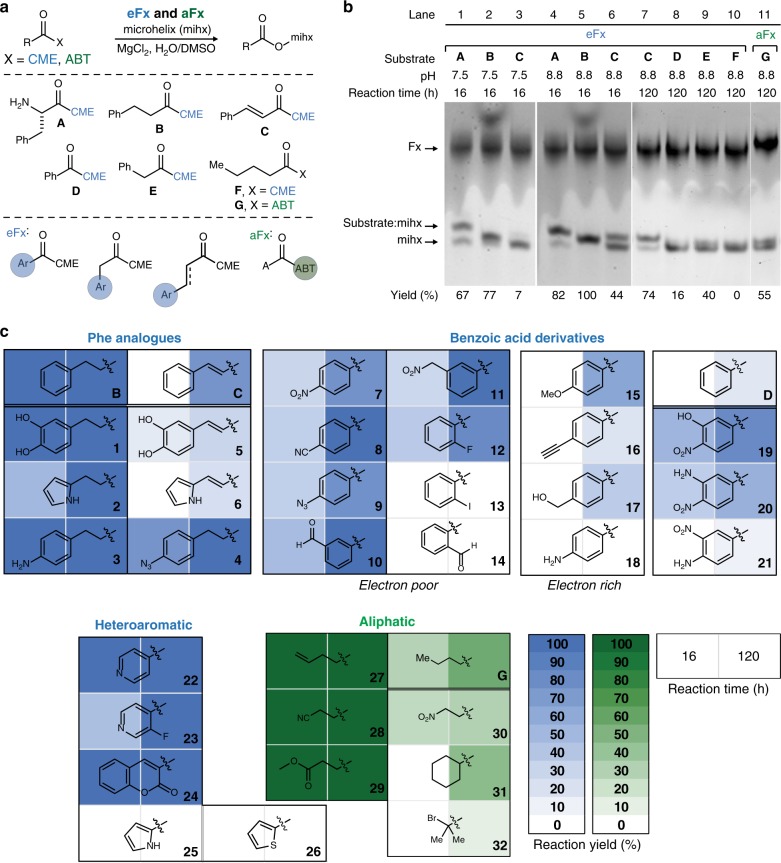
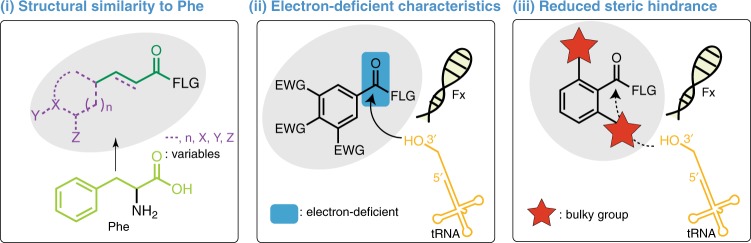
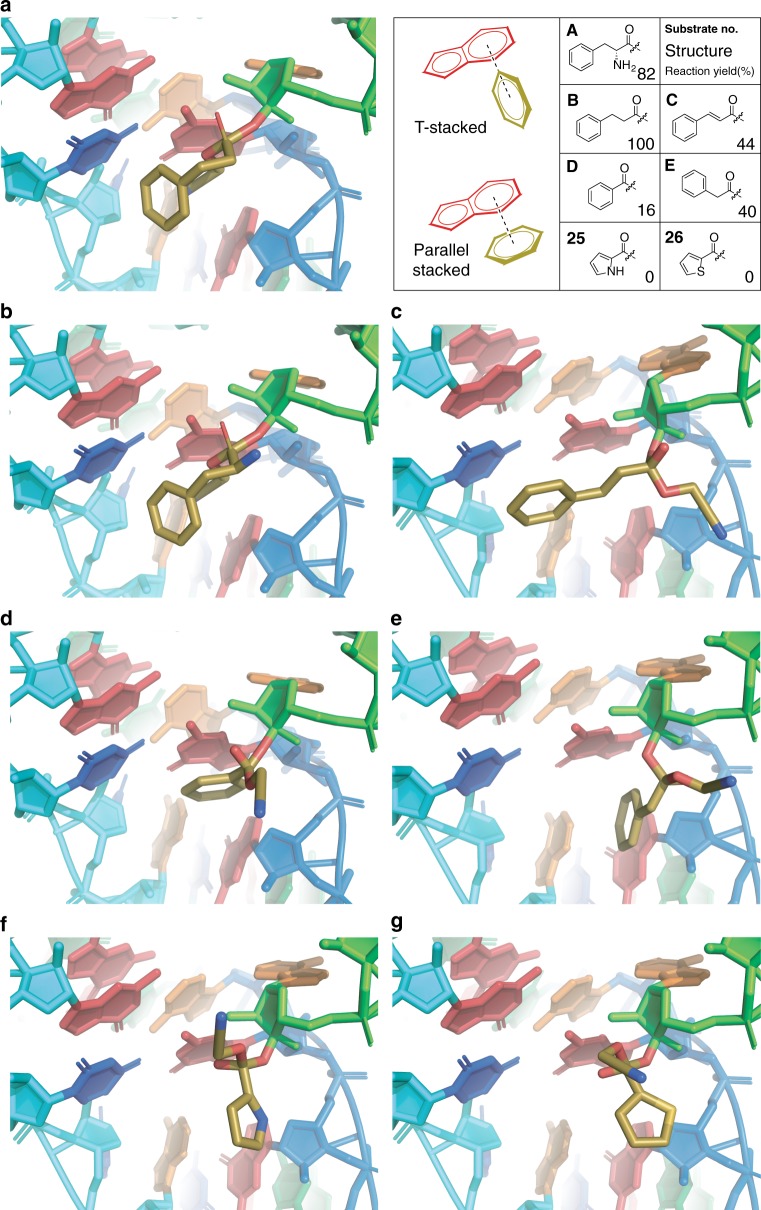
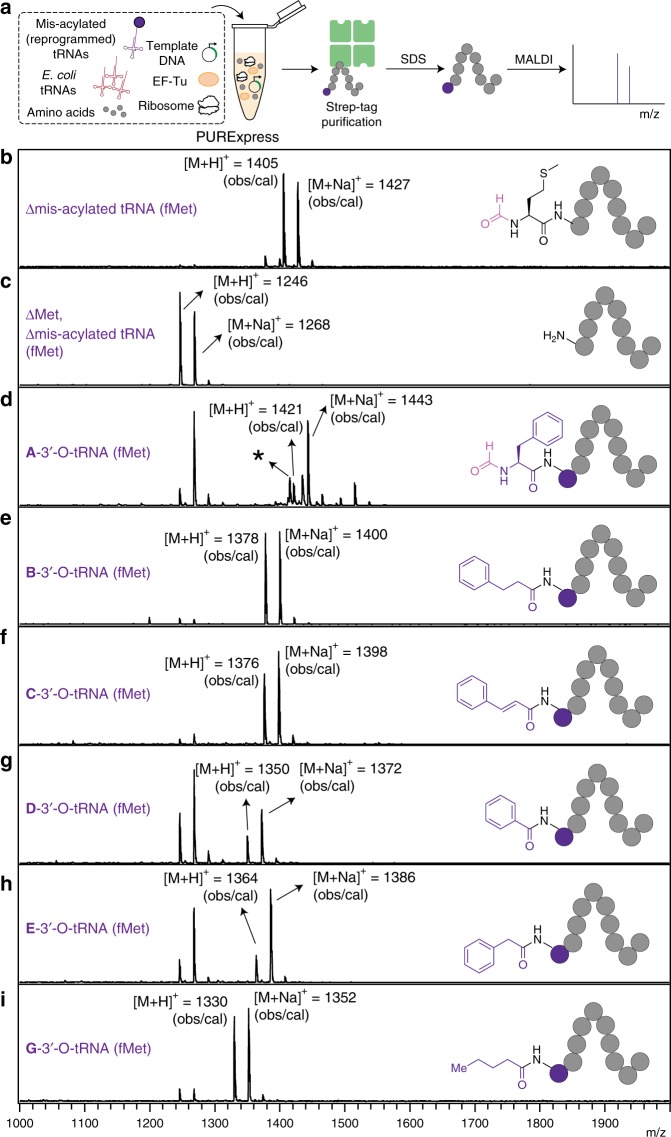
The site-specific incorporation of noncanonical monomers into polypeptides through genetic code reprogramming permits synthesis of bio-based products that extend beyond natural limits. To better enable such efforts, flexizymes (transfer RNA (tRNA) synthetase-like ribozymes that recognize synthetic leaving groups) have been used to expand the scope of chemical substrates for ribosome-directed polymerization. The development of design rules for flexizyme-catalyzed acylation should allow scalable and rational expansion of genetic code reprogramming. Here we report the systematic synthesis of 37 substrates based on 4 chemically diverse scaffolds (phenylalanine, benzoic acid, heteroaromatic, and aliphatic monomers) with different electronic and steric factors. Of these substrates, 32 were acylated onto tRNA and incorporated into peptides by in vitro translation. Based on the design rules derived from this expanded alphabet, we successfully predicted the acylation of 6 additional monomers that could uniquely be incorporated into peptides and direct N-terminal incorporation of an aldehyde group for orthogonal bioconjugation reactions.
通过遗传密码重编程将非规范单体特异性地掺入多肽中,可以合成超越自然限制的基于生物的产品。为了更好地实现这一目标,已经使用了 flexizymes(识别合成离去基团的 tRNA 合成酶样核酶)来扩展核糖体定向聚合的化学底物范围。flexizyme 催化酰化的设计规则的发展应该允许遗传密码重编程的可扩展和合理扩展。在这里,我们报告了基于 4 种化学上不同的支架(苯丙氨酸、苯甲酸、杂芳环和脂肪族单体)的 37 种底物的系统合成,这些底物具有不同的电子和空间因素。在这些底物中,有 32 种被酰化到 tRNA 上,并通过体外翻译掺入到肽中。基于从这个扩展字母表中得出的设计规则,我们成功预测了另外 6 种单体的酰化,这些单体可以独特地掺入肽中,并指导 N 端醛基的掺入,用于正交生物偶联反应。