• 文献检索
  • 文档翻译
  • 深度研究
  • 学术资讯
  • Suppr Zotero 插件Zotero 插件
  • 邀请有礼
  • 套餐&价格
  • 历史记录
应用&插件
Suppr Zotero 插件Zotero 插件浏览器插件Mac 客户端Windows 客户端微信小程序
定价
高级版会员购买积分包购买API积分包
服务
文献检索文档翻译深度研究API 文档MCP 服务
关于我们
关于 Suppr公司介绍联系我们用户协议隐私条款
关注我们

Suppr 超能文献

核心技术专利:CN118964589B侵权必究
粤ICP备2023148730 号-1Suppr @ 2026

文献检索

告别复杂PubMed语法,用中文像聊天一样搜索,搜遍4000万医学文献。AI智能推荐,让科研检索更轻松。

立即免费搜索

文件翻译

保留排版,准确专业,支持PDF/Word/PPT等文件格式,支持 12+语言互译。

免费翻译文档

深度研究

AI帮你快速写综述,25分钟生成高质量综述,智能提取关键信息,辅助科研写作。

立即免费体验

比较多发性硬化症中的病灶分割方法:一个手动勾画的病例输入就足以实现准确的病灶分割。

Comparing lesion segmentation methods in multiple sclerosis: Input from one manually delineated subject is sufficient for accurate lesion segmentation.

机构信息

Department of Radiology and Nuclear Medicine, MS Center Amsterdam, Amsterdam Neuroscience, Amsterdam UMC, location VUmc, De Boelelaan 1118, 1081 HV Amsterdam PO box 7057, Amsterdam 1007 MB, The Netherlands.

Department of Radiology and Nuclear Medicine, MS Center Amsterdam, Amsterdam Neuroscience, Amsterdam UMC, location VUmc, De Boelelaan 1118, 1081 HV Amsterdam PO box 7057, Amsterdam 1007 MB, The Netherlands.

出版信息

Neuroimage Clin. 2019;24:102074. doi: 10.1016/j.nicl.2019.102074. Epub 2019 Nov 5.

DOI:10.1016/j.nicl.2019.102074
PMID:31734527
原文链接:https://pmc.ncbi.nlm.nih.gov/articles/PMC6861662/
Abstract

PURPOSE

Accurate lesion segmentation is important for measurements of lesion load and atrophy in subjects with multiple sclerosis (MS). International MS lesion challenges show a preference of convolutional neural networks (CNN) strategies, such as nicMSlesions. However, since the software is trained on fairly homogenous training data, we aimed to test the performance of nicMSlesions in an independent dataset with manual and other automatic lesion segmentations to determine whether this method is suitable for larger, multi-center studies.

METHODS

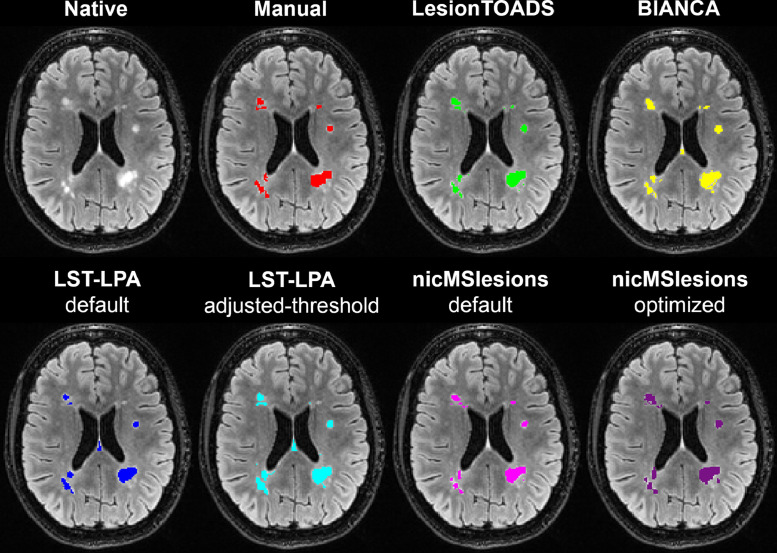
Manual lesion segmentation was performed in fourteen subjects with MS on sagittal 3D FLAIR images from a 3T GE whole-body scanner with 8-channel head coil. We compared five different categories of automated lesion segmentation methods for their volumetric and spatial agreement with manual segmentation: (i) unsupervised, untrained (LesionTOADS); (ii) supervised, untrained (LST-LPA and nicMSlesions with default settings); (iii) supervised, untrained with threshold adjustment (LST-LPA optimized for current data); (iv) supervised, trained with leave-one-out cross-validation on fourteen subjects with MS (nicMSlesions and BIANCA); and (v) supervised, trained on a single subject with MS (nicMSlesions). Volumetric accuracy was determined by the intra-class correlation coefficient (ICC) and spatial accuracy by Dice's similarity index (SI). Volumes and SI were compared between methods using repeated measures ANOVA or Friedman tests with post-hoc pairwise comparison.

RESULTS

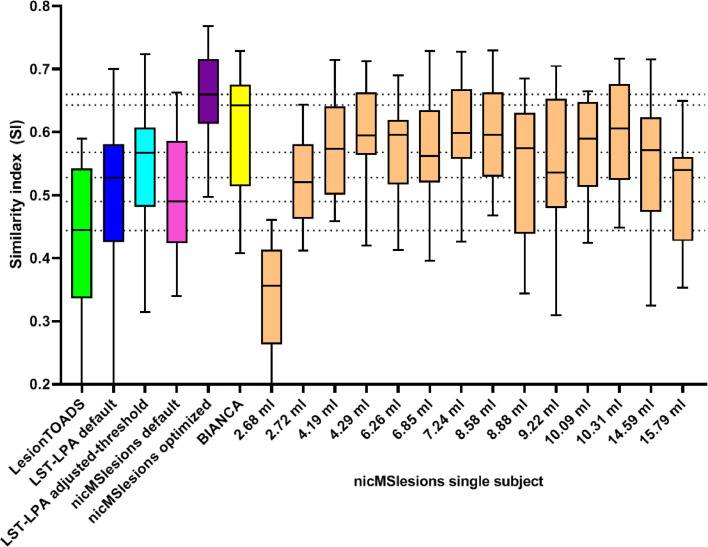
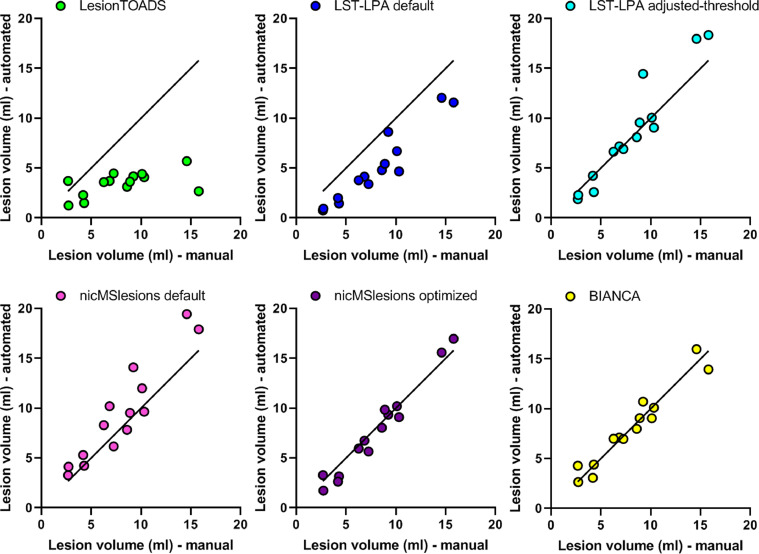
The best volumetric and spatial agreement with manual was obtained with the supervised and trained methods nicMSlesions and BIANCA (ICC absolute agreement > 0.968 and median SI > 0.643) and the worst with the unsupervised, untrained method LesionTOADS (ICC absolute agreement = 0.140 and median SI = 0.444). Agreement with manual in the single-subject network training of nicMSlesions was poor for input with low lesion volumes (i.e. two subjects with lesion volumes ≤ 3.0 ml). For the other twelve subjects, ICC varied from 0.593 to 0.973 and median SI varied from 0.535 to 0.606. In all cases, the single-subject trained nicMSlesions segmentations outperformed LesionTOADS, and in almost all cases it also outperformed LST-LPA.

CONCLUSION

Input from only one subject to re-train the deep learning CNN nicMSlesions is sufficient for adequate lesion segmentation, with on average higher volumetric and spatial agreement with manual than obtained with the untrained methods LesionTOADS and LST-LPA.

摘要

目的

准确的病变分割对于多发性硬化症(MS)患者的病变负荷和萎缩测量非常重要。国际 MS 病变挑战赛倾向于使用卷积神经网络(CNN)策略,例如 nicMSlesions。然而,由于该软件是基于相当同质的训练数据进行训练的,我们旨在将 nicMSlesions 在一个独立的数据集上进行测试,该数据集具有手动和其他自动病变分割,以确定该方法是否适用于更大的、多中心的研究。

方法

在 14 名 MS 患者的矢状位 3D FLAIR 图像上进行手动病变分割,这些图像来自 3T GE 全身扫描仪和 8 通道头部线圈。我们比较了五种不同类别的自动病变分割方法在体积和空间上与手动分割的一致性:(i)无监督、未训练(LesionTOADS);(ii)有监督、未训练(LST-LPA 和默认设置下的 nicMSlesions);(iii)有监督、未训练但阈值调整(针对当前数据优化的 LST-LPA);(iv)在 14 名 MS 患者上进行了基于留一交叉验证的有监督、训练(nicMSlesions 和 BIANCA);和(v)在单个 MS 患者上进行了有监督、训练(nicMSlesions)。体积准确性通过组内相关系数(ICC)确定,空间准确性通过 Dice 相似性指数(SI)确定。使用重复测量方差分析或 Friedman 检验,对各种方法之间的体积和 SI 进行比较,并进行事后两两比较。

结果

与手动方法最一致的是有监督和训练的方法 nicMSlesions 和 BIANCA(ICC 绝对一致性>0.968,中位数 SI>0.643),而最不一致的是无监督、未训练的方法 LesionTOADS(ICC 绝对一致性=0.140,中位数 SI=0.444)。在单个患者网络训练中,nicMSlesions 的输入病变体积较低时(即两名患者的病变体积≤3.0ml),与手动方法的一致性较差。对于其他 12 名患者,ICC 从 0.593 到 0.973,中位数 SI 从 0.535 到 0.606。在所有情况下,单个患者训练的 nicMSlesions 分割都优于 LesionTOADS,并且在几乎所有情况下,它也优于 LST-LPA。

结论

仅从一个患者输入重新训练深度学习 CNN nicMSlesions 就足以进行充分的病变分割,与未经训练的方法 LesionTOADS 和 LST-LPA 相比,平均具有更高的体积和空间一致性。
https://cdn.ncbi.nlm.nih.gov/pmc/blobs/4fb8/6861662/8e914a885140/gr3.jpg
https://cdn.ncbi.nlm.nih.gov/pmc/blobs/4fb8/6861662/6cc3db155218/gr1.jpg
https://cdn.ncbi.nlm.nih.gov/pmc/blobs/4fb8/6861662/21f646ec42cf/gr2.jpg
https://cdn.ncbi.nlm.nih.gov/pmc/blobs/4fb8/6861662/8e914a885140/gr3.jpg
https://cdn.ncbi.nlm.nih.gov/pmc/blobs/4fb8/6861662/6cc3db155218/gr1.jpg
https://cdn.ncbi.nlm.nih.gov/pmc/blobs/4fb8/6861662/21f646ec42cf/gr2.jpg
https://cdn.ncbi.nlm.nih.gov/pmc/blobs/4fb8/6861662/8e914a885140/gr3.jpg

相似文献

1
Comparing lesion segmentation methods in multiple sclerosis: Input from one manually delineated subject is sufficient for accurate lesion segmentation.比较多发性硬化症中的病灶分割方法:一个手动勾画的病例输入就足以实现准确的病灶分割。
Neuroimage Clin. 2019;24:102074. doi: 10.1016/j.nicl.2019.102074. Epub 2019 Nov 5.
2
Automatic segmentation of white matter hyperintensities: validation and comparison with state-of-the-art methods on both Multiple Sclerosis and elderly subjects.自动分割脑白质高信号:在多发性硬化症和老年患者中验证和比较最先进的方法。
Neuroimage Clin. 2022;33:102940. doi: 10.1016/j.nicl.2022.102940. Epub 2022 Jan 10.
3
FLAIR improves LesionTOADS automatic segmentation of multiple sclerosis lesions in non-homogenized, multi-center, 2D clinical magnetic resonance images.FLAIR 可提高 LesionTOADS 对非均质、多中心、2D 临床磁共振图像中多发性硬化病变的自动分割。
Neuroimage Clin. 2019;23:101918. doi: 10.1016/j.nicl.2019.101918. Epub 2019 Jul 5.
4
Performance of five research-domain automated WM lesion segmentation methods in a multi-center MS study.五种研究领域自动化 WM 病变分割方法在多中心 MS 研究中的性能。
Neuroimage. 2017 Dec;163:106-114. doi: 10.1016/j.neuroimage.2017.09.011. Epub 2017 Sep 9.
5
MRI FLAIR lesion segmentation in multiple sclerosis: Does automated segmentation hold up with manual annotation?多发性硬化症中磁共振成像液体衰减反转恢复序列(FLAIR)病变分割:自动分割与手动标注相比如何?
Neuroimage Clin. 2016 Nov 20;13:264-270. doi: 10.1016/j.nicl.2016.11.020. eCollection 2017.
6
Validation of mean upper cervical cord area (MUCCA) measurement techniques in multiple sclerosis (MS): High reproducibility and robustness to lesions, but large software and scanner effects.多 sclerosis (MS) 中平均上颈椎脊髓面积 (MUCCA) 测量技术的验证:高重复性和对病变的稳健性,但软件和扫描仪的影响较大。
Neuroimage Clin. 2019;24:101962. doi: 10.1016/j.nicl.2019.101962. Epub 2019 Aug 6.
7
Scanner-specific optimisation of automated lesion segmentation in MS.基于扫描仪的 MS 自动病灶分割的优化。
Neuroimage Clin. 2024;44:103680. doi: 10.1016/j.nicl.2024.103680. Epub 2024 Oct 2.
8
Semi-supervised learning for automatic segmentation of the knee from MRI with convolutional neural networks.基于卷积神经网络的膝关节 MRI 半自动分割的半监督学习。
Comput Methods Programs Biomed. 2020 Jun;189:105328. doi: 10.1016/j.cmpb.2020.105328. Epub 2020 Jan 11.
9
Limited One-time Sampling Irregularity Map (LOTS-IM) for Automatic Unsupervised Assessment of White Matter Hyperintensities and Multiple Sclerosis Lesions in Structural Brain Magnetic Resonance Images.用于结构磁共振成像中白质高信号和多发性硬化病变自动无监督评估的有限一次性采样不规则图(LOTS-IM)。
Comput Med Imaging Graph. 2020 Jan;79:101685. doi: 10.1016/j.compmedimag.2019.101685. Epub 2019 Nov 27.
10
SegAE: Unsupervised white matter lesion segmentation from brain MRIs using a CNN autoencoder.SegAE:基于 CNN 自动编码器的脑 MRI 无监督白质病变分割。
Neuroimage Clin. 2019;24:102085. doi: 10.1016/j.nicl.2019.102085. Epub 2019 Nov 9.

引用本文的文献

1
Scanner-specific optimisation of automated lesion segmentation in MS.基于扫描仪的 MS 自动病灶分割的优化。
Neuroimage Clin. 2024;44:103680. doi: 10.1016/j.nicl.2024.103680. Epub 2024 Oct 2.
2
3D U-Net for automated detection of multiple sclerosis lesions: utility of transfer learning from other pathologies.用于自动检测多发性硬化症病变的3D U-Net:从其他病理学进行迁移学习的效用。
Front Neurosci. 2023 Oct 27;17:1188336. doi: 10.3389/fnins.2023.1188336. eCollection 2023.
3
Multimodal MRI study on the relation between WM integrity and connected GM atrophy and its effect on disability in early multiple sclerosis.

本文引用的文献

1
One-shot domain adaptation in multiple sclerosis lesion segmentation using convolutional neural networks.基于卷积神经网络的多发性硬化病变分割中单样本域自适应
Neuroimage Clin. 2019;21:101638. doi: 10.1016/j.nicl.2018.101638. Epub 2018 Dec 10.
2
Survey of automated multiple sclerosis lesion segmentation techniques on magnetic resonance imaging.磁共振成像上自动多发性硬化病变分割技术调查。
Comput Med Imaging Graph. 2018 Dec;70:83-100. doi: 10.1016/j.compmedimag.2018.10.002. Epub 2018 Oct 5.
3
Objective Evaluation of Multiple Sclerosis Lesion Segmentation using a Data Management and Processing Infrastructure.
多模态 MRI 研究早期多发性硬化症中 WM 完整性与 GM 萎缩的相关性及其对残疾的影响。
J Neurol. 2024 Jan;271(1):355-373. doi: 10.1007/s00415-023-11937-2. Epub 2023 Sep 17.
4
Assessing robustness and generalization of a deep neural network for brain MS lesion segmentation on real-world data.评估深度神经网络在真实世界数据上进行脑 MS 病变分割的鲁棒性和泛化能力。
Eur Radiol. 2024 Mar;34(3):2024-2035. doi: 10.1007/s00330-023-10093-5. Epub 2023 Aug 31.
5
BIANCA-MS: An optimized tool for automated multiple sclerosis lesion segmentation.Bianca-MS:用于自动多发性硬化病变分割的优化工具。
Hum Brain Mapp. 2023 Oct 1;44(14):4893-4913. doi: 10.1002/hbm.26424. Epub 2023 Aug 2.
6
Comparison of the clinical value of MRI and plasma markers for cognitive impairment in patients aged ≥75 years: a retrospective study.≥75 岁患者认知障碍的 MRI 与血浆标志物临床价值比较:一项回顾性研究。
PeerJ. 2023 Jun 22;11:e15581. doi: 10.7717/peerj.15581. eCollection 2023.
7
Differential Associations of Mobility With Fronto-Striatal Integrity and Lesion Load in Older Adults With and Without Multiple Sclerosis.老年人多发性硬化症患者与非多发性硬化症患者的运动能力与额纹状体完整性和损伤负荷的差异关联。
Neurorehabil Neural Repair. 2023 Apr;37(4):205-217. doi: 10.1177/15459683231164787. Epub 2023 Apr 18.
8
Automatic Intelligent System Using Medical of Things for Multiple Sclerosis Detection.基于物联网的自动智能多发性硬化症检测系统。
Comput Intell Neurosci. 2023 Feb 21;2023:4776770. doi: 10.1155/2023/4776770. eCollection 2023.
9
Framework to Segment and Evaluate Multiple Sclerosis Lesion in MRI Slices Using VGG-UNet.基于 VGG-UNet 的 MRI 切片中多发性硬化病变分割与评估框架。
Comput Intell Neurosci. 2022 Jun 2;2022:4928096. doi: 10.1155/2022/4928096. eCollection 2022.
10
The Effect of Training Sample Size on the Prediction of White Matter Hyperintensity Volume in a Healthy Population Using BIANCA.训练样本量对使用BIANCA预测健康人群白质高信号体积的影响。
Front Aging Neurosci. 2022 Jan 11;13:720636. doi: 10.3389/fnagi.2021.720636. eCollection 2021.
利用数据管理和处理基础设施对多发性硬化病变进行客观评估。
Sci Rep. 2018 Sep 12;8(1):13650. doi: 10.1038/s41598-018-31911-7.
4
Performance of five research-domain automated WM lesion segmentation methods in a multi-center MS study.五种研究领域自动化 WM 病变分割方法在多中心 MS 研究中的性能。
Neuroimage. 2017 Dec;163:106-114. doi: 10.1016/j.neuroimage.2017.09.011. Epub 2017 Sep 9.
5
Volumetric Analysis from a Harmonized Multisite Brain MRI Study of a Single Subject with Multiple Sclerosis.来自对一名多发性硬化症单一受试者的多站点脑磁共振成像(MRI)协调研究的容积分析。
AJNR Am J Neuroradiol. 2017 Aug;38(8):1501-1509. doi: 10.3174/ajnr.A5254. Epub 2017 Jun 22.
6
Evaluating the effect of multiple sclerosis lesions on automatic brain structure segmentation.评估多发性硬化症病变对脑结构自动分割的影响。
Neuroimage Clin. 2017 May 8;15:228-238. doi: 10.1016/j.nicl.2017.05.003. eCollection 2017.
7
Improving automated multiple sclerosis lesion segmentation with a cascaded 3D convolutional neural network approach.采用级联3D卷积神经网络方法改进自动多发性硬化病变分割
Neuroimage. 2017 Jul 15;155:159-168. doi: 10.1016/j.neuroimage.2017.04.034. Epub 2017 Apr 19.
8
Longitudinal multiple sclerosis lesion segmentation: Resource and challenge.纵向多发性硬化病变分割:资源与挑战。
Neuroimage. 2017 Mar 1;148:77-102. doi: 10.1016/j.neuroimage.2016.12.064. Epub 2017 Jan 11.
9
BIANCA (Brain Intensity AbNormality Classification Algorithm): A new tool for automated segmentation of white matter hyperintensities.BIANCA(脑强度异常分类算法):一种用于白质高信号自动分割的新工具。
Neuroimage. 2016 Nov 1;141:191-205. doi: 10.1016/j.neuroimage.2016.07.018. Epub 2016 Jul 9.
10
Accurate white matter lesion segmentation by k nearest neighbor classification with tissue type priors (kNN-TTPs).基于组织类型先验的 k 最近邻分类(kNN-TTPs)实现准确的脑白质病变分割。
Neuroimage Clin. 2013 Oct 14;3:462-9. doi: 10.1016/j.nicl.2013.10.003. eCollection 2013.