The Louis and Beatrice Laufer Center for Physical and Quantitative Biology, Stony Brook University, Stony Brook, NY 11794-5252.
Department of Biomedical Engineering, Stony Brook University, Stony Brook, NY 11794-5281.
Proc Natl Acad Sci U S A. 2019 Dec 10;116(50):25162-25171. doi: 10.1073/pnas.1912257116. Epub 2019 Nov 21.
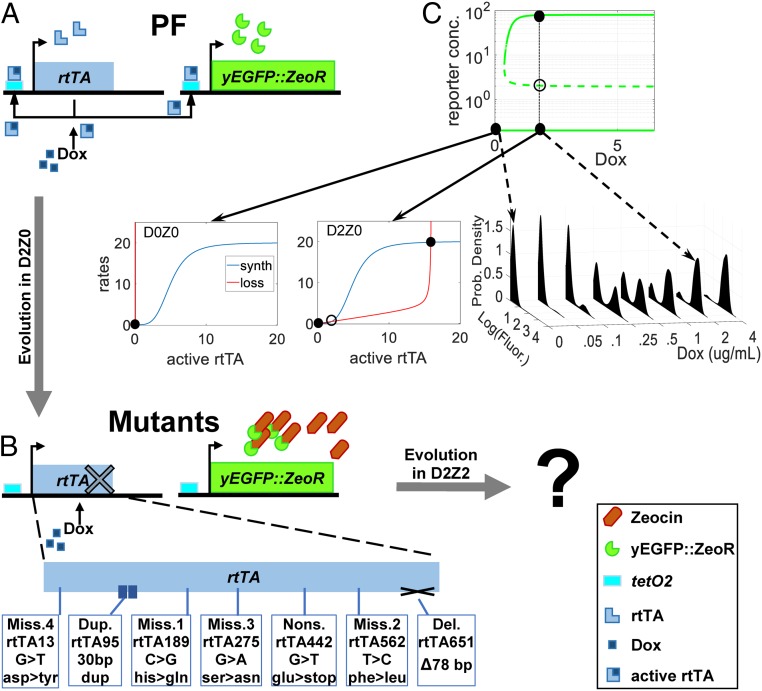
Evolutionary reversibility-the ability to regain a lost function-is an important problem both in evolutionary and synthetic biology, where repairing natural or synthetic systems broken by evolutionary processes may be valuable. Here, we use a synthetic positive-feedback (PF) gene circuit integrated into haploid cells to test if the population can restore lost PF function. In previous evolution experiments, mutations in a gene eliminated the fitness costs of PF activation. Since PF activation also provides drug resistance, exposing such compromised or broken mutants to both drug and inducer should create selection pressure to regain drug resistance and possibly PF function. Indeed, evolving 7 PF mutant strains in the presence of drug revealed 3 adaptation scenarios through genomic, PF-external mutations that elevate PF basal expression, possibly by affecting transcription, translation, degradation, and other fundamental cellular processes. Nonfunctional mutants gained drug resistance without ever developing high expression, while quasifunctional and dysfunctional PF mutants developed high expression nongenetically, which then diminished, although more slowly for dysfunctional mutants where revertant clones arose. These results highlight how intracellular context, such as the growth rate, can affect regulatory network dynamics and evolutionary dynamics, which has important consequences for understanding the evolution of drug resistance and developing future synthetic biology applications.
进化的可逆性——重新获得失去功能的能力——是进化生物学和合成生物学中的一个重要问题,修复因进化过程而受损的自然或合成系统可能具有重要价值。在这里,我们使用整合到单倍体细胞中的合成正反馈(PF)基因回路来测试种群是否能够恢复失去的 PF 功能。在之前的进化实验中,基因突变消除了 PF 激活的适应代价。由于 PF 激活还提供了药物抗性,因此将这种受损或有缺陷的突变体暴露于药物和诱导剂应该会产生恢复药物抗性和可能的 PF 功能的选择压力。事实上,在存在药物的情况下对 7 个 PF 突变株进行进化,通过基因组 PF 外部突变揭示了 3 种适应场景,这些突变可能通过影响转录、翻译、降解和其他基本细胞过程来提高 PF 的基础表达。无功能的突变体获得了药物抗性,而从未发展出高表达,而准功能和功能失调的 PF 突变体则以非遗传方式发展出高表达,尽管功能失调的突变体恢复的速度较慢,因为出现了回复突变体克隆。这些结果强调了细胞内环境(如生长速度)如何影响调控网络动态和进化动态,这对理解药物抗性的进化和开发未来的合成生物学应用具有重要意义。