Li Jingen, Gu Shuying, Zhao Zhen, Chen Bingchen, Liu Qian, Sun Tao, Sun Wenliang, Tian Chaoguang
Key Laboratory of Systems Microbial Biotechnology, Tianjin Institute of Industrial Biotechnology, Chinese Academy of Sciences, Tianjin, 300308 China.
Fungal Biol Biotechnol. 2019 Nov 13;6:21. doi: 10.1186/s40694-019-0083-8. eCollection 2019.
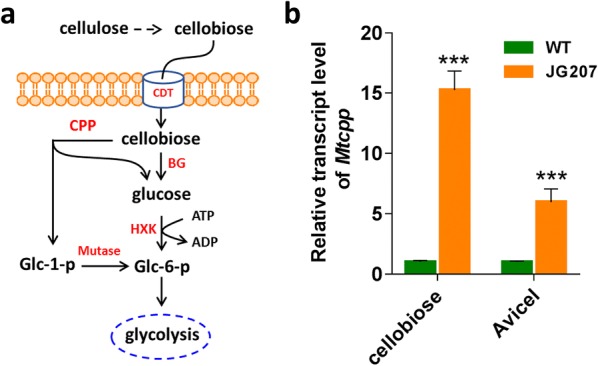
Lignocellulosic biomass has long been recognized as a potential sustainable source for industrial applications. The costs associated with conversion of plant biomass to fermentable sugar represent a significant barrier to the production of cost-competitive biochemicals. Consolidated bioprocessing (CBP) is considered a potential breakthrough for achieving cost-efficient production of biomass-based fuels and commodity chemicals. During the degradation of cellulose, cellobiose (major end-product of cellulase activity) is catabolized by hydrolytic and phosphorolytic pathways in cellulolytic organisms. However, the details of the two intracellular cellobiose metabolism pathways in cellulolytic fungi remain to be uncovered.
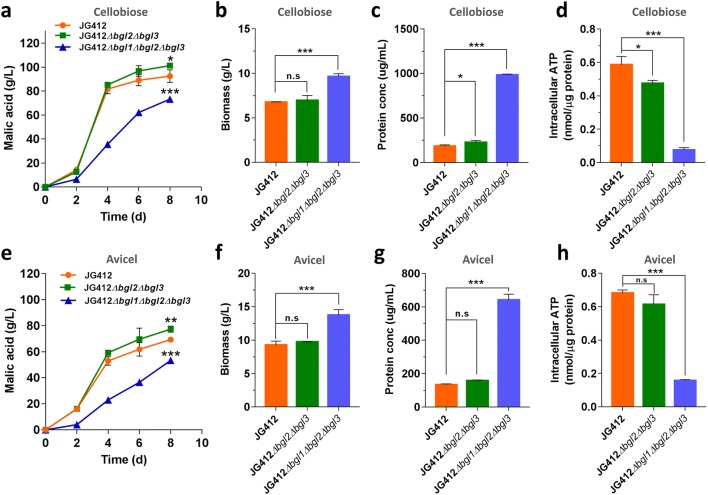
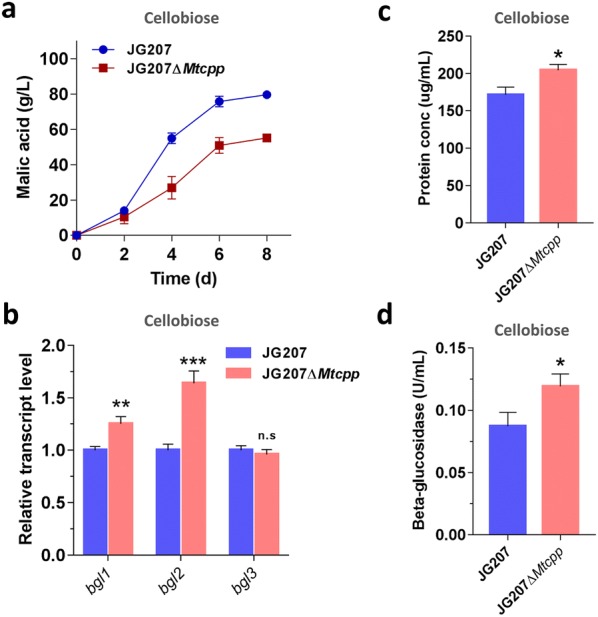
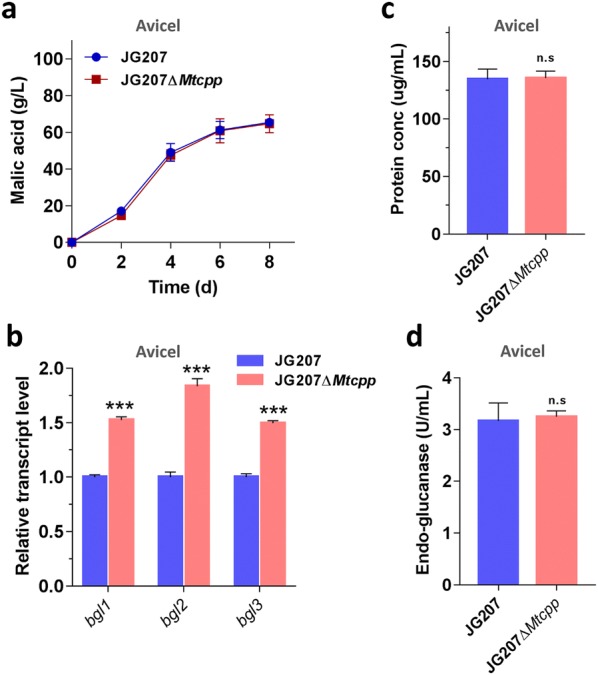
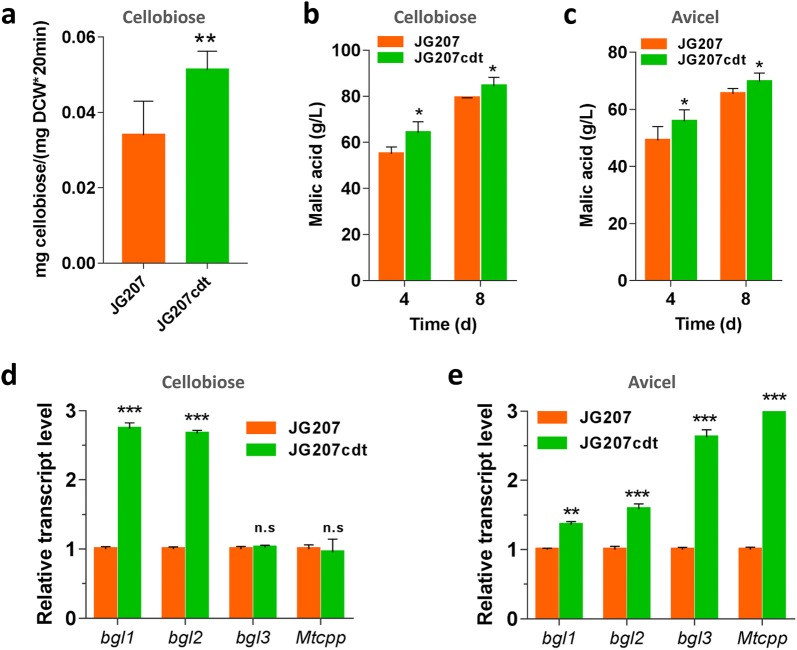
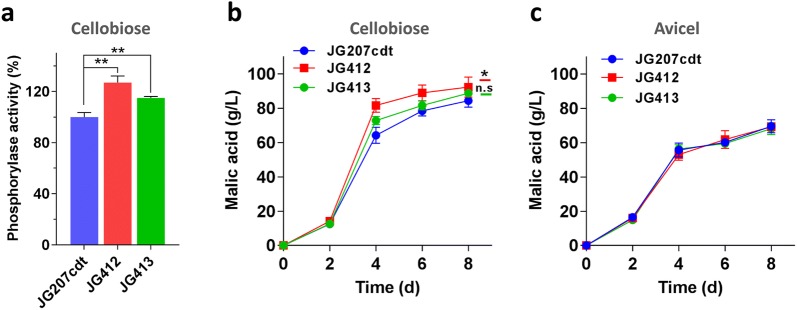
Using the engineered malic acid production fungal strain JG207, we demonstrated that the hydrolytic pathway by β-glucosidase and the phosphorolytic pathway by phosphorylase are both used for intracellular cellobiose metabolism in , and the yield of malic acid can benefit from the energy advantages of phosphorolytic cleavage. There were obvious differences in regulation of the two cellobiose catabolic pathways depending on whether JG207 was grown on cellobiose or Avicel. Disruption of in strain JG207 led to decreased production of malic acid under cellobiose conditions, while expression levels of all three intracellular β-glucosidase genes were significantly up-regulated to rescue the impairment of the phosphorolytic pathway under Avicel conditions. When the flux of the hydrolytic pathway was reduced, we found that β-glucosidase encoded by was the dominant enzyme in the hydrolytic pathway and deletion of resulted in significant enhancement of protein secretion but reduction of malate production. Combining comprehensive manipulation of both cellobiose utilization pathways and enhancement of cellobiose uptake by overexpression of a cellobiose transporter, the final strain JG412 produced up to 101.2 g/L and 77.4 g/L malic acid from cellobiose and Avicel, respectively, which corresponded to respective yields of 1.35 g/g and 1.03 g/g, representing significant improvement over the starting strain JG207.
This is the first report of detailed investigation of intracellular cellobiose catabolism in cellulolytic fungus . These results provide insights that can be applied to industrial fungi for production of biofuels and biochemicals from cellobiose and cellulose.
木质纤维素生物质长期以来一直被认为是工业应用中潜在的可持续资源。将植物生物质转化为可发酵糖的相关成本是生产具有成本竞争力的生物化学品的重大障碍。整合生物加工(CBP)被认为是实现基于生物质的燃料和商品化学品经济高效生产的潜在突破。在纤维素降解过程中,纤维二糖(纤维素酶活性的主要终产物)在纤维素分解生物体中通过水解和磷酸解途径被分解代谢。然而,纤维素分解真菌中两种细胞内纤维二糖代谢途径的细节仍有待揭示。
使用工程化的苹果酸生产真菌菌株JG207,我们证明了β-葡萄糖苷酶的水解途径和磷酸化酶的磷酸解途径都用于里氏木霉的细胞内纤维二糖代谢,并且苹果酸的产量可以受益于磷酸解裂解的能量优势。根据JG207是在纤维二糖还是微晶纤维素上生长,两种纤维二糖分解代谢途径的调节存在明显差异。在菌株JG207中破坏bgl3导致在纤维二糖条件下苹果酸产量降低,而在微晶纤维素条件下,所有三个细胞内β-葡萄糖苷酶基因的表达水平均显著上调以挽救磷酸解途径的损伤。当水解途径的通量降低时,我们发现bgl3编码的β-葡萄糖苷酶是水解途径中的主导酶,缺失bgl3导致蛋白质分泌显著增强,但苹果酸产量降低。通过对两种纤维二糖利用途径进行综合调控,并通过过表达纤维二糖转运蛋白增强纤维二糖摄取,最终菌株JG412分别从纤维二糖和微晶纤维素中产生高达101.2 g/L和77.4 g/L的苹果酸,其产率分别为1.35 g/g和1.03 g/g,相对于起始菌株JG207有显著提高。
这是关于纤维素分解真菌里氏木霉细胞内纤维二糖分解代谢详细研究的首次报道。这些结果提供了可应用于工业真菌以从纤维二糖和纤维素生产生物燃料及生物化学品的见解。