Students' Research Committee, Department of Food Sciences and Technology, Faculty of Nutrition and Food Sciences, Tabriz University of Medical Sciences, Tabriz, Iran.
Department of Food Sciences and Technology, Faculty of Nutrition and Food Sciences, Tabriz University of Medical Sciences, Tabriz, Iran.
Sci Rep. 2019 Nov 25;9(1):17439. doi: 10.1038/s41598-019-54025-0.
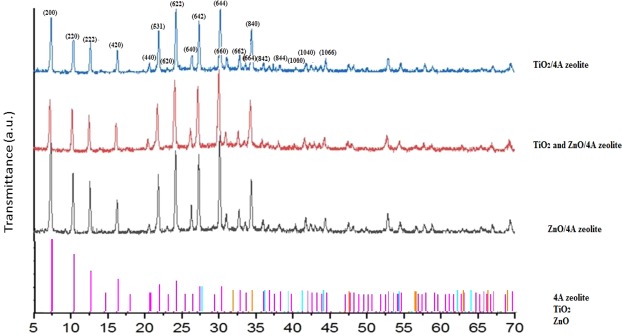
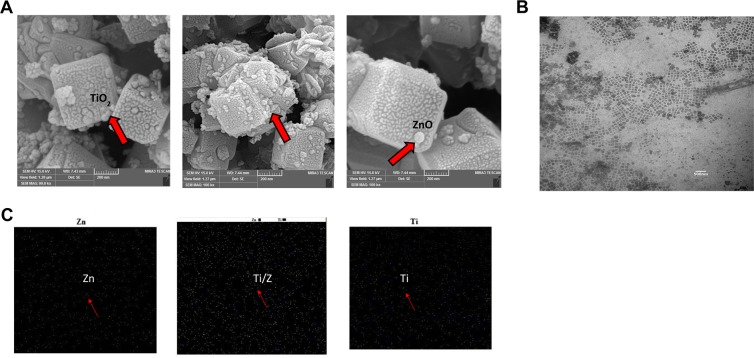
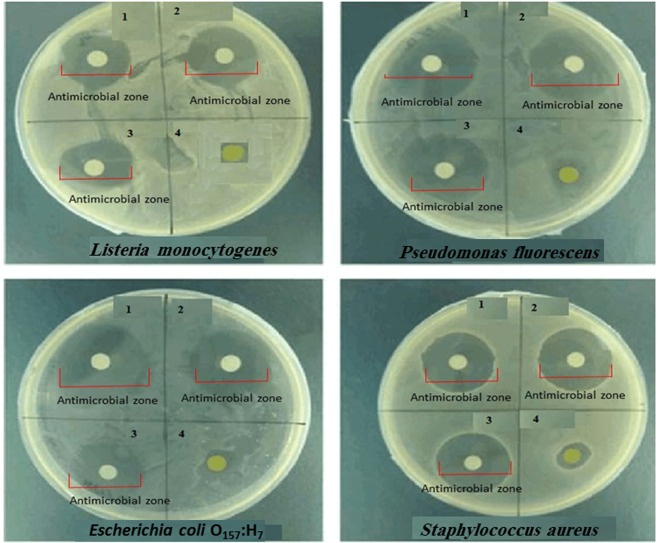
In this study, the antimicrobial activity of titanium dioxide (TiO), zinc oxide (ZnO), and TiO/ZnO nanoparticles supported into 4A zeolite (4A z) was assessed. Based on antimicrobial experiments, minimum inhibitory concentration (MIC), minimum bactericidal concentration (MBC), fractional inhibitory concentration (FIC) and disc diffusion test were determined after 24 h of contact with the prepared nanocomposites. These results are in agreements with the results of disc diffusion test. During the experiments, the numbers of viable bacterial cells of Staphylococcus aureus, Pseudomonas fluorescens, Listeria monocytogenes and Escherichia coli O:H decreased significantly. The crystallinity and morphology of nanoparticles were investigated by X-ray diffraction patterns (XRD), elemental mapping at the microstructural level by scanning electron microscopy (SEM) with energy dispersive X-ray spectrometry (EDS), and transmission electron microscopy (TEM). As a result, it was demonstrated that TiO/ZnO nanoparticles supported in 4A zeolite could lead to an optimum activity as antimicrobial agents.
在这项研究中,评估了负载在 4A 沸石(4A z)中的二氧化钛(TiO)、氧化锌(ZnO)和 TiO/ZnO 纳米粒子的抗菌活性。根据抗菌实验,在与制备的纳米复合材料接触 24 小时后,确定了最小抑菌浓度(MIC)、最小杀菌浓度(MBC)、抑菌浓度分数(FIC)和圆盘扩散试验。这些结果与圆盘扩散试验的结果一致。在实验过程中,金黄色葡萄球菌、荧光假单胞菌、单核细胞增生李斯特菌和大肠杆菌 O:H 的活菌数明显减少。通过 X 射线衍射图谱(XRD)、扫描电子显微镜(SEM)结合能谱(EDS)的微观结构水平的元素映射以及透射电子显微镜(TEM)研究了纳米粒子的结晶度和形态。结果表明,负载在 4A 沸石中的 TiO/ZnO 纳米粒子可以作为抗菌剂发挥最佳活性。