Department of Hospital Administration, Juntendo University Graduate School of Medicine, Bunkyo-ku, Tokyo, Japan.
Department of Hospital Administration, Juntendo University Graduate School of Medicine, Bunkyo-ku, Tokyo, Japan
BMJ Open. 2019 Nov 25;9(11):e033940. doi: 10.1136/bmjopen-2019-033940.
The Ocular Surface Disease Index (OSDI) questionnaire is widely used to evaluate subjective symptoms of dry eye disease (DED) as a primary diagnostic criterion. This study aimed to develop a Japanese version of the OSDI (J-OSDI) and assess its reliability and validity.
Hospital-based cross-sectional observational study.
A total of 209 patients recruited from the Department of Ophthalmology at Juntendo University Hospital.
We translated and culturally adapted the OSDI into Japanese. The J-OSDI was then assessed for internal consistency, reliability and validity. We also evaluated the optimal cut-off value to suspect DED using an area under the receiver operating characteristic curve (AUC) analysis.
Internal consistency, test-retest reliability and discriminant validity of the J-OSDI as well as the optimal cut-off value to suspect DED.
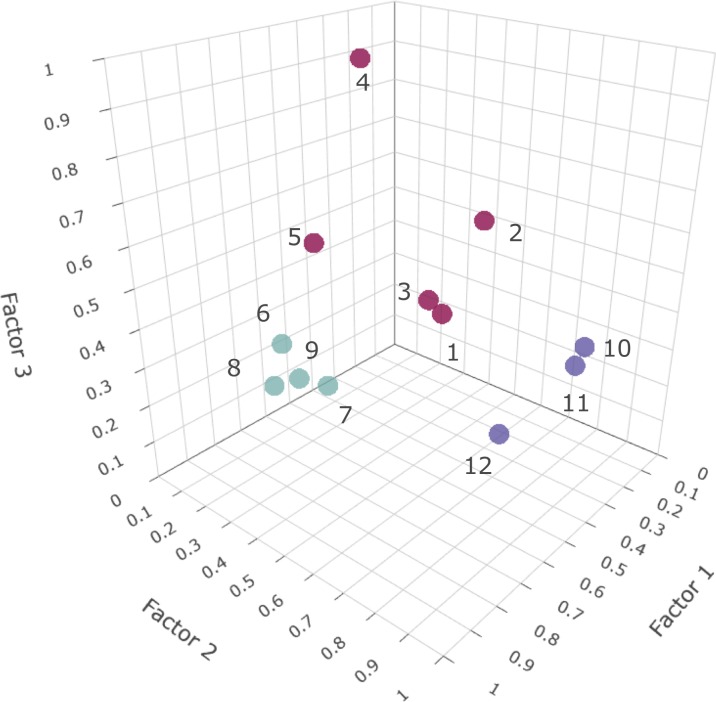
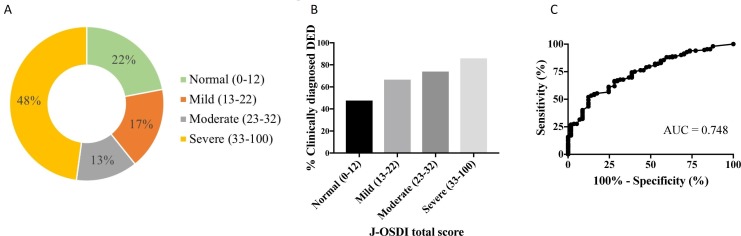
Of the participants, 152 had DED and 57 did not. The J-OSDI total score showed good internal consistency (Cronbach's alpha=0.884), test-retest reliability (interclass correlation coefficient=0.910) and discriminant validity by known-group comparisons (non-DED, 19.4±16.0; DED, 37.7±22.2; p<0.001). Factor validity was used to confirm three subscales within the J-OSDI according to the original version of the questionnaire. Concurrent validity was assessed by Pearson correlation analysis, and the J-OSDI total score showed a strong positive correlation with the Dry Eye-Related Quality-of-Life Score (γ=0.829). The optimal cut-off value of the J-OSDI total score was 36.3 (AUC=0.744).
The J-OSDI was developed and validated in terms of reliability and validity as an effective tool for DED assessment and monitoring in the Japanese population.
眼表疾病指数(OSDI)问卷被广泛用于评估干眼症(DED)的主观症状,作为主要诊断标准。本研究旨在开发日本版 OSDI(J-OSDI)并评估其可靠性和有效性。
基于医院的横断面观察性研究。
共招募自顺天堂大学医院眼科的 209 名患者。
我们将 OSDI 翻译成日语并进行文化调适。然后评估 J-OSDI 的内部一致性、可靠性和有效性。我们还使用接受者操作特征曲线(ROC)分析下的面积(AUC)评估可疑 DED 的最佳截断值。
J-OSDI 的内部一致性、重测信度和判别有效性以及可疑 DED 的最佳截断值。
参与者中,152 名患有 DED,57 名未患有 DED。J-OSDI 总分显示出良好的内部一致性(Cronbach's alpha=0.884)、重测信度(组内相关系数=0.910)和通过已知组比较的判别有效性(非 DED,19.4±16.0;DED,37.7±22.2;p<0.001)。因子有效性用于根据问卷原始版本确认 J-OSDI 中的三个子量表。同时通过 Pearson 相关分析评估了同时效性,J-OSDI 总分与干眼相关生活质量评分呈强正相关(γ=0.829)。J-OSDI 总分的最佳截断值为 36.3(AUC=0.744)。
J-OSDI 在日本人群中具有可靠性和有效性,是评估和监测 DED 的有效工具。