Department of Social and Political Sciences, Bocconi University, Milan, Italy.
Centre for Global Health Inequalities Research (CHAIN), Norwegian University of Science and Technology, Trondheim, Norway.
Global Health. 2019 Nov 28;15(Suppl 1):70. doi: 10.1186/s12992-019-0516-4.
Recent scholarship has increasingly identified global power asymmetries as the root cause of health inequities. This article examines how such asymmetries manifest in global governance for health, and how this impacts health outcomes.
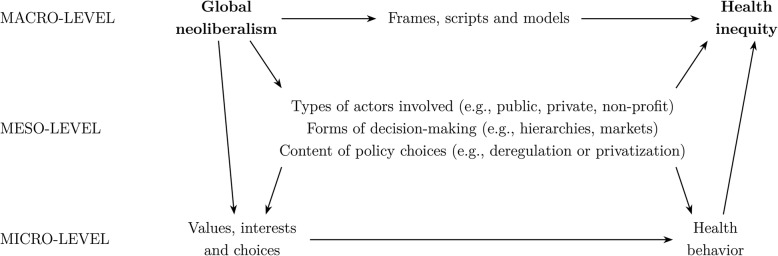
We focus on the political-economic determinants of global health inequities, and how these determinants operate at different levels of social action (micro, meso, and macro) through distinct but interacting mechanisms. To clarify how these mechanisms operate, we develop an integrative framework for examining the links between global neoliberalism-the currently dominant policy paradigm premised on advancing the reach of markets and promoting ever-growing international economic integration-and global health inequities, and show how these mechanisms have macro-macro, macro-meso-macro, and macro-micro-macro manifestations.
Our approach enables the design of theoretically-nuanced empirical strategies to document the multiple ways in which the political economy entrenches or, alternatively, might ameliorate global health inequities.
最近的学术研究越来越多地指出,全球权力不对称是健康不平等的根源。本文探讨了这些不对称现象如何在全球卫生治理中表现出来,以及这如何影响健康结果。
我们关注全球卫生不平等的政治经济决定因素,以及这些决定因素如何通过不同但相互作用的机制在社会行动的不同层面(微观、中观和宏观)运作。为了澄清这些机制的运作方式,我们制定了一个综合框架,用于研究全球新自由主义(目前占主导地位的政策范式,其前提是扩大市场的影响力,促进不断增长的国际经济一体化)与全球卫生不平等之间的联系,并展示这些机制如何在宏观-宏观、宏观-中观-宏观和宏观-微观-宏观层面表现出来。
我们的方法使设计理论上细致的经验策略成为可能,以记录政治经济巩固或可能缓解全球卫生不平等的多种方式。