Ganie Mohd Ashraf, Sahar Tajali, Rashid Aafia, Wani Ishfaq A, Nisar Sobia, Sathyapalan Thozhukat, Vishnubhatla Sreenivas, Ramakrishnan Lakshmy, Parvez Tabasum, Geer Ishaq
Department of Endocrinology, Sheri-Kashmir Institute of Medical Sciences, Srinagar, India.
Department of Medicine, Government Medical College, Srinagar, India.
Front Endocrinol (Lausanne). 2019 Nov 8;10:699. doi: 10.3389/fendo.2019.00699. eCollection 2019.
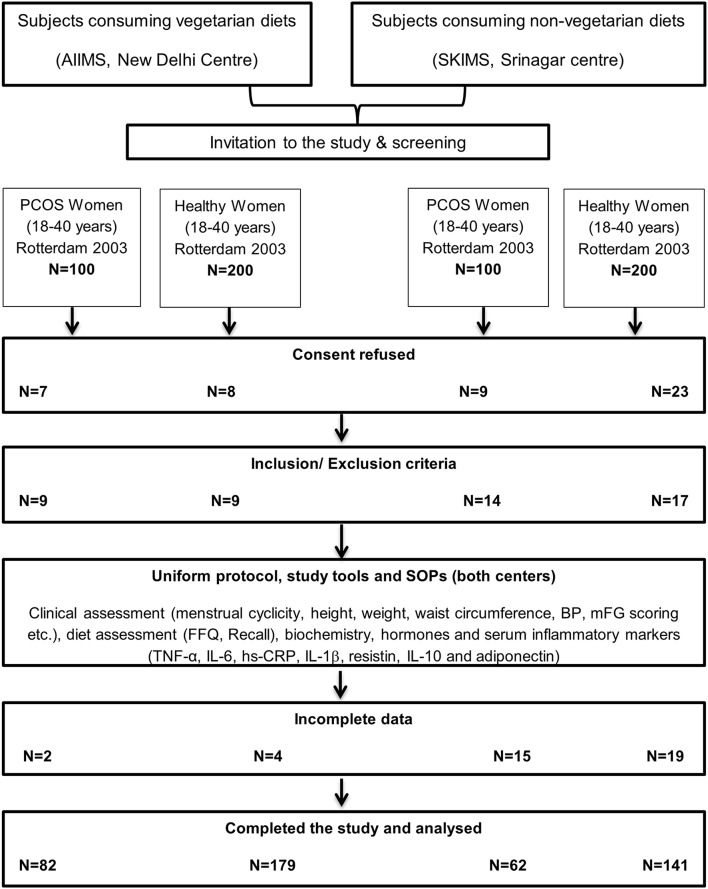
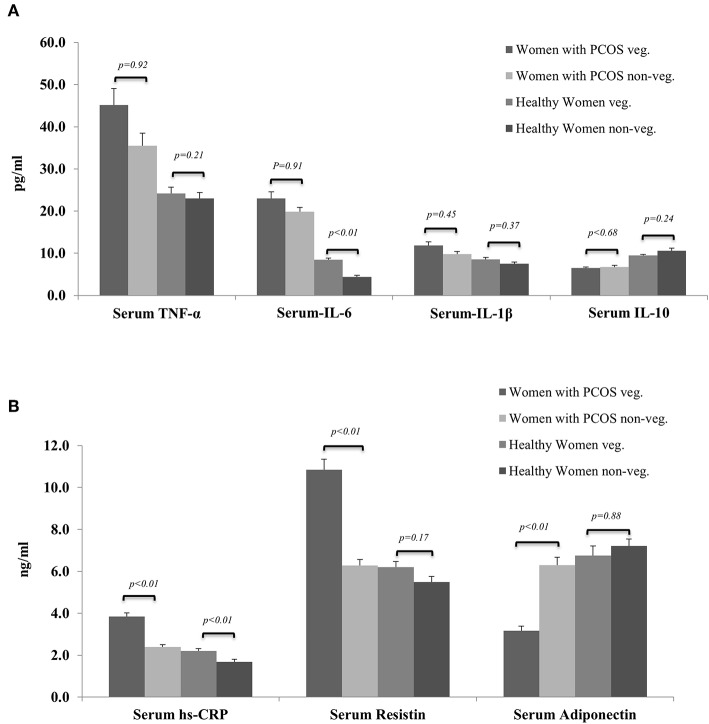
Sub-inflammation and insulin resistance characterize women with PCOS. Data on dietary modulation of inflammation among PCOS women is scant, particularly from Indian subcontinent. The present study aimed to assess the effect of plant based vs. animal origin diets on serum markers of inflammation (primary outcome measure). This observational case-control study compared age and BMI matched PCOS and apparently healthy women from two populations following different dietary practices. The vegetarian women from New-Delhi ( = 82 PCOS and = 179 healthy) and non-vegetarian women from Srinagar ( = 62 PCOS and = 141 healthy) formed the groups. Using a uniform methodology, detailed clinical, biochemical, hormonal, and inflammatory marker assessment was undertaken. The mean age of the overall cohort was 26.23 ± 4.59 years with a mean BMI of 24.39 ± 3.72 kg/m. Overall pro-inflammatory markers (TNF-α, IL-6, IL-1β, hs-CRP and serum resistin) were significantly higher ( ≤ 0.05) and anti-inflammatory markers (IL-10 and adiponectin) were lower among women with PCOS than healthy subjects. On comparing vegetarian women with non-vegetarians, higher daily calorie intake (1895.46 ± 258.19 vs. 1860.13 ± 323.96 Kcal) with a higher protein and fat and lower carbohydrate intake was recorded in the latter, although the percent energy derived from carbohydrates was higher among vegetarians. Clinical and biochemical parameters were comparable among the groups except mFG score, total serum testosterone and serum lipid levels which were higher among non-vegetarian women as compared to their vegetarian counterparts from both categories (PCOS and healthy). Interestingly, vegetarian women with PCOS and healthy women had higher serum pro-inflammatory and lower anti-inflammatory markers compared to their non-vegetarian counterparts. Women with PCOS consuming Indian vegetarian diet have higher pro-inflammatory and lower anti-inflammatory marker levels than their age and BMI matched healthy non-vegetarian counterparts. This interesting observation can be attributed to the dietary composition, among other factors and needs confirmation from well-designed randomized studies on a larger cohort. The study was registered with CTRI database under registration number CTRI/2013/09/003996.
亚炎症和胰岛素抵抗是多囊卵巢综合征(PCOS)女性的特征。关于PCOS女性炎症的饮食调节的数据很少,尤其是来自印度次大陆的数据。本研究旨在评估植物性饮食与动物性饮食对炎症血清标志物的影响(主要结局指标)。这项观察性病例对照研究比较了来自两个遵循不同饮食习惯人群的年龄和体重指数(BMI)匹配的PCOS女性和明显健康的女性。来自新德里的素食女性(82例PCOS患者和179例健康女性)和来自斯利那加的非素食女性(62例PCOS患者和141例健康女性)组成了研究组。采用统一方法,进行了详细的临床、生化、激素和炎症标志物评估。整个队列的平均年龄为26.23±4.59岁,平均BMI为24.39±3.72kg/m²。与健康受试者相比,PCOS女性的总体促炎标志物(肿瘤坏死因子-α、白细胞介素-6、白细胞介素-1β、高敏C反应蛋白和血清抵抗素)显著更高(P≤0.05),抗炎标志物(白细胞介素-10和脂联素)更低。比较素食女性和非素食女性时,后者的每日热量摄入量更高(1895.46±258.19千卡对1860.13±323.96千卡),蛋白质和脂肪摄入量更高,碳水化合物摄入量更低,尽管素食者中来自碳水化合物的能量百分比更高。除了改良多毛评分、总血清睾酮和血脂水平外,两组之间的临床和生化参数具有可比性,与来自两个类别(PCOS和健康)的素食女性相比,非素食女性的这些指标更高。有趣的是,与非素食女性相比,患有PCOS的素食女性和健康素食女性具有更高的血清促炎标志物和更低的抗炎标志物。与年龄和BMI匹配的健康非素食女性相比,食用印度素食的PCOS女性具有更高的促炎标志物水平和更低的抗炎标志物水平。这一有趣的观察结果可能归因于饮食组成等因素,需要来自更大队列的精心设计的随机研究加以证实。该研究已在CTRI数据库注册,注册号为CTRI/2013/09/003996。