Serraino Andrea, Bonilauri Paolo, Kerekes Kata, Farkas Zsuzsa, Giacometti Federica, Canever Alessandra, Zambrini Angelo Vittorio, Ambrus Árpád
Department of Veterinary Medical Sciences, Alma Mater Studiorum, University of Bologna, Bologna, Italy.
Experimental Zooprophylactic Institute of Lombardy and Emilia-Romagna, Reggio Emilia, Italy.
Front Microbiol. 2019 Nov 8;10:2516. doi: 10.3389/fmicb.2019.02516. eCollection 2019.
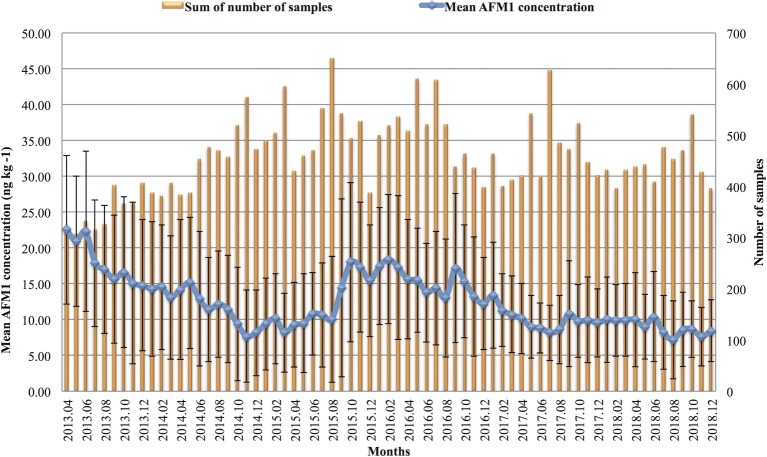
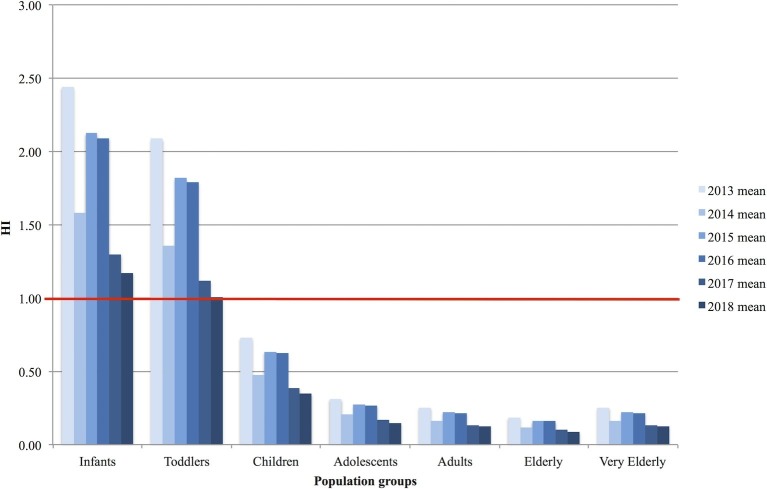
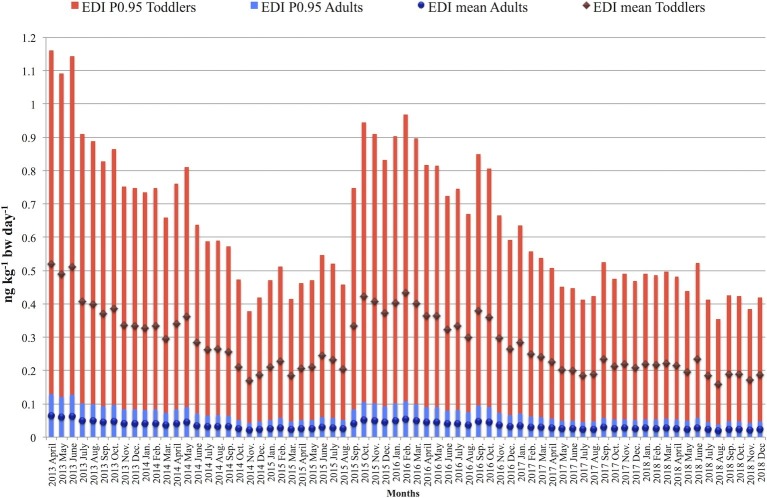
The current study is based on the AFM contamination of milk determined from April 2013 to December 2018 in the framework of a self-control plan of six milk processing plants in Italy. These data - together with the consumption data of milk consumers - were evaluated and used for the calculation of the Estimated Daily Intake (EDI), the Hazard Index (HI), and the fraction of hepatocarcinoma cases (HCC) due to AFM exposure in different population groups. Altogether a total of 31,702 milk samples were analyzed, representing 556,413 tons of milk, which is an outstanding amount compared to published studies. The results indicate the monthly fluctuation of AFM levels through a period of nearly 6 years. The EDI of AFM in different population groups was in the range of 0.025-0.328 ng kg body weight (bw) per day, based on the average consumption levels and weighted mean contamination of the milk in the study period. Considering average consumptions, in the groups of infants and toddlers, the HI calculation resulted in 1.64 and 1.4, respectively, while for older age groups, it was <1. The estimated fractions of HCC incidences attributable to the AFM intakes were 0.005 and 0.004 cases per 100,000 individuals in the 0-0.9 and 1-2.9-year age groups, respectively, and below 0.004 cases in the other age categories. The monthly average AFM contamination of tested milk consignments ranged between 7.19 and 22.53 ng kg. Although the results of this extensive investigation showed a low risk of HCC, the variability of climatic conditions throughout years that influence AFB contamination of feed and consequently AFM contamination of milk justifies their continuous monitoring and update of the risk assessment.
本研究基于2013年4月至2018年12月期间,在意大利六个牛奶加工厂的自控计划框架内测定的牛奶中的AFM污染情况。这些数据——连同牛奶消费者的消费数据——经过评估后用于计算不同人群组的估计每日摄入量(EDI)、危害指数(HI)以及因AFM暴露导致的肝癌病例(HCC)比例。总共分析了31,702份牛奶样本,代表556,413吨牛奶,与已发表的研究相比,这是一个相当可观的数量。结果表明,在近6年的时间里,AFM水平存在月度波动。根据研究期间牛奶的平均消费水平和加权平均污染情况,不同人群组的AFM的EDI范围为每天0.025 - 0.328纳克/千克体重(bw)。考虑到平均消费量,在婴幼儿组中,HI计算结果分别为1.64和1.4,而在年龄较大的组中,HI <1。在0 - 0.9岁和1 - 2.9岁年龄组中,归因于AFM摄入的HCC发病率估计分别为每10万人0.005例和0.004例,在其他年龄类别中低于0.004例。测试牛奶批次的每月平均AFM污染范围在7.19至22.53纳克/千克之间。尽管这项广泛调查的结果显示HCC风险较低,但多年来气候条件的变化会影响饲料中的AFB污染,进而影响牛奶中的AFM污染,因此有必要持续监测并更新风险评估。