Oerke Erich-Christian, Leucker Marlene, Steiner Ulrike
1INRES-Plant Diseases and Crop Protection, Rheinische Friedrich-Wilhelms-Universitaet Bonn, Nussallee 9, 53115 Bonn, Germany.
Plant Protection Service, Chamber of Agriculture, Gartenstraße 11, 50765 Cologne, Germany.
Plant Methods. 2019 Nov 16;15:133. doi: 10.1186/s13007-019-0521-x. eCollection 2019.
Due to its high damaging potential, Cercospora leaf spot (CLS) caused by is a continuous threat to sugar beet production worldwide. Breeding for disease resistance is hampered by the quantitative nature of resistance which may result from differences in penetration, colonization, and sporulation of the pathogen on sugar beet genotypes. In particular, problems in the quantitative assessment of sporulation have resulted in the common practice to assess field resistance late in the growth period as quantitative resistance parameter. Recently, hyperspectral sensors have shown potential to assess differences in CLS severity. Hyperspectral microscopy was used for the quantification of sporulation on sugar beet leaves in order to characterize the host plant suitability / resistance of genotypes for decision-making in breeding for CLS resistance.
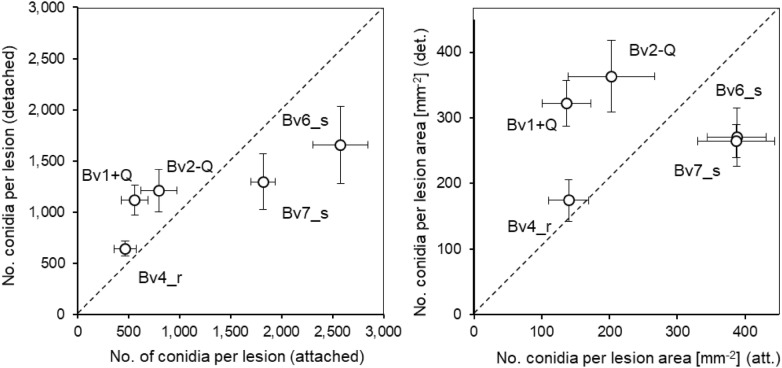
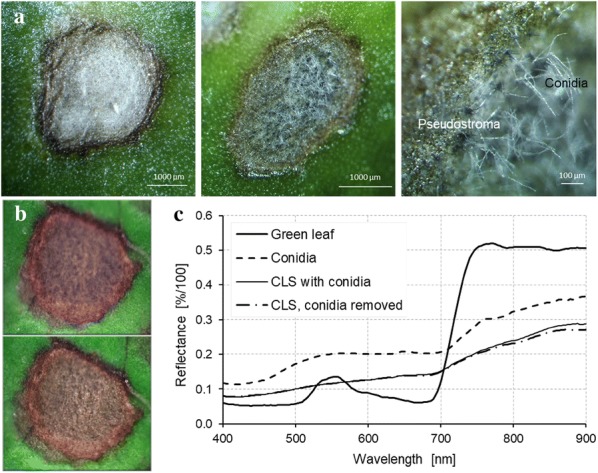
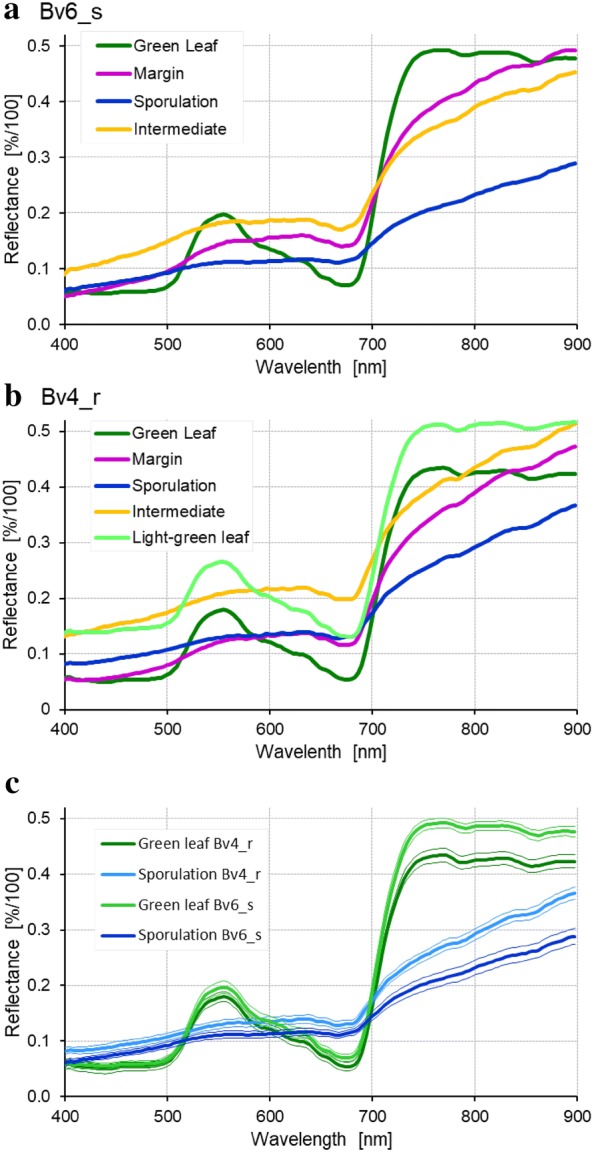
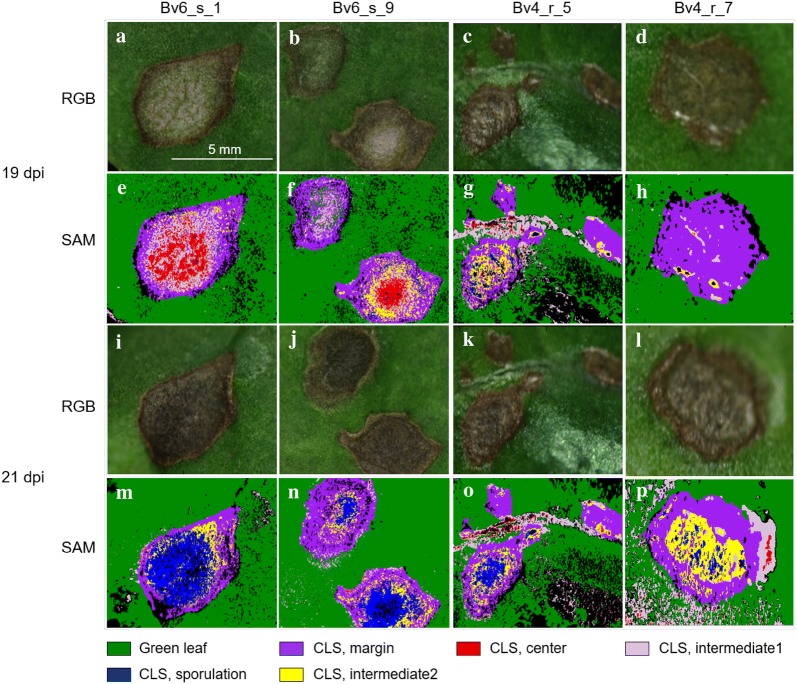
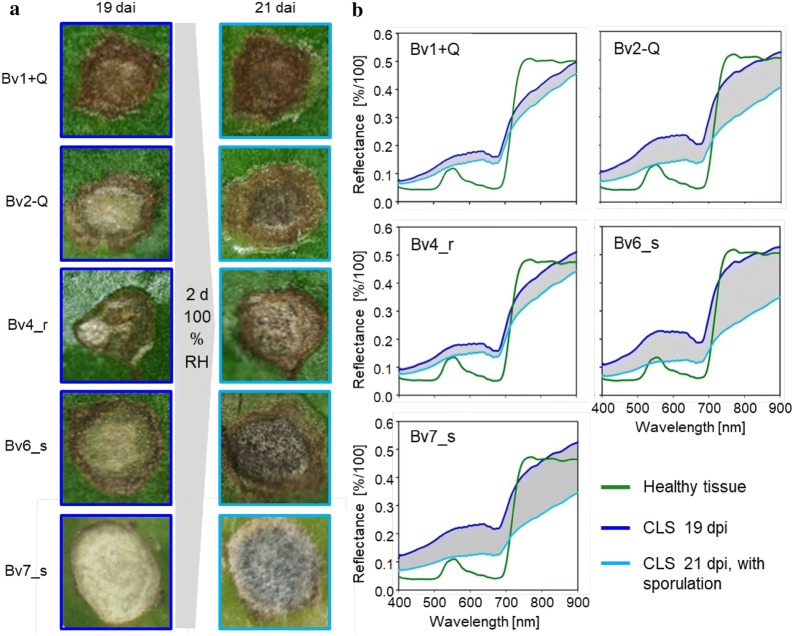
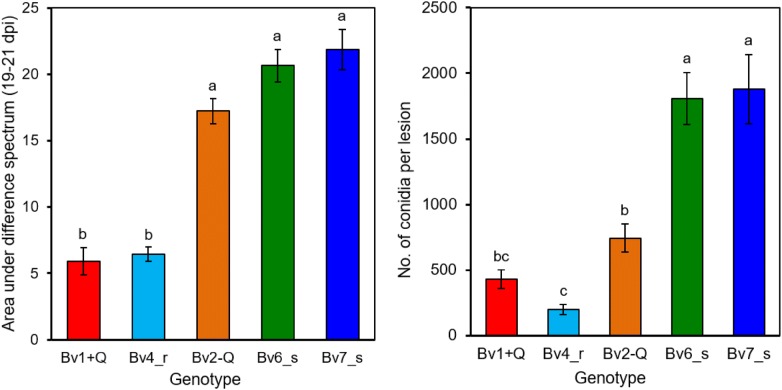
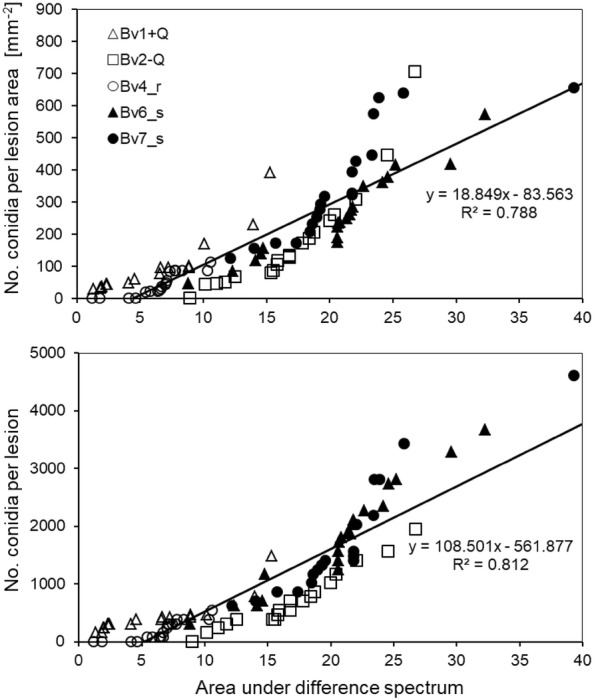
Assays with attached and detached leaves demonstrated that vital plant tissue is essential for the full potential of genotypic mechanisms of disease resistance and susceptibility. Spectral information (400 to 900 nm, 160 wavebands) of CLSs recorded before and after induction of sporulation allowed the identification of sporulating leaf spot sub-areas. A supervised classification and quantification of sporulation structures was possible, but the necessity of genotype-specific reference spectra restricts the general applicability of this approach. Fungal sporulation could be quantified independent of the host plant genotype by calculating the area under the difference reflection spectrum from hyperspectral imaging before and with sporulation. The overall relationship between sensor-based and visual quantification of sporulation on five genotypes differing in CLS resistance was R = 0.81; count-based differences among genotypes could be reproduced spectrally.
For the first time, hyperspectral imaging was successfully tested for the quantification of sporulation as a fungal activity depending on host plant suitability. The potential of this non-invasive and non-destructive approach for the quantification of fungal sporulation in other host-pathogen systems and for the phenotyping of crop traits complex as sporulation resistance is discussed.
由于其具有很高的破坏潜力,由[病原菌名称未给出]引起的尾孢叶斑病(CLS)对全球甜菜生产构成持续威胁。抗病育种受到抗性数量性状的阻碍,这种抗性数量性状可能源于病原菌在甜菜基因型上的穿透、定殖和产孢差异。特别是,病原菌产孢定量评估方面的问题导致在生长后期将田间抗性作为定量抗性参数进行评估成为常见做法。最近,高光谱传感器已显示出评估CLS严重程度差异的潜力。高光谱显微镜用于定量甜菜叶片上的病原菌产孢,以表征基因型对CLS抗性育种决策的寄主植物适宜性/抗性。
对附着叶片和离体叶片的测定表明,活的植物组织对于抗病性和感病性基因型机制的充分发挥至关重要。在诱导病原菌产孢前后记录的CLS光谱信息(400至900纳米,160个波段)可用于识别产孢叶斑亚区域。对产孢结构进行监督分类和定量是可行的,但基因型特异性参考光谱的必要性限制了该方法的普遍适用性。通过计算高光谱成像在产孢前和产孢时的差异反射光谱下的面积,可以独立于寄主植物基因型对真菌产孢进行定量。基于传感器的和视觉定量评估CLS抗性不同的五个基因型上的病原菌产孢之间的总体关系为R = 0.81;基因型之间基于计数的差异可以通过光谱再现。
首次成功测试了高光谱成像用于根据寄主植物适宜性对作为真菌活性的产孢进行定量。讨论了这种非侵入性和非破坏性方法在其他寄主 - 病原体系统中定量真菌产孢以及对产孢抗性等复杂作物性状进行表型分析的潜力。