Key Laboratory of Intelligent Computing in Medical Image (MIIC), Northeastern University, Ministry of Education, Shenyang, China.
Biomedical and Information Engineering School, Northeastern University, Shenyang, China.
Comput Math Methods Med. 2019 Oct 30;2019:6978650. doi: 10.1155/2019/6978650. eCollection 2019.
Breast cancer is a major cause of mortality among women if not treated in early stages. Recognizing molecular markers from DCE-MRI directly to distinguish the four molecular subtypes without invasive biopsy is helpful for guiding treatment plans for breast cancer, which provides a fast way to consequential treatment plan decision in early time and best opportunity for patients.
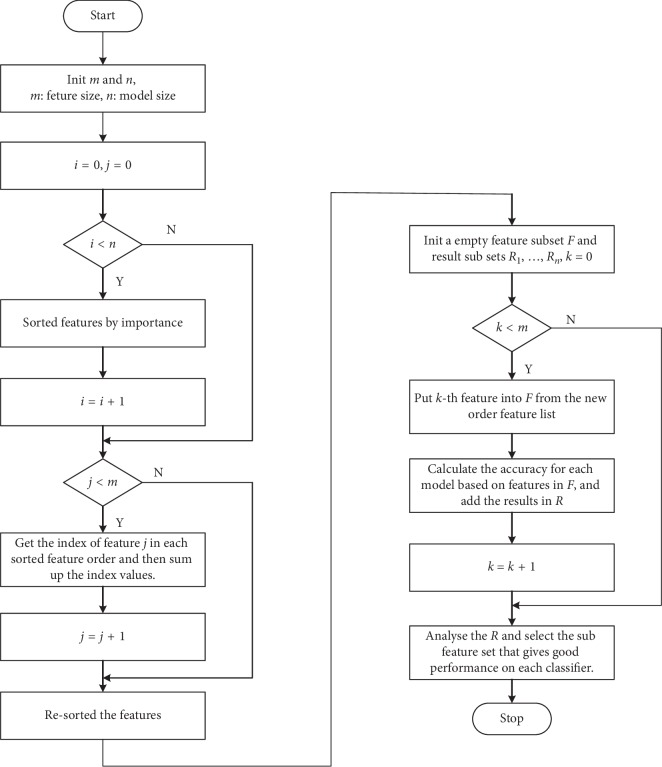
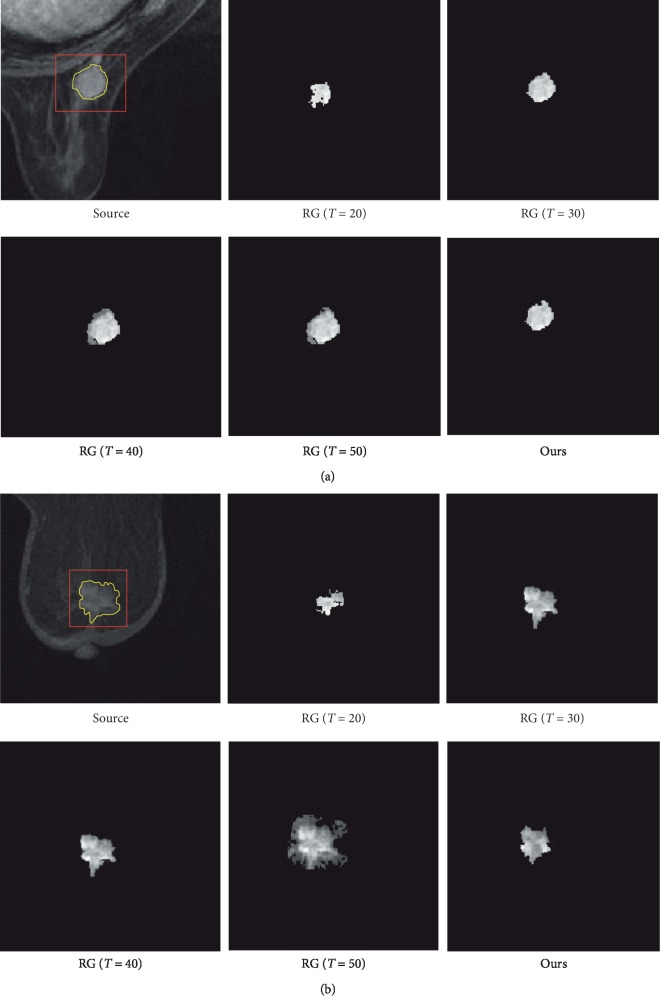
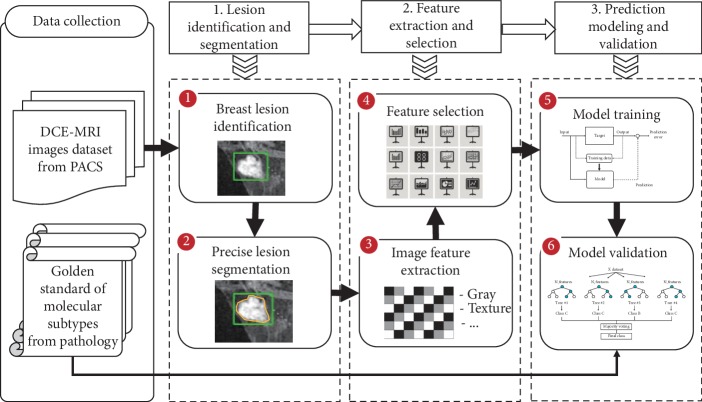
This study presents an approach of molecular subtypes recognition from breast cancer image phenotypes by radiomics. An improved region growth algorithm with dynamic threshold without user interaction is proposed for cancer lesion segmentation, which gives the precise border of lesion other than area with background. The lesions are extracted automatically based on radiologists' annotation which guarantees the lesion is segmented correctly. Various features are extracted on lesions data including texture, morphology, dynamic kinetics, and statistics features carried out on a large patient cohort, which are used to validate the relationship between image phenotypes and the molecular subtypes. A new algorithm of multimodel-based recursive feature elimination is applied on the radiomics data generated by the feature extraction process. This method obtains the feature subset with stable performance for different classification models, and the gradient boosting decision tree model gets the best results of both classification performance and imbalance performance on molecular subtypes.
From the experimental results, 69 optimal features from 143 original features are found by the multimodel-based recursive feature elimination algorithms and the gradient boosting decision tree classifier obtains a good performance with accuracy 0.87, precise 0.88, recall 0.87, and F1-score 0.87. The dataset with 637 patients in this paper has serious imbalance problem on different molecular subtypes, and the the robust features that are generated by multimodel-based recursive feature eliminiation algorithm make the gradient boosting decision tree classifier have good behaviors. The recognition precision for the four molecular subtypes of luminal A, luminal B, HER-2, and basal-like are 0.91, 0.89, 0.83, and 0.87, respectively.
The improved lesion segmentation method gives more precise lesion edge, which not only saves the time of automatic extraction of lesion region of interest without threshold setting for each case, but also prevents the segmentation error by manual and prejudice from different radiologists. The feature selection algorithm of multimodel-based recursive feature elimination has the ability to find robust and optimal features that distinguish the four molecular subtypes from image phenotypes. The gradient boosting decision tree classifier rather plays a main role in recognition than other models used in this paper.
如果不在早期阶段进行治疗,乳腺癌是导致女性死亡的主要原因之一。直接从 DCE-MRI 中识别分子标志物来区分四种分子亚型,而无需进行侵入性活检,有助于指导乳腺癌的治疗计划,为患者提供早期及时的治疗计划决策和最佳机会。
本研究通过放射组学从乳腺癌图像表型中提出一种识别分子亚型的方法。提出了一种改进的区域生长算法,该算法具有无需用户交互的动态阈值,可用于癌症病变分割,该算法可以提供病变的精确边界,而不仅仅是背景区域的面积。病变是基于放射科医生的注释自动提取的,这保证了病变的正确分割。在大型患者队列中对病变数据进行了各种特征提取,包括纹理、形态、动态动力学和统计特征,用于验证图像表型与分子亚型之间的关系。应用一种新的多模型递归特征消除算法对特征提取过程生成的放射组学数据进行处理。该方法获得了具有不同分类模型稳定性能的特征子集,梯度提升决策树模型在分子亚型的分类性能和不平衡性能方面均取得了最佳结果。
从实验结果可以看出,通过多模型递归特征消除算法找到了 69 个最优特征,梯度提升决策树分类器的性能良好,准确率为 0.87,精确率为 0.88,召回率为 0.87,F1 得分为 0.87。本文数据集有 637 名患者,不同分子亚型之间存在严重的不平衡问题,多模型递归特征消除算法生成的稳健特征使梯度提升决策树分类器具有良好的性能。四种分子亚型(管腔 A、管腔 B、HER-2 和基底样)的识别精度分别为 0.91、0.89、0.83 和 0.87。
改进的病变分割方法提供了更精确的病变边缘,不仅节省了为每个病例设置阈值自动提取病变感兴趣区的时间,而且还防止了不同放射科医生的手动和偏见造成的分割错误。多模型递归特征消除的特征选择算法具有从图像表型中找到区分四种分子亚型的稳健和最优特征的能力。梯度提升决策树分类器在识别中起着比本文中使用的其他模型更重要的作用。