From the Department of Neurology (O.S. T.T.), Karolinska University Hospital; Department of Clinical Neuroscience (O.S. T.T.) and Institute of Environmental Medicine (T.A., S.C.), Karolinska Institutet; Center for Occupational and Environmental Medicine (T.A.), Stockholm County Council; and Department of Neuroscience (P.M.), University of Uppsala, Sweden.
Neurology. 2020 Jan 28;94(4):e419-e429. doi: 10.1212/WNL.0000000000008741. Epub 2019 Dec 12.
We conducted a nationwide case-control study in Sweden to test the hypothesis that specific clinical characteristics are associated with increased risk of sudden unexpected death in epilepsy (SUDEP).
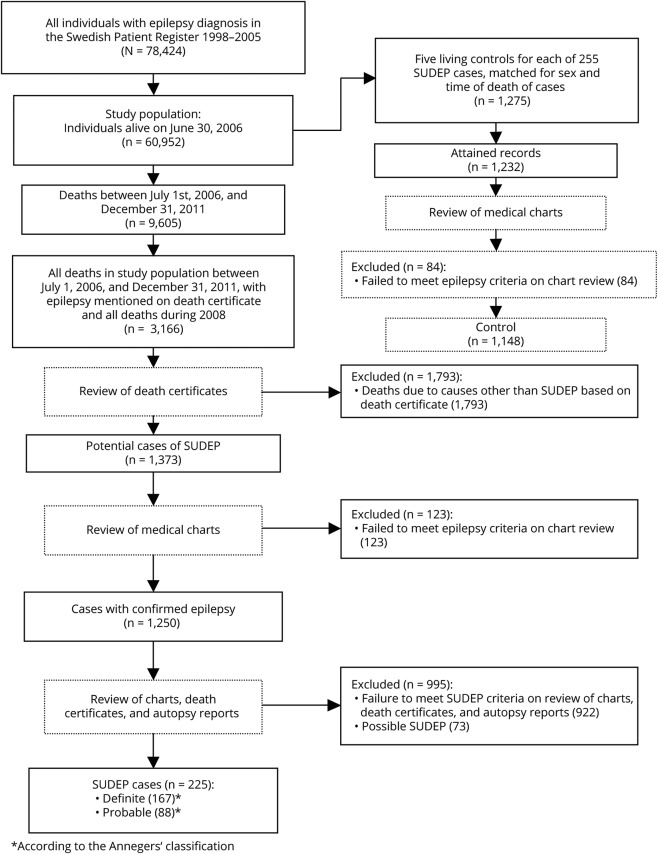
The study included 255 SUDEP cases (definite and probable) and 1,148 matched controls. Clinical information was obtained from medical records and the National Patient Register. The association between SUDEP and potential risk factors was assessed by odds ratios (ORs) and 95% confidence intervals (CIs) and interaction assessed by attributable proportion due to interaction (AP).
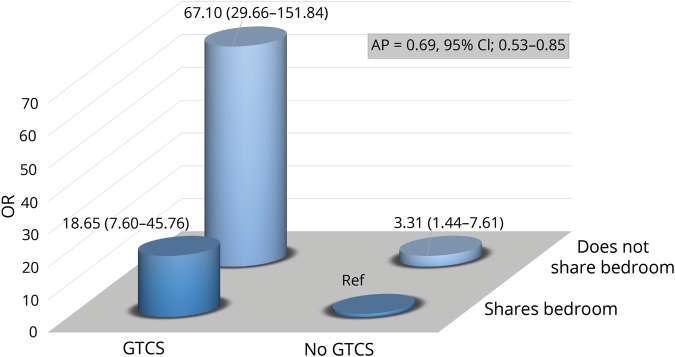
Experiencing generalized tonic-clonic seizures (GTCS) during the preceding year was associated with a 27-fold increased risk (OR 26.81, 95% CI 14.86-48.38), whereas no excess risk was seen in those with exclusively non-GTCS seizures (OR 1.15, 95% CI 0.54-48.38). The presence of nocturnal GTCS during the last year of observation was associated with a 15-fold risk (OR 15.31, 95% CI 9.57-24.47). Living alone was associated with a 5-fold increased risk of SUDEP (OR 5.01, 95% CI 2.93-8.57) and interaction analysis showed that the combination of not sharing a bedroom and having GTCS conferred an OR of 67.10 (95% CI 29.66-151.88), with AP estimated at 0.69 (CI 0.53-0.85). Among comorbid diseases, a previous diagnosis of substance abuse or alcohol dependence was associated with excess risk of SUDEP.
Individuals with GTCS who sleep alone have a dramatically increased SUDEP risk. Our results indicate that 69% of SUDEP cases in patients who have GTCS and live alone could be prevented if the patients were not unattended at night or were free from GTCS.
我们在瑞典进行了一项全国性病例对照研究,以检验以下假设,即特定的临床特征与癫痫猝死(SUDEP)风险增加相关。
该研究纳入了 255 例 SUDEP 病例(确诊和可能)和 1148 例匹配对照。临床信息来自病历和国家患者登记处。通过比值比(OR)和 95%置信区间(CI)评估 SUDEP 与潜在危险因素之间的关联,并通过交互归因比例(AP)评估交互作用。
在过去一年中经历全身性强直阵挛发作(GTCS)与风险增加 27 倍相关(OR 26.81,95%CI 14.86-48.38),而无 GTCS 发作的患者风险无增加(OR 1.15,95%CI 0.54-48.38)。在观察的最后一年中存在夜间 GTCS 与 15 倍的风险相关(OR 15.31,95%CI 9.57-24.47)。独居与 SUDEP 风险增加 5 倍相关(OR 5.01,95%CI 2.93-8.57),交互作用分析显示,不共享卧室和 GTCS 的组合使 OR 达到 67.10(95%CI 29.66-151.88),AP 估计值为 0.69(CI 0.53-0.85)。在合并症中,物质滥用或酒精依赖的既往诊断与 SUDEP 的风险增加相关。
患有 GTCS 且独居的个体具有明显增加的 SUDEP 风险。如果这些患者在夜间无人陪伴或没有 GTCS,我们的结果表明,69%的 GTCS 患者和独居患者的 SUDEP 病例可以预防。