Sharma Ramavtar, Shahi Vinod Kumar, Khanduri Shruti, Goyal Arun, Chaudhary Suhas, Rana Rakesh Kumar, Singhal Richa, Srikanth Narayanam, Dhiman Kartar Singh
Central Council for Research in Ayurvedic Sciences, Headquarters, New Delhi, India.
Regional Ayurveda Research Institute for Infectious Diseases, Patna, Bihar, India.
Ayu. 2019 Jan-Mar;40(1):8-15. doi: 10.4103/ayu.AYU_105_19.
Type 2 diabetes is a lifestyle-related disorder that affects around 422 million individuals in India. Integration of AYUSH (Ayurveda) with the National Programme for Prevention and Control of Cancer, Diabetes, Cardiovascular Diseases and Stroke (NPCDCS) was conceived on pilot basis at Gaya, Bihar, to provide integrative treatment for non-communicable disease patients and to manage the burden of non-communicable diseases in India.
The objective of this study was to analyze the effect of Ayurveda intervention, lifestyle modification and in the management of type 2 diabetes under NPCDCS-AYUSH integration project.
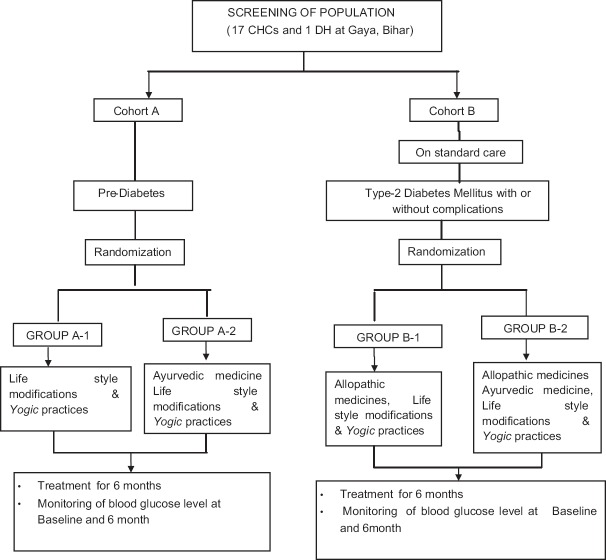
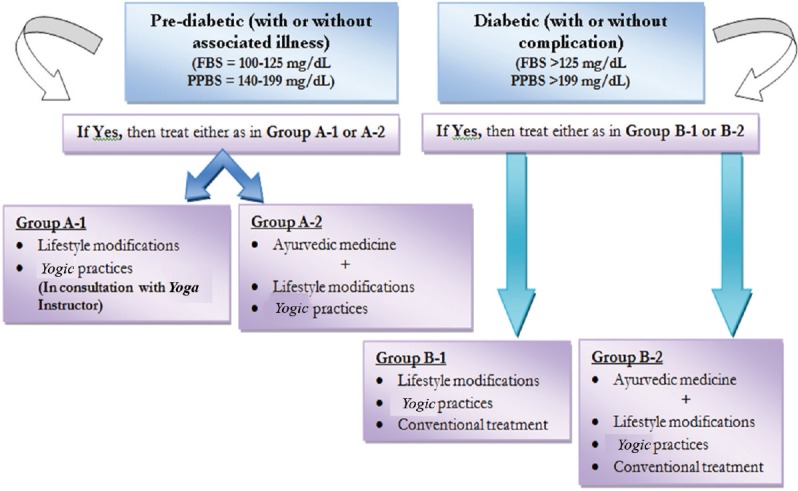
A multi-centric, open-labeled, prospective, comparative clinical study was conducted at 17 community health centers and 1 district hospital. Population over 30 years of age was screened and prediabetic or type 2 diabetic individuals were enrolled in two cohorts, i.e., pre-diabetic (Cohort A) and type 2 diabetic (Cohort B). Each cohort was further divided into two groups: Group A1 was advised for lifestyle modification and and group A2 was given Ayurveda medication in addition to lifestyle modification and . Similarly, group B1 was advised for lifestyle modification and Yoga along with allopathic medication and group B2 was given Ayurveda medication, i.e., , and powder in addition to lifestyle modification and along with allopathic medication. Treatment was given for 6 months. Data were analyzed through paired -test.
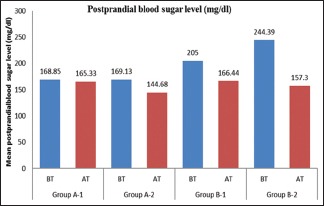
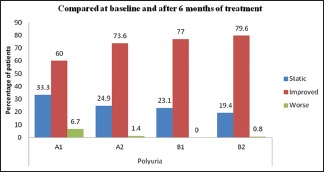
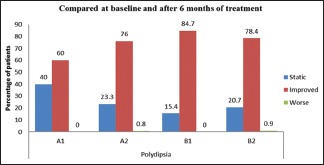
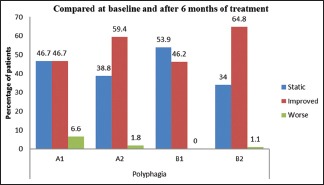
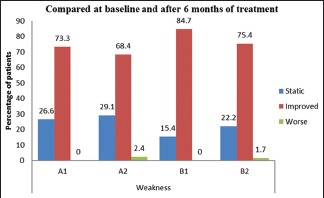
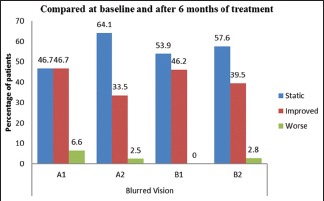
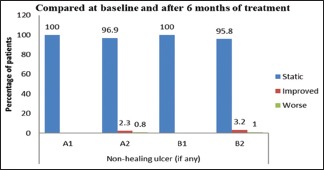
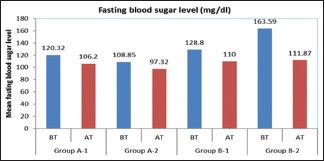
A significant reduction was observed in fasting blood sugar level in groups A2 and B2 ( = 0.001) and also in the postprandial blood sugar level in Groups A2 and B2 ( = 0.001). Further, improvement in subjective symptoms such as polyuria, polydipsia, polyphagia, blurred vision and weakness was found in all the groups, while non-healing ulcer does not show any improvement.
The study reveals that Ayurveda intervention, i.e., (1 g), (3 g) and (3 g) two times a day effectively controls blood sugar level in pre-diabetic and type 2 diabetic patients and improves the disease management with lifestyle modification and as well as with allopathic treatment.
2型糖尿病是一种与生活方式相关的疾病,在印度约有4.22亿人受其影响。阿育吠陀(印度草医学)与国家癌症、糖尿病、心血管疾病及中风预防与控制计划(NPCDCS)的整合在比哈尔邦加亚进行了试点,旨在为非传染性疾病患者提供综合治疗,并应对印度非传染性疾病的负担。
本研究的目的是分析在NPCDCS - 阿育吠陀整合项目下,阿育吠陀干预、生活方式改变对2型糖尿病管理的影响。
在17个社区卫生中心和1家区级医院开展了一项多中心、开放标签、前瞻性、对比临床研究。对30岁以上人群进行筛查,将糖尿病前期或2型糖尿病个体纳入两个队列,即糖尿病前期(队列A)和2型糖尿病(队列B)。每个队列再进一步分为两组:A1组接受生活方式改变和瑜伽建议,A2组除生活方式改变和瑜伽外还给予阿育吠陀药物。同样,B1组接受生活方式改变和瑜伽建议并同时使用西药,B2组除生活方式改变和瑜伽外还给予阿育吠陀药物,即每天两次服用印度楝树叶(1克)、胡芦巴(3克)和苦瓜(3克)粉末,并同时使用西药。治疗为期6个月。通过配对t检验分析数据。
A2组和B2组空腹血糖水平显著降低(P = 0.001),A2组和B2组餐后血糖水平也显著降低(P = 0.001)。此外,所有组中多尿、多饮、多食、视力模糊和虚弱等主观症状均有改善,而不愈合溃疡无改善。
该研究表明,阿育吠陀干预,即每天两次服用印度楝树叶(1克)、胡芦巴(3克)和苦瓜(3克),可有效控制糖尿病前期和2型糖尿病患者的血糖水平,并通过生活方式改变、瑜伽以及西药治疗改善疾病管理。