Jones Mackenzie T, Deckler Elizabeth, Laurrari Carlos, Jarskog L Fredrik, Penn David L, Pinkham Amy E, Harvey Philip D
Department of Psychiatry and Behavioral Sciences, University of Miami Miller School of Medicine, Miami, FL, United States of America.
Department of Psychiatry, University of North Carolina, Chapel Hill, NC, United States of America.
Schizophr Res Cogn. 2019 Feb 8;19:002-2. doi: 10.1016/j.scog.2019.01.002. eCollection 2020 Mar.
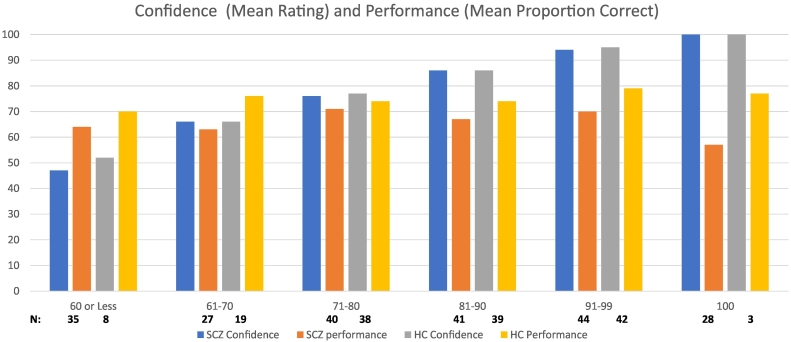
Impairments in self-assessment in schizophrenia have been shown to have functional and clinical implications. Prior studies have suggested that overconfidence can be associated with poorer cognitive performance in people with schizophrenia, and that reduced awareness of performance may be associated with disability. However, overconfidence is common in healthy individuals as well. This study examines the correlations between performance on a social cognitive test, confidence in performance, effort allocated to the task, and correlates of confidence in patients with schizophrenia and healthy controls (HC). Measures included self-reports of depression, social cognitive ability, and social functioning. A performance-based emotion recognition test assessed social cognitive performance and provided the basis for confidence judgments. Although schizophrenia patients had reduced levels of overall confidence, there was a substantial subset of schizophrenic patients who manifested extreme overconfidence and these people had the poorest performance and reported the least depression. Further, a substantial number of HC over-estimated their performance as well. Patients with schizophrenia, in contrast to HC, did not adjust their effort to match task difficulty. Confidence was minimally related to task performance in patients but was associated with more rapid decisions in HC, across both correct and incorrect responses. Performance on social cognitive measures was minimally related to self-reports of social functioning in both samples. These data suggest global self-assessments are based on multiple factors, with confidence affecting self-assessments in the absence of feedback about performance.
精神分裂症患者自我评估受损已被证明具有功能和临床意义。先前的研究表明,过度自信可能与精神分裂症患者较差的认知表现有关,而对表现的意识降低可能与残疾有关。然而,过度自信在健康个体中也很常见。本研究考察了社会认知测试表现、对表现的信心、分配给任务的努力以及精神分裂症患者和健康对照(HC)中信心的相关因素之间的相关性。测量包括抑郁、社会认知能力和社会功能的自我报告。一项基于表现的情绪识别测试评估了社会认知表现,并为信心判断提供了基础。尽管精神分裂症患者的总体信心水平较低,但有相当一部分精神分裂症患者表现出极度过度自信,这些人的表现最差,且报告的抑郁程度最低。此外,相当数量的健康对照也高估了自己的表现。与健康对照相比,精神分裂症患者没有根据任务难度调整他们的努力程度。在患者中,信心与任务表现的相关性最小,但在健康对照中,无论正确还是错误反应,信心都与更快的决策相关。在两个样本中,社会认知测量的表现与社会功能的自我报告相关性最小。这些数据表明,整体自我评估基于多个因素,在缺乏关于表现的反馈时,信心会影响自我评估。