• 文献检索
  • 文档翻译
  • 深度研究
  • 学术资讯
  • Suppr Zotero 插件Zotero 插件
  • 邀请有礼
  • 套餐&价格
  • 历史记录
应用&插件
Suppr Zotero 插件Zotero 插件浏览器插件Mac 客户端Windows 客户端微信小程序
定价
高级版会员购买积分包购买API积分包
服务
文献检索文档翻译深度研究API 文档MCP 服务
关于我们
关于 Suppr公司介绍联系我们用户协议隐私条款
关注我们

Suppr 超能文献

核心技术专利:CN118964589B侵权必究
粤ICP备2023148730 号-1Suppr @ 2026

文献检索

告别复杂PubMed语法,用中文像聊天一样搜索,搜遍4000万医学文献。AI智能推荐,让科研检索更轻松。

立即免费搜索

文件翻译

保留排版,准确专业,支持PDF/Word/PPT等文件格式,支持 12+语言互译。

免费翻译文档

深度研究

AI帮你快速写综述,25分钟生成高质量综述,智能提取关键信息,辅助科研写作。

立即免费体验

哮喘儿童上呼吸道微生物群与哮喘控制丢失的关系。

The upper-airway microbiota and loss of asthma control among asthmatic children.

机构信息

Department of Medicine, University of Connecticut, Farmington, CT, USA.

The Jackson Laboratory for Genomic Medicine, Farmington, CT, 06032, USA.

出版信息

Nat Commun. 2019 Dec 16;10(1):5714. doi: 10.1038/s41467-019-13698-x.

DOI:10.1038/s41467-019-13698-x
PMID:31844063
原文链接:https://pmc.ncbi.nlm.nih.gov/articles/PMC6915697/
Abstract

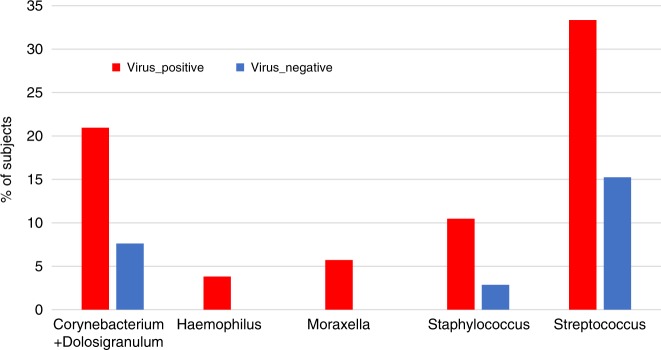
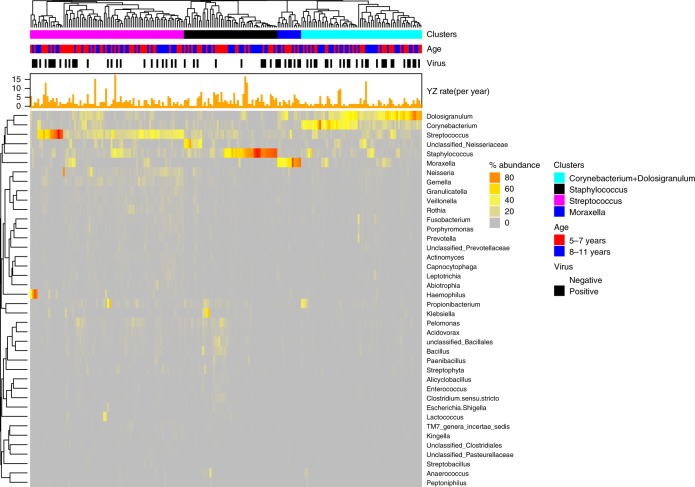
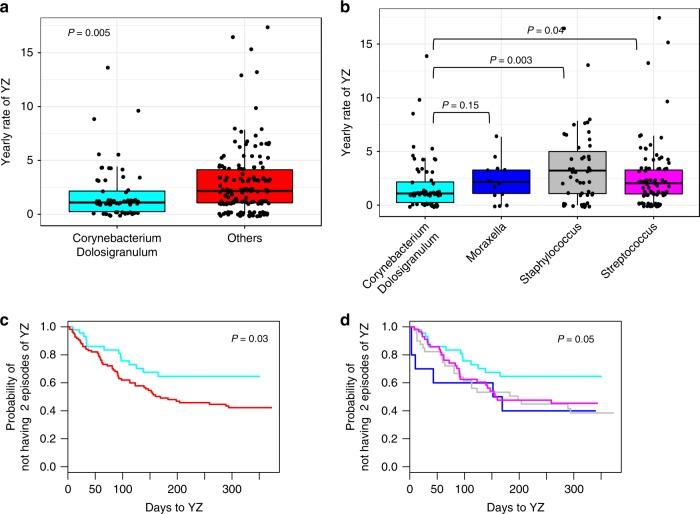
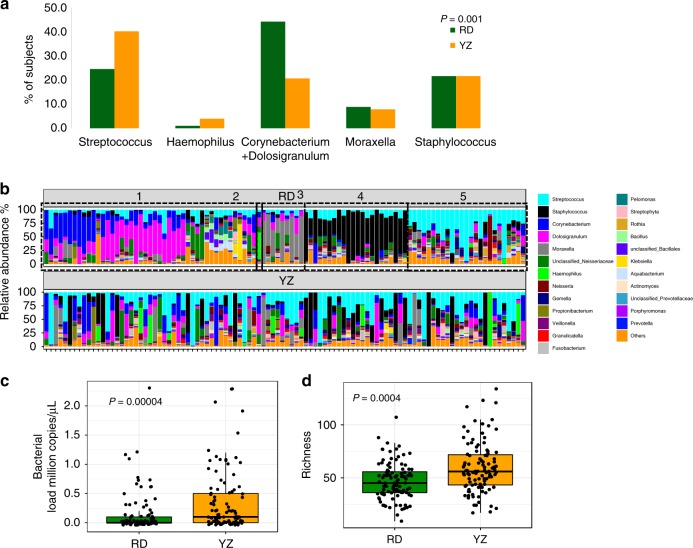
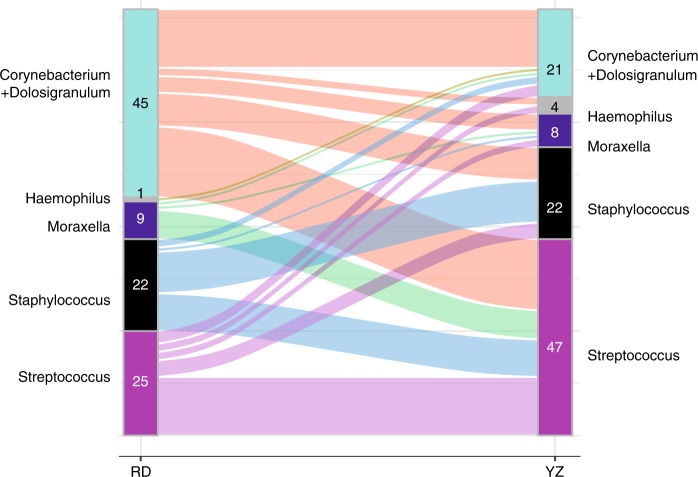
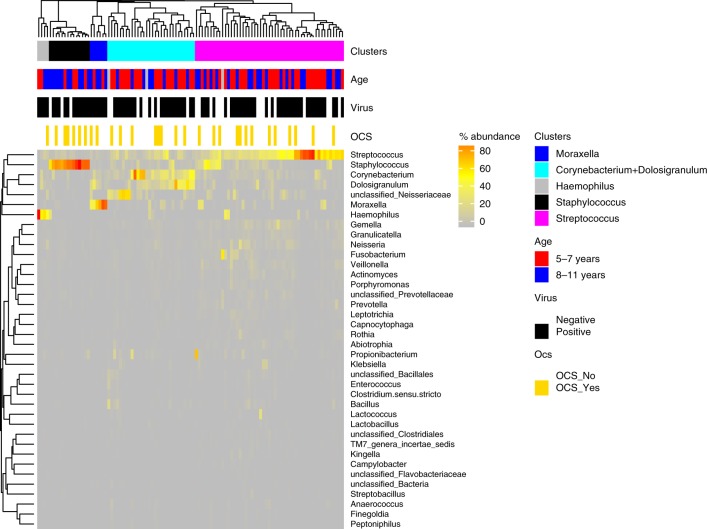
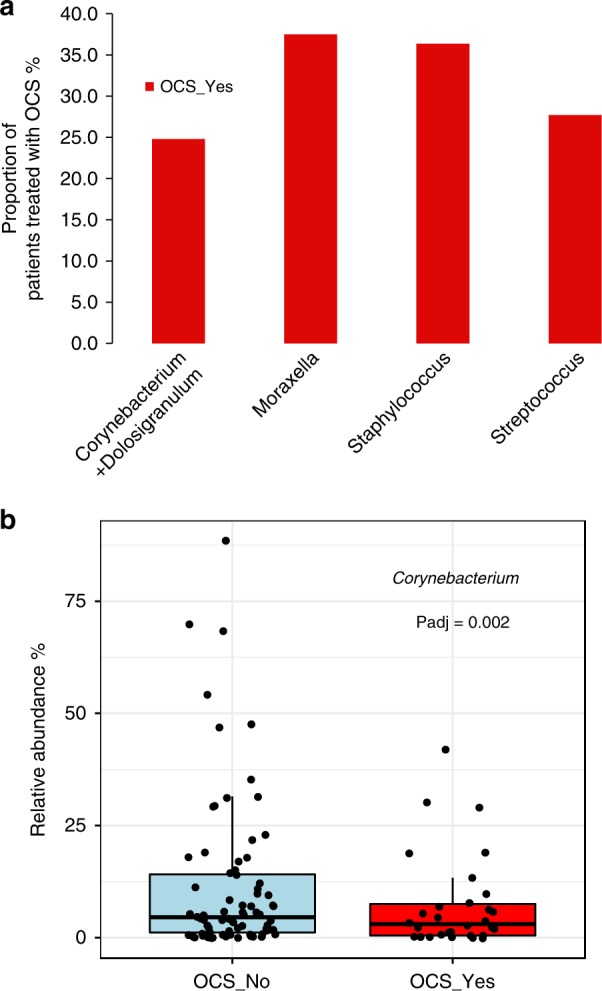
The airway microbiome has an important role in asthma pathophysiology. However, little is known on the relationships between the airway microbiome of asthmatic children, loss of asthma control, and severe exacerbations. Here we report that the microbiota's dynamic patterns and compositions are related to asthma exacerbations. We collected nasal blow samples (n = 319) longitudinally during a clinical trial at 2 time-points within one year: randomization when asthma is under control, and at time of early loss of asthma control (yellow zone (YZ)). We report that participants whose microbiota was dominated by the commensal Corynebacterium + Dolosigranulum cluster at RD experience the lowest rates of YZs (p = 0.005) and have longer time to develop at least 2 episodes of YZ (p = 0.03). The airway microbiota have changed from randomization to YZ. A switch from the Corynebacterium + Dolosigranulum cluster at randomization to the Moraxella- cluster at YZ poses the highest risk of severe asthma exacerbation (p = 0.04). Corynebacterium's relative abundance at YZ is inversely associated with severe exacerbation (p = 0.002).

摘要

气道微生物组在哮喘发病机制中具有重要作用。然而,对于哮喘儿童的气道微生物组、哮喘控制丧失和严重恶化之间的关系,人们知之甚少。在这里,我们报告说,微生物组的动态模式和组成与哮喘恶化有关。我们在一年内的 2 个时间点收集了鼻吹气样本(n=319):在哮喘得到控制时进行随机分组,以及在哮喘控制早期丧失时(黄色区域(YZ))。我们报告说,在 RD 时,其微生物组被共生棒状杆菌+小球菌簇主导的参与者经历 YZ 的最低率(p=0.005),并且发展至少 2 次 YZ 的时间更长(p=0.03)。气道微生物群从随机分组到 YZ 已经发生了变化。从随机分组时的棒状杆菌+小球菌簇到 YZ 时的莫拉氏菌簇的转变,是严重哮喘恶化的最高风险(p=0.04)。YZ 时棒状杆菌的相对丰度与严重恶化呈负相关(p=0.002)。
https://cdn.ncbi.nlm.nih.gov/pmc/blobs/b525/6915697/8905462269df/41467_2019_13698_Fig8_HTML.jpg
https://cdn.ncbi.nlm.nih.gov/pmc/blobs/b525/6915697/20d97672c1bb/41467_2019_13698_Fig1_HTML.jpg
https://cdn.ncbi.nlm.nih.gov/pmc/blobs/b525/6915697/6e1078179294/41467_2019_13698_Fig2_HTML.jpg
https://cdn.ncbi.nlm.nih.gov/pmc/blobs/b525/6915697/2afb503608ac/41467_2019_13698_Fig3_HTML.jpg
https://cdn.ncbi.nlm.nih.gov/pmc/blobs/b525/6915697/9bbda1f51eaa/41467_2019_13698_Fig4_HTML.jpg
https://cdn.ncbi.nlm.nih.gov/pmc/blobs/b525/6915697/64fd6b874c37/41467_2019_13698_Fig5_HTML.jpg
https://cdn.ncbi.nlm.nih.gov/pmc/blobs/b525/6915697/5f0e1da67b04/41467_2019_13698_Fig6_HTML.jpg
https://cdn.ncbi.nlm.nih.gov/pmc/blobs/b525/6915697/f0ce3bd0962c/41467_2019_13698_Fig7_HTML.jpg
https://cdn.ncbi.nlm.nih.gov/pmc/blobs/b525/6915697/8905462269df/41467_2019_13698_Fig8_HTML.jpg
https://cdn.ncbi.nlm.nih.gov/pmc/blobs/b525/6915697/20d97672c1bb/41467_2019_13698_Fig1_HTML.jpg
https://cdn.ncbi.nlm.nih.gov/pmc/blobs/b525/6915697/6e1078179294/41467_2019_13698_Fig2_HTML.jpg
https://cdn.ncbi.nlm.nih.gov/pmc/blobs/b525/6915697/2afb503608ac/41467_2019_13698_Fig3_HTML.jpg
https://cdn.ncbi.nlm.nih.gov/pmc/blobs/b525/6915697/9bbda1f51eaa/41467_2019_13698_Fig4_HTML.jpg
https://cdn.ncbi.nlm.nih.gov/pmc/blobs/b525/6915697/64fd6b874c37/41467_2019_13698_Fig5_HTML.jpg
https://cdn.ncbi.nlm.nih.gov/pmc/blobs/b525/6915697/5f0e1da67b04/41467_2019_13698_Fig6_HTML.jpg
https://cdn.ncbi.nlm.nih.gov/pmc/blobs/b525/6915697/f0ce3bd0962c/41467_2019_13698_Fig7_HTML.jpg
https://cdn.ncbi.nlm.nih.gov/pmc/blobs/b525/6915697/8905462269df/41467_2019_13698_Fig8_HTML.jpg

相似文献

1
The upper-airway microbiota and loss of asthma control among asthmatic children.哮喘儿童上呼吸道微生物群与哮喘控制丢失的关系。
Nat Commun. 2019 Dec 16;10(1):5714. doi: 10.1038/s41467-019-13698-x.
2
Distinct nasal airway bacterial microbiotas differentially relate to exacerbation in pediatric patients with asthma.儿童哮喘患者的鼻腔气道细菌微生物群与加重的关系存在差异。
J Allergy Clin Immunol. 2019 Nov;144(5):1187-1197. doi: 10.1016/j.jaci.2019.05.035. Epub 2019 Jun 13.
3
The Fungal Microbiome of the Upper Airway Is Associated With Future Loss of Asthma Control and Exacerbation Among Children With Asthma.上呼吸道真菌微生物组与哮喘儿童未来哮喘控制的丧失和加重有关。
Chest. 2023 Aug;164(2):302-313. doi: 10.1016/j.chest.2023.03.034. Epub 2023 Mar 30.
4
Temporal Dynamics of the Nasopharyngeal Microbiome and its Relationship with Childhood Asthma Exacerbation.鼻咽微生物组的时间动态及其与儿童哮喘恶化的关系。
Microbiol Spectr. 2022 Jun 29;10(3):e0012922. doi: 10.1128/spectrum.00129-22. Epub 2022 May 12.
5
Pediatric asthma comprises different phenotypic clusters with unique nasal microbiotas.儿童哮喘包含具有独特鼻腔微生物群的不同表型簇。
Microbiome. 2018 Oct 4;6(1):179. doi: 10.1186/s40168-018-0564-7.
6
Nasopharyngeal microbiota in children is associated with severe asthma exacerbations.儿童鼻咽微生物群与严重哮喘加重有关。
J Allergy Clin Immunol. 2024 Jun;153(6):1574-1585.e14. doi: 10.1016/j.jaci.2024.02.020. Epub 2024 Mar 10.
7
Early nasal microbiota and acute respiratory infections during the first years of life.生命最初几年的鼻腔微生物群与急性呼吸道感染。
Thorax. 2019 Jun;74(6):592-599. doi: 10.1136/thoraxjnl-2018-212629. Epub 2019 May 10.
8
Seasonal airway microbiome and transcriptome interactions promote childhood asthma exacerbations.季节性气道微生物组和转录组的相互作用促进儿童哮喘恶化。
J Allergy Clin Immunol. 2022 Jul;150(1):204-213. doi: 10.1016/j.jaci.2022.01.020. Epub 2022 Feb 8.
9
Longitudinal Changes in Early Nasal Microbiota and the Risk of Childhood Asthma.早期鼻腔微生物组的纵向变化与儿童哮喘的风险。
Pediatrics. 2020 Oct;146(4). doi: 10.1542/peds.2020-0421. Epub 2020 Sep 15.
10
Different functional genes of upper airway microbiome associated with natural course of childhood asthma.上呼吸道微生物组的不同功能基因与儿童哮喘的自然病程相关。
Allergy. 2018 Mar;73(3):644-652. doi: 10.1111/all.13331. Epub 2017 Nov 20.

引用本文的文献

1
Multi-Omics Reveals Aberrant Phenotypes of Respiratory Microbiome and Phospholipidomics Associated with Asthma-Related Inflammation.多组学揭示与哮喘相关炎症相关的呼吸道微生物组和磷脂组学的异常表型。
Microorganisms. 2025 Jul 28;13(8):1761. doi: 10.3390/microorganisms13081761.
2
Integrative systems biology approaches for analyzing microbiome dysbiosis and species interactions.用于分析微生物群落失调和物种相互作用的整合系统生物学方法。
Brief Bioinform. 2025 Jul 2;26(4). doi: 10.1093/bib/bbaf323.
3
Relationship between pediatric asthma and respiratory microbiota, intestinal microbiota: a narrative review.

本文引用的文献

1
Distinct nasal airway bacterial microbiotas differentially relate to exacerbation in pediatric patients with asthma.儿童哮喘患者的鼻腔气道细菌微生物群与加重的关系存在差异。
J Allergy Clin Immunol. 2019 Nov;144(5):1187-1197. doi: 10.1016/j.jaci.2019.05.035. Epub 2019 Jun 13.
2
Airway Microbiota Dynamics Uncover a Critical Window for Interplay of Pathogenic Bacteria and Allergy in Childhood Respiratory Disease.气道微生物组动态揭示了儿童呼吸道疾病中致病菌和过敏相互作用的关键窗口。
Cell Host Microbe. 2018 Sep 12;24(3):341-352.e5. doi: 10.1016/j.chom.2018.08.005.
3
Bacterial biogeography of adult airways in atopic asthma.
儿童哮喘与呼吸道微生物群、肠道微生物群的关系:一篇叙述性综述。
Front Microbiol. 2025 May 9;16:1550783. doi: 10.3389/fmicb.2025.1550783. eCollection 2025.
4
Investigation of dynamic microbial migration patterns in the respiratory tract.呼吸道中动态微生物迁移模式的研究
Front Cell Infect Microbiol. 2025 Apr 22;15:1542562. doi: 10.3389/fcimb.2025.1542562. eCollection 2025.
5
Post-viral lung diseases: the microbiota as a key player.病毒感染后肺部疾病:微生物群作为关键因素
ERJ Open Res. 2025 Apr 7;11(2). doi: 10.1183/23120541.00560-2024. eCollection 2025 Mar.
6
Oral microbiota related to allergy in Norwegian adults.挪威成年人中与过敏相关的口腔微生物群。
J Allergy Clin Immunol Glob. 2025 Feb 5;4(2):100435. doi: 10.1016/j.jacig.2025.100435. eCollection 2025 May.
7
The Microbiome in Asthma Heterogeneity: The Role of Multi-Omic Investigations.哮喘异质性中的微生物组:多组学研究的作用。
Immunol Rev. 2025 Mar;330(1):e70015. doi: 10.1111/imr.70015.
8
Microbial influencers: the airway microbiome's role in asthma.微生物影响因素:气道微生物群在哮喘中的作用
J Clin Invest. 2025 Feb 17;135(4):e184316. doi: 10.1172/JCI184316.
9
Computational and in vitro evaluation of probiotic treatments for nasal decolonization.用于鼻腔去定植的益生菌治疗的计算和体外评估。
Proc Natl Acad Sci U S A. 2025 Feb 18;122(7):e2412742122. doi: 10.1073/pnas.2412742122. Epub 2025 Feb 11.
10
Respiratory Flora Intervention: A New Strategy for the Prevention and Treatment of Occupationally Related Respiratory Allergy in Healthcare Workers.呼吸道菌群干预:医护人员职业性相关呼吸道过敏防治的新策略
Microorganisms. 2024 Dec 20;12(12):2653. doi: 10.3390/microorganisms12122653.
特应性哮喘成人气道中的细菌生物地理学。
Microbiome. 2018 Jun 9;6(1):104. doi: 10.1186/s40168-018-0487-3.
4
The nasal microbiome in asthma.哮喘患者的鼻腔微生物组。
J Allergy Clin Immunol. 2018 Sep;142(3):834-843.e2. doi: 10.1016/j.jaci.2018.02.020. Epub 2018 Mar 5.
5
Quintupling Inhaled Glucocorticoids to Prevent Childhood Asthma Exacerbations.将吸入性糖皮质激素剂量增加至五倍以预防儿童哮喘发作
N Engl J Med. 2018 Mar 8;378(10):891-901. doi: 10.1056/NEJMoa1710988. Epub 2018 Mar 3.
6
Nasopharyngeal Lactobacillus is associated with a reduced risk of childhood wheezing illnesses following acute respiratory syncytial virus infection in infancy.鼻咽乳酸杆菌与婴儿期急性呼吸道合胞病毒感染后儿童喘息性疾病风险降低有关。
J Allergy Clin Immunol. 2018 Nov;142(5):1447-1456.e9. doi: 10.1016/j.jaci.2017.10.049. Epub 2018 Jan 10.
7
Quantitative microbiome profiling links gut community variation to microbial load.定量微生物组谱分析将肠道群落变化与微生物负荷联系起来。
Nature. 2017 Nov 23;551(7681):507-511. doi: 10.1038/nature24460. Epub 2017 Nov 15.
8
Community characteristics of the gut microbiomes of competitive cyclists.竞技自行车运动员肠道微生物组的群落特征。
Microbiome. 2017 Aug 10;5(1):98. doi: 10.1186/s40168-017-0320-4.
9
Maturation of the Infant Respiratory Microbiota, Environmental Drivers, and Health Consequences. A Prospective Cohort Study.婴儿呼吸微生物组的成熟、环境驱动因素和健康后果。一项前瞻性队列研究。
Am J Respir Crit Care Med. 2017 Dec 15;196(12):1582-1590. doi: 10.1164/rccm.201703-0554OC.
10
Airway microbial dysbiosis in asthmatic patients: A target for prevention and treatment?哮喘患者的气道微生物失调:预防和治疗的新靶点?
J Allergy Clin Immunol. 2017 Apr;139(4):1071-1081. doi: 10.1016/j.jaci.2017.02.004.