Department of Computer Science and Engineering, The Ohio State University, 2015 Neil Ave, Columbus, 43210, Ohio, USA.
Department of Biomedical Informatics, The Ohio State University, 1800 Cannon Drive, Columbus, 43210, Ohio, USA.
BMC Med Inform Decis Mak. 2019 Dec 18;19(1):279. doi: 10.1186/s12911-019-0999-1.
Adverse drug reaction (ADR) is a major burden for patients and healthcare industry. Early and accurate detection of potential ADRs can help to improve drug safety and reduce financial costs. Post-market spontaneous reports of ADRs remain a cornerstone of pharmacovigilance and a series of drug safety signal detection methods play an important role in providing drug safety insights. However, existing methods require sufficient case reports to generate signals, limiting their usages for newly approved drugs with few (or even no) reports.
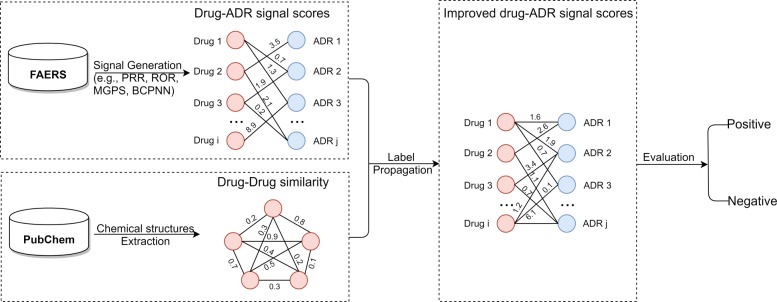
In this study, we propose a label propagation framework to enhance drug safety signals by combining drug chemical structures with FDA Adverse Event Reporting System (FAERS). First, we compute original drug safety signals via common signal detection algorithms. Then, we construct a drug similarity network based on chemical structures. Finally, we generate enhanced drug safety signals by propagating original signals on the drug similarity network. Our proposed framework enriches post-market safety reports with pre-clinical drug similarity network, effectively alleviating issues of insufficient cases for newly approved drugs.
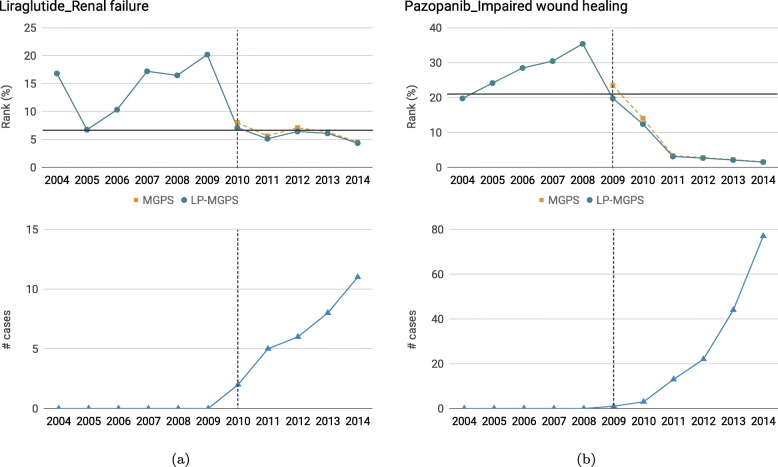
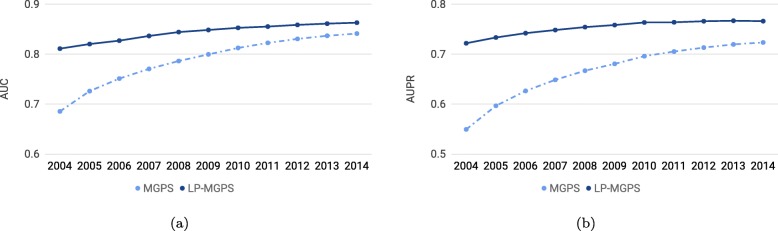
We apply the label propagation framework to four popular signal detection algorithms (PRR, ROR, MGPS, BCPNN) and find that our proposed framework generates more accurate drug safety signals than the corresponding baselines. In addition, our framework identifies potential ADRs for newly approved drugs, thus paving the way for early detection of ADRs.
The proposed label propagation framework combines pre-clinical drug structures with post-market safety reports, generates enhanced drug safety signals, and can potentially help to accurately detect ADRs ahead of time.
The source code for this paper is available at: https://github.com/ruoqi-liu/LP-SDA.
药物不良反应(ADR)是患者和医疗保健行业的主要负担。早期准确地发现潜在的 ADR 有助于提高药物安全性并降低财务成本。上市后自发报告的 ADR 仍然是药物警戒的基石,一系列药物安全信号检测方法在提供药物安全见解方面发挥着重要作用。然而,现有的方法需要足够的病例报告来产生信号,这限制了它们在新批准的药物中使用,这些药物的报告很少(甚至没有)。
在这项研究中,我们提出了一种标签传播框架,通过将药物化学结构与 FDA 不良事件报告系统(FAERS)相结合,来增强药物安全性信号。首先,我们通过常见的信号检测算法计算原始药物安全性信号。然后,我们基于化学结构构建药物相似性网络。最后,我们通过在药物相似性网络上传播原始信号来生成增强的药物安全性信号。我们的框架通过将临床前药物相似性网络与上市后安全性报告相结合,丰富了后市场安全性报告,有效地缓解了新批准药物病例不足的问题。
我们将标签传播框架应用于四种流行的信号检测算法(PRR、ROR、MGPS、BCPNN),发现我们提出的框架比相应的基线产生更准确的药物安全性信号。此外,我们的框架还确定了新批准药物的潜在 ADR,从而为早期发现 ADR 铺平了道路。
所提出的标签传播框架将临床前药物结构与上市后安全性报告相结合,生成增强的药物安全性信号,有可能帮助提前准确地检测 ADR。
本文的源代码可在 https://github.com/ruoqi-liu/LP-SDA 上获得。