Department of Internal Medicine, Asan Medical Center, University of Ulsan College of Medicine, Seoul, Republic of Korea.
PyeongChang Health Center and County Hospital, PyeongChang, Gangwon-Do, Republic of Korea.
J Cachexia Sarcopenia Muscle. 2020 Apr;11(2):497-504. doi: 10.1002/jcsm.12507. Epub 2019 Dec 21.
We aimed to assess the clinical characteristics of sarcopenia by the original and revised European Working Group on Sarcopenia in Older People (EWGSOP 1 and 2), and to propose a new sarcopenia phenotype score (SPS) to improve relevance of clinical outcomes.
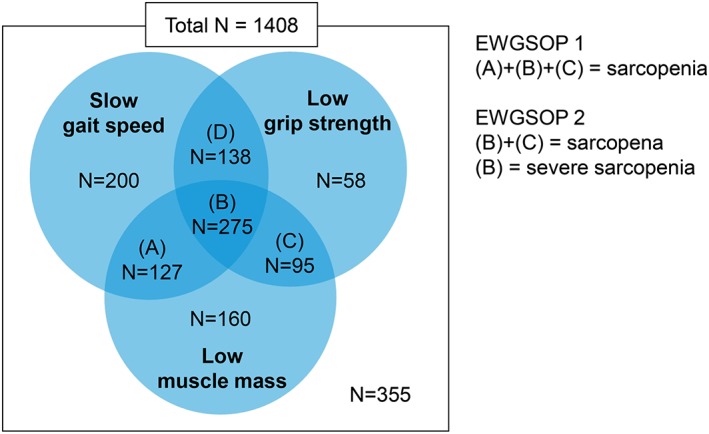
Analyses were performed in 1408 older adults of the Aging Study of PyeongChang Rural Area, a community-based cohort in Korea. For sarcopenia definitions, we used EWGSOP 1, EWGSOP 2, and SPS, a new index counting number of abnormal domains among components of grip strength, gait speed, or muscle mass. Frailty status by the frailty index and the Cardiovascular Health Study frailty score was compared with sarcopenia measures. Prediction ability for composite outcome combining death and institutionalization due to functional decline was assessed among sarcopenia measures.
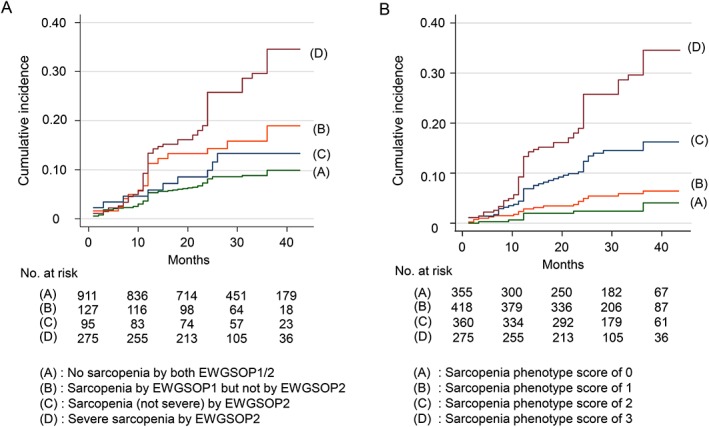
Generally, sarcopenia spectrum by both EWGSOP 1 and 2 was associated with worse functional status in parameters of geriatric assessments. However, population who were considered as sarcopenic by EWGSOP 1, but not by EWGSOP 2, showed increased risk of composite outcome and worse frailty status, compared with people who were classified as not sarcopenic by both EWGSOP 1 and 2. With SPS, dose-response relationship was observed with both frailty status and outcome prediction. Prediction for composite outcome was better in SPS than in EWGSOP 2 classification.
A new SPS might be used to classify sarcopenic burden in older adults to resolve possible inconsistencies in phenotype correlation and outcome prediction of EWGSOP 2 criteria.
我们旨在通过欧洲老年人肌少症工作组(EWGSOP1 和 2)的原始和修订版本评估肌少症的临床特征,并提出一种新的肌少症表型评分(SPS),以提高临床结局的相关性。
在韩国一个社区为基础的平昌农村地区老龄化研究的 1408 名老年人中进行了分析。对于肌少症定义,我们使用了 EWGSOP1、EWGSOP2 和 SPS,这是一个新的指数,用于计数握力、步态速度或肌肉质量等组成部分中异常域的数量。通过虚弱指数和心血管健康研究虚弱评分比较了虚弱状态与肌少症测量值。评估了肌少症测量值对因功能下降而死亡和因机构化导致的复合结局的预测能力。
一般来说,EWGSOP1 和 2 定义的肌少症谱与老年评估中更差的功能状态相关。然而,与 EWGSOP1 但不符合 EWGSOP2 的人相比,被认为是肌少症的人群,与 EWGSOP1 和 2 都没有被认为是肌少症的人群相比,复合结局的风险增加,且虚弱状态更差。与 EWGSOP2 分类相比,SPS 与虚弱状态和结局预测均存在剂量反应关系。SPS 对复合结局的预测优于 EWGSOP2 分类。
新的 SPS 可用于分类老年人的肌少症负担,以解决 EWGSOP2 标准在表型相关性和结局预测方面可能存在的不一致性。