Ga Hyuk, Won Chang Won, Jung Hee-Won
Institute of Geriatric Medicine, Incheon Eun-Hye Hospital, Incheon, Korea.
Elderly Frailty Research Center, Department of Family Medicine, College of Medicine, Kyung Hee University, Seoul, Korea.
Ann Geriatr Med Res. 2018 Mar;22(1):20-25. doi: 10.4235/agmr.2018.22.1.20. Epub 2018 Mar 31.
Numerous elderly individuals with multimorbidity and impaired function are admitted in long-term care hospitals (LTCHs) in Korea. In this study, we aimed to describe the frailty status of elderly patients admitted in a LTCH using the FRAIL-NH scale and to identify the clinical relevance of frailty status on clinical outcomes, including death.
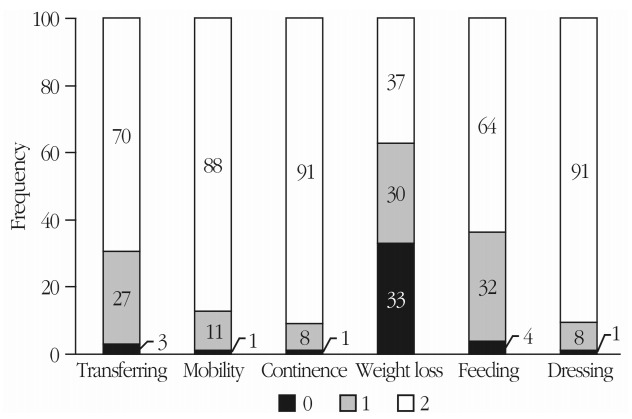
We retrospectively reviewed the medical records of 100 elderly patients who were hospitalized and died in an LTCH from March 2011 to February 2017. The monthly assessment results obtained from the inpatients' data set (IDS) were used as main data sources for the 6-item FRAIL-NH scale and frailty index that was composed of 22 newly established items.
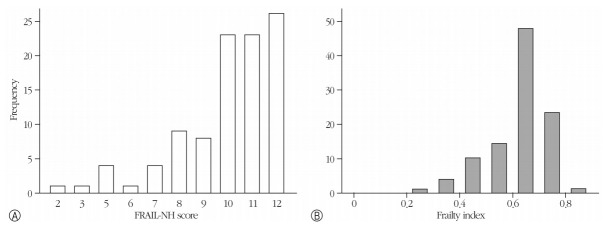
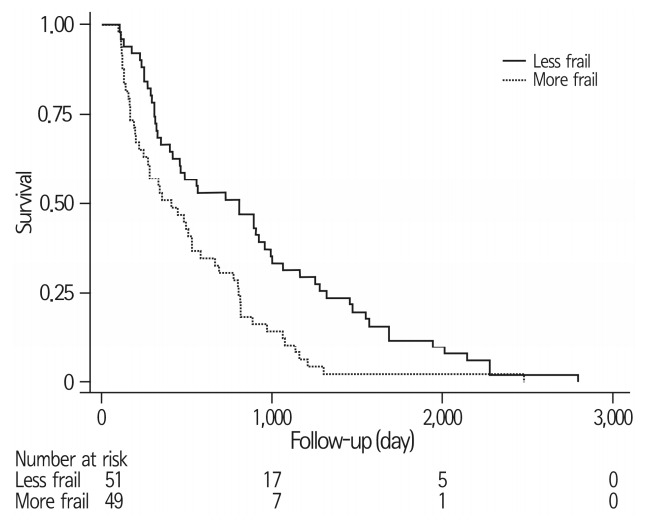
The mean frailty index of the patients included in the analysis (mean age, 81.5±7.2 years; men, 53%) was 0.60 (standard deviation [SD], 0.10; range, 0.28-0.80). The distribution of the FRAIL-NH score in this population was in accordance with the 22-item frailty index, which shows a standardized beta of 0.571 (p<0.001, R=0.572). When the patients were categorized based on the FRAIL-NH score, the mean survival durations of the more fail group (FRAIL-NH >10, n=49) and less frail group (FRAIL-NH ≤10, n=51) were 529.3 days (SD, 453.4) and 888 days (SD, 679.9), respectively. Similarly, the frailty index was associated with earlier mortality.
Frailty is extremely common in elderly patients admitted in an LTCH and can be easily measured using the FRAIL-NH scale that utilizes the IDS of LTCHs in Korea. Since frailty is associated with earlier mortality, the assessment of frailty status in patients admitted in LTCHs may be helpful in clinical decision-making.
韩国众多患有多种疾病且功能受损的老年人入住长期护理医院(LTCHs)。在本研究中,我们旨在使用FRAIL-NH量表描述入住LTCH的老年患者的衰弱状况,并确定衰弱状况与包括死亡在内的临床结局的临床相关性。
我们回顾性分析了2011年3月至2017年2月在一家LTCH住院并死亡的100例老年患者的病历。从住院患者数据集(IDS)获得的月度评估结果用作6项FRAIL-NH量表和由22个新设立项目组成的衰弱指数的主要数据源。
纳入分析的患者(平均年龄81.5±7.2岁;男性占53%)的平均衰弱指数为0.60(标准差[SD]为0.10;范围为0.28 - 0.80)。该人群中FRAIL-NH评分的分布与22项衰弱指数一致,标准化β为0.571(p<0.001,R = 0.572)。当根据FRAIL-NH评分对患者进行分类时,衰弱程度较高组(FRAIL-NH>10,n = 49)和衰弱程度较低组(FRAIL-NH≤10,n = 51)的平均生存时间分别为529.3天(SD,453.4)和888天(SD,679.9)。同样,衰弱指数与更早的死亡率相关。
衰弱在入住LTCH的老年患者中极为常见,并且可以使用利用韩国LTCHs的IDS的FRAIL-NH量表轻松测量。由于衰弱与更早的死亡率相关,对入住LTCH的患者进行衰弱状况评估可能有助于临床决策。