School of Economics and Management and Institute of Management Science and Engineering, China University of Geosciences, Wuhan 430000, China.
Business School, Central South University, Changsha 410000, China.
Int J Environ Res Public Health. 2019 Dec 27;17(1):221. doi: 10.3390/ijerph17010221.
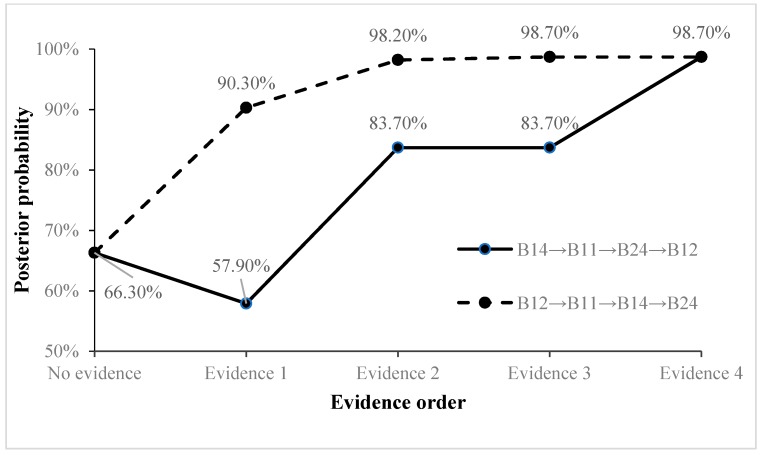
Unsafe behavior is a critical factor leading to construction accidents. Despite numerous studies supporting this viewpoint, the process by which accidents are influenced by construction workers' unsafe behaviors and the extent to which unsafe behaviors are involved in this process remain poorly discussed. Therefore, this paper selects cases from Chinese building construction accidents to explore the probabilistic transmission paths from unsafe behaviors to accidents using a Bayesian network. First, a list of unsafe behaviors is constructed based on safety standards and operating procedures. Second, several chains of unsafe behaviors are extracted from 287 accident cases within four types (fall, collapse, struck-by and lifting) to form a Bayesian network model. Finally, two accidents are specifically analyzed to verify the rationality of the proposed model through forward reasoning. Additionally, critical groups of unsafe behaviors leading to the four types of accidents are identified through backward reasoning. The results show the following: (i) The time sequence of unsafe behaviors in a chain does not affect the final posterior probability of an accident, but the accident attribute strength of an unsafe behavior, affects the growth rate of the posterior probability of an accident. (ii) The four critical groups of unsafe behaviors leading to fall, collapse, struck-by, and lifting are identified. This study is of theoretical and practical significance for on-site behavioral management and accident prevention.
不安全行为是导致建筑事故的关键因素。尽管有大量研究支持这一观点,但事故受建筑工人不安全行为影响的过程以及不安全行为在这一过程中的参与程度仍未得到充分讨论。因此,本文选择了中国建筑施工事故案例,使用贝叶斯网络探索不安全行为向事故的概率传递路径。首先,根据安全标准和操作规程构建了一份不安全行为清单。其次,从四类事故(坠落、坍塌、撞击和起重)中的 287 个事故案例中提取了几串不安全行为,形成了一个贝叶斯网络模型。最后,通过正向推理对两个事故进行了具体分析,验证了所提出模型的合理性。此外,通过反向推理确定了导致四类事故的关键不安全行为群。结果表明:(i)链中不安全行为的时间顺序不会影响事故的最终后验概率,但不安全行为的事故属性强度会影响事故后验概率的增长率。(ii)确定了导致坠落、坍塌、撞击和起重的四个关键不安全行为群。本研究对现场行为管理和事故预防具有理论和实际意义。