Department of Biodiversity and Molecular Ecology, Research and Innovation Centre, Fondazione Edmund Mach, San Michele all'Adige (TN), Italy.
Epilab-JRU, FEM-FBK Joint Research Unit, Province of Trento, Italy.
PLoS Negl Trop Dis. 2020 Jan 2;14(1):e0007953. doi: 10.1371/journal.pntd.0007953. eCollection 2020 Jan.
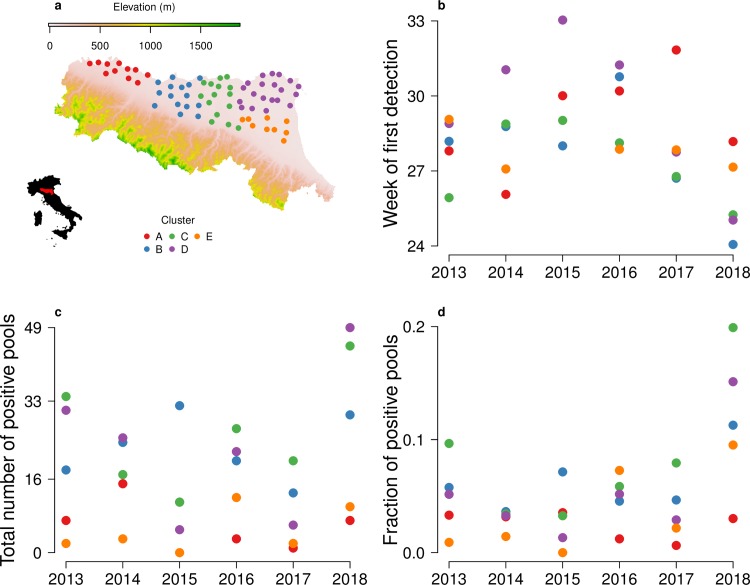
West Nile virus (WNV) transmission was much greater in 2018 than in previous seasons in Europe. Focusing on Emilia-Romagna region (northern Italy), we analyzed detailed entomological and epidemiological data collected in 2013-2018 to quantitatively assess environmental drivers of transmission and explore hypotheses to better understand why the 2018 epidemiological season was substantially different than the previous seasons. In particular, in 2018 WNV was detected at least two weeks before the observed circulation in 2013-2017 and in a larger number of mosquito pools. Transmission resulted in 100 neuroinvasive human cases in the region, more than the total number of cases recorded between 2013 and 2017.
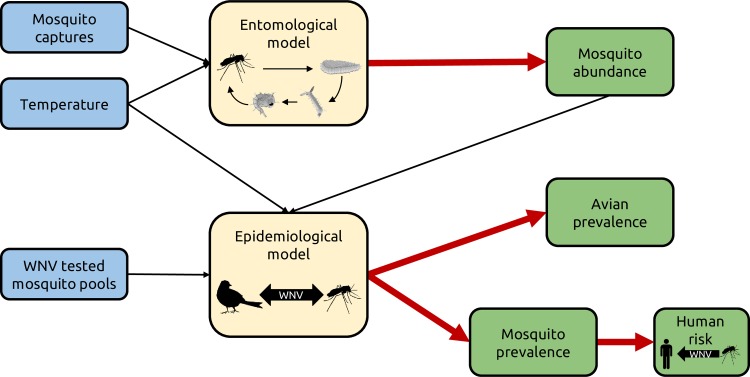
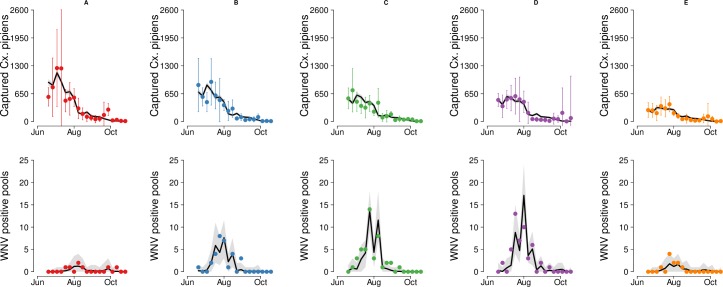
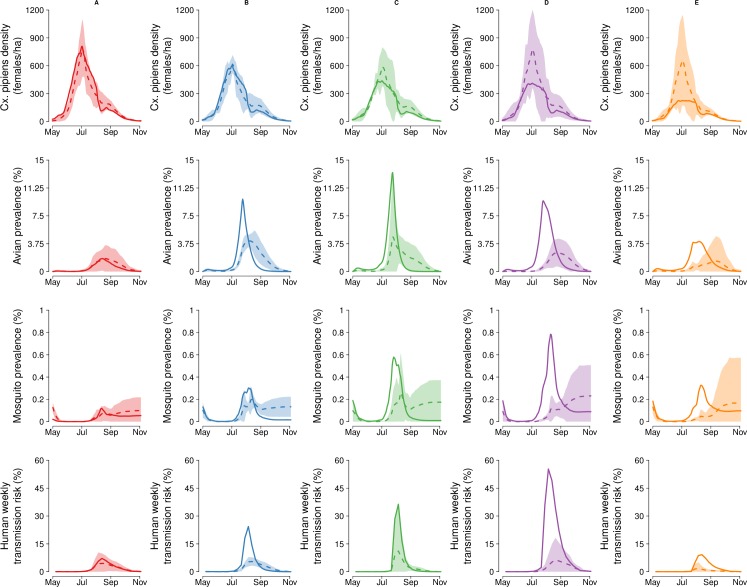
We used temperature-driven mathematical models calibrated through a Bayesian approach to simulate mosquito population dynamics and WNV infection rates in the avian population. We then estimated the human transmission risk as the probability, for a person living in the study area, of being bitten by an infectious mosquito in a given week. Finally, we translated such risk into reported WNV human infections.
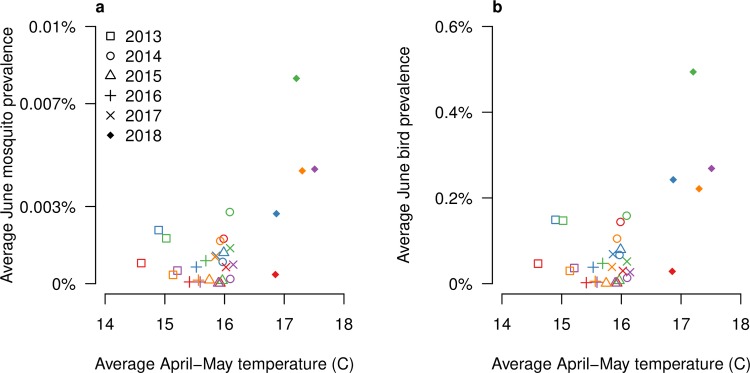
The estimated prevalence of WNV in the mosquito and avian populations were significantly higher in 2018 with respect to 2013-2017 seasons, especially in the eastern part of the region. Furthermore, peak avian prevalence was estimated to have occurred earlier, corresponding to a steeper decline towards the end of summer. The high mosquito prevalence resulted in a much greater predicted risk for human transmission in 2018, which was estimated to be up to eight times higher than previous seasons. We hypothesized, on the basis of our modelling results, that such greater WNV circulation might be partially explained by exceptionally high spring temperatures, which have likely helped to amplify WNV transmission at the beginning of the 2018 season.
2018 年,西尼罗河病毒(WNV)在欧洲的传播比以往任何季节都更为广泛。我们聚焦于意大利北部的艾米利亚-罗马涅地区,分析了 2013-2018 年收集的详细昆虫学和流行病学数据,以定量评估传播的环境驱动因素,并探索假设以更好地理解为什么 2018 年的流行病学季节与前几个季节有很大不同。特别是,2018 年在观察到的 2013-2017 年传播之前至少两周就检测到了 WNV,并且在更多的蚊子池中都检测到了该病毒。该地区的神经侵入性人类病例多达 100 例,比 2013 年至 2017 年记录的总病例数还要多。
我们使用温度驱动的数学模型,通过贝叶斯方法进行校准,以模拟蚊子种群动态和鸟类群体中的 WNV 感染率。然后,我们估计了居住在研究区域的人在给定的一周内被感染蚊子叮咬的可能性,从而计算出人类传播的风险。最后,我们将这种风险转化为报告的 WNV 人类感染。
与 2013-2017 年季节相比,2018 年蚊子和鸟类群体中 WNV 的流行率明显更高,尤其是在该地区的东部。此外,估计鸟类的流行高峰更早出现,这对应着夏季末期更为陡峭的下降趋势。高蚊子流行率导致 2018 年人类传播的预测风险大大增加,估计比前几个季节高 8 倍以上。根据我们的建模结果,我们假设这种更高的 WNV 循环可能部分是由于异常高的春季温度所致,这可能有助于在 2018 年季节开始时放大 WNV 的传播。