Max Planck Institute for Medical Research, Jahnstraße 29, 69120, Heidelberg, Germany.
Institute for Physical Chemistry, Heidelberg University, INF 253, 69120, Heidelberg, Germany.
Nat Commun. 2020 Jan 2;11(1):32. doi: 10.1038/s41467-019-13877-w.
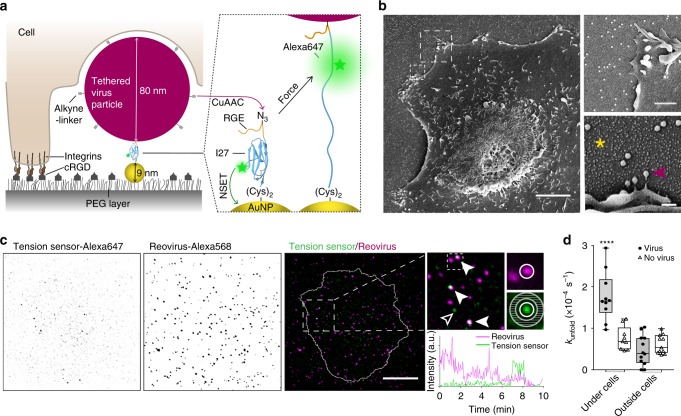
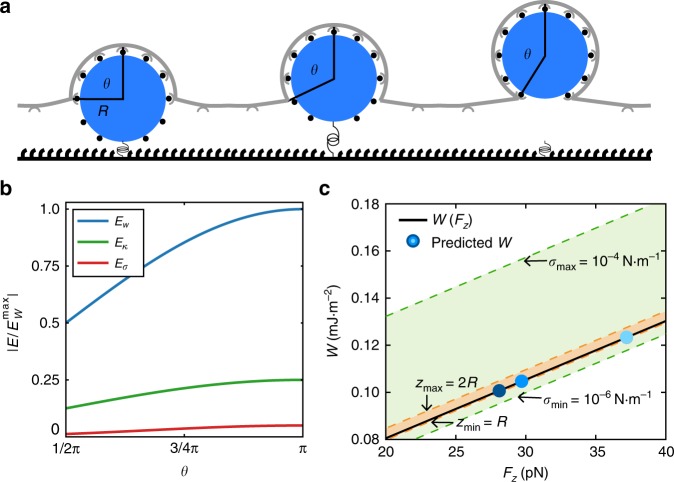
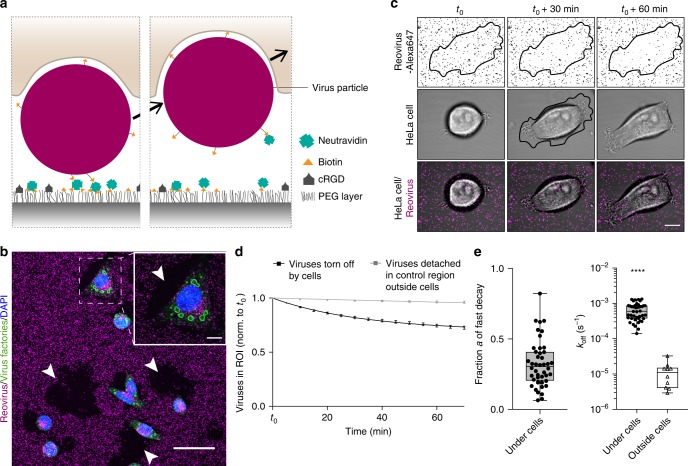
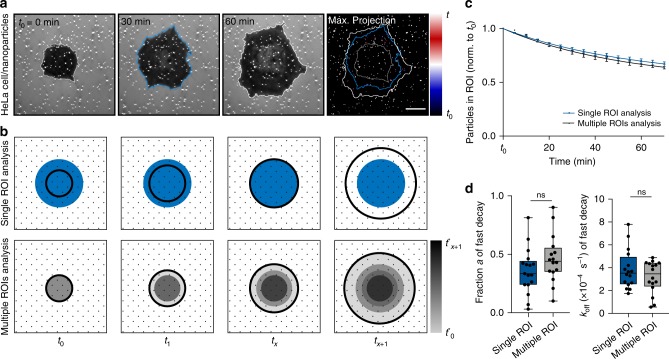
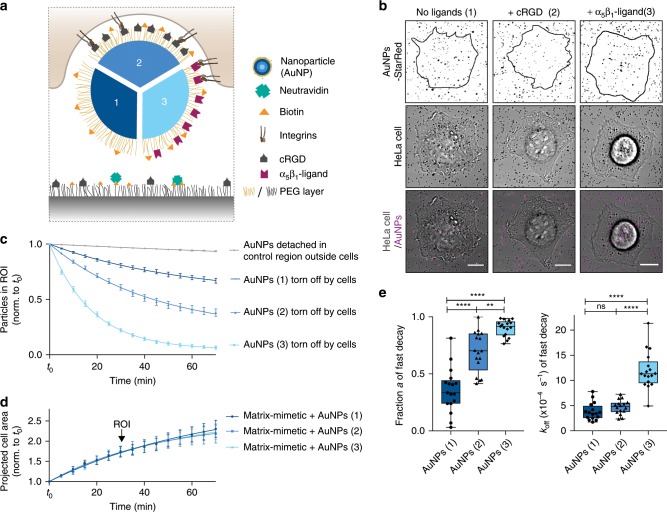
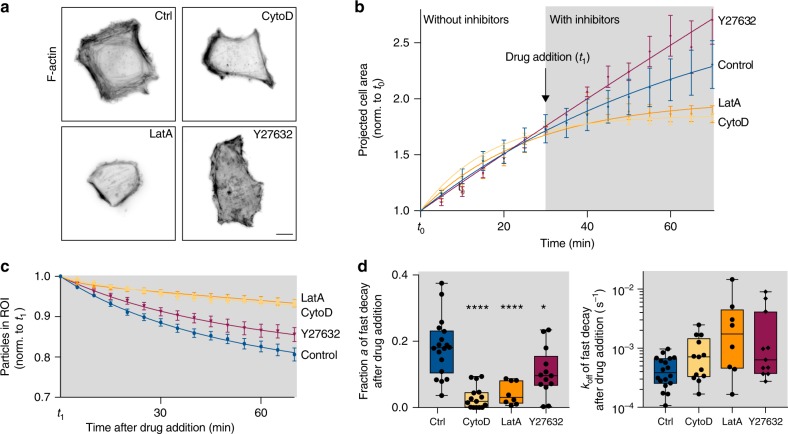
Many intracellular pathogens, such as mammalian reovirus, mimic extracellular matrix motifs to specifically interact with the host membrane. Whether and how cell-matrix interactions influence virus particle uptake is unknown, as it is usually studied from the dorsal side. Here we show that the forces exerted at the ventral side of adherent cells during reovirus uptake exceed the binding strength of biotin-neutravidin anchoring viruses to a biofunctionalized substrate. Analysis of virus dissociation kinetics using the Bell model revealed mean forces higher than 30 pN per virus, preferentially applied in the cell periphery where close matrix contacts form. Utilizing 100 nm-sized nanoparticles decorated with integrin adhesion motifs, we demonstrate that the uptake forces scale with the adhesion energy, while actin/myosin inhibitions strongly reduce the uptake frequency, but not uptake kinetics. We hypothesize that particle adhesion and the push by the substrate provide the main driving forces for uptake.
许多细胞内病原体,如哺乳动物呼肠孤病毒,模拟细胞外基质基序以特异性地与宿主膜相互作用。细胞-基质相互作用是否以及如何影响病毒粒子的摄取尚不清楚,因为通常从背侧进行研究。在这里,我们表明,在呼肠孤病毒摄取过程中,粘附细胞腹侧施加的力超过了生物素-亲和素锚定病毒与生物功能化基底结合的强度。使用 Bell 模型分析病毒解离动力学表明,每个病毒的平均力高于 30pN,优先施加在接近基质接触形成的细胞边缘。利用用整合素粘附基序修饰的 100nm 大小的纳米颗粒,我们证明摄取力与粘附能成正比,而肌动球蛋白抑制强烈降低摄取频率,但不改变摄取动力学。我们假设颗粒粘附和底物的推动提供了摄取的主要驱动力。