Population, Policy and Practice, Great Ormond Street Institute of Child Health, University College London, London, UK.
MRC/CSO Social and Public Health Sciences Unit, University of Glasgow, Glasgow, UK.
Eur J Public Health. 2020 Apr 1;30(2):316-322. doi: 10.1093/eurpub/ckz232.
Rapid weight gain (RWG) in early-life is associated with increased risk of childhood obesity and is common among low-birth weight infants. Few studies have compared body mass index (BMI) trajectories of children experienced RWG to those who did not, across birth weight groups. We investigated the association between RWG in early-life and subsequent BMI trajectory and whether the association differs by birth weight.
We included term singletons from the UK Millennium Cohort Study (n = 10 637). RWG was defined as an increase in weight z-scores (derived using UK-WHO growth reference) between birth and 3 years >0.67. Mixed-effect fractional polynomial models were applied to examine the association between RWG and BMI trajectories (5-14 years). Models were further adjusted for confounders and stratified by birth weight-for-gestational-age group.
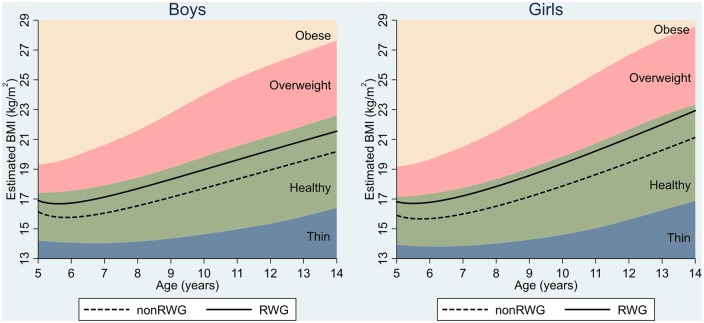
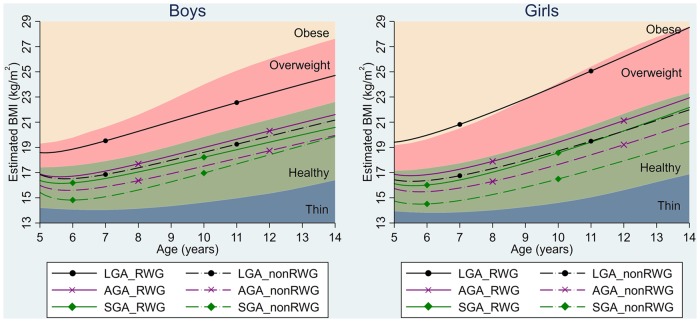
Mean BMI trajectories were higher in children who experienced RWG in early-life, compared with their non-RWG counterparts. RWG was associated with higher BMI at five years [by 0.76 kg/m2 (95% CI: 0.67-0.85) in boys and 0.87 kg/m2 (0.76-0.97) in girls]; the difference persisted into adolescence [1.37 kg/m2 (1.17-1.58) and 1.75 kg/m2 (1.52-1.99) at 14 years, respectively]. Differences remained after adjustment and were particularly greater for children born large-for-gestational-age than those born small- and appropriate-for-gestational-age. Mean BMI trajectories for large-for-gestational-age children with RWG exceeded international reference curves for overweight (for obesity at some ages in girls).
RWG was associated with higher BMI trajectories throughout childhood and adolescence, especially in large-for-gestational-age children. Strategies for obesity prevention need to address factors during and before infancy and preventing excessive weight gain among infants who have already had adequate growth in utero.
婴儿期体重快速增加(RWG)与儿童肥胖风险增加有关,并且在低出生体重儿中很常见。很少有研究比较经历过 RWG 的儿童和未经历过 RWG 的儿童的体重指数(BMI)轨迹,也没有比较不同出生体重组的 BMI 轨迹。我们调查了婴儿期 RWG 与随后 BMI 轨迹之间的关系,以及这种关系是否因出生体重而异。
我们纳入了来自英国千禧年队列研究(n = 10637)的足月单胎。RWG 定义为出生至 3 岁时体重 z 分数(使用英国-世卫组织生长参考值计算)增加>0.67。采用混合效应分数多项式模型来研究 RWG 与 BMI 轨迹(5-14 岁)之间的关系。模型进一步根据出生体重与胎龄比组进行了调整和分层。
与非 RWG 儿童相比,经历过婴儿期 RWG 的儿童的平均 BMI 轨迹更高。RWG 与五岁时更高的 BMI 相关[男孩为 0.76 kg/m2(95%CI:0.67-0.85),女孩为 0.87 kg/m2(0.76-0.97)];这种差异在青春期持续存在[分别为 14 岁时的 1.37 kg/m2(1.17-1.58)和 1.75 kg/m2(1.52-1.99)]。调整后差异仍然存在,并且对于出生体重较大的儿童比出生体重较小和适当的儿童更为明显。经历过 RWG 的出生体重较大的儿童的平均 BMI 轨迹超过了超重的国际参考曲线(在某些年龄组的女孩中为肥胖)。
RWG 与儿童期和青春期的 BMI 轨迹较高相关,尤其是在出生体重较大的儿童中。肥胖预防策略需要解决婴儿期和婴儿期前的因素,并防止已经在子宫内获得足够生长的婴儿体重过度增加。