Imani Farnad, Rahimzadeh Poupak, Khademi Seyed-Hossein, Narimani Zamanabadi Mahnaz, Sadegi Kambiz, Abolfazli-Karizi Abouzar
Pain Research Center, Iran University of Medical Sciences, Tehran, Iran.
Department of Anesthesiology, Mashhad University of Medical Sciences, Mashhad, Iran.
Anesth Pain Med. 2019 Oct 23;9(5):e96117. doi: 10.5812/aapm.96117. eCollection 2019 Oct.
Administration of steroids in the lumbar transforaminal block for lumbar radicular pain is considered one of the preferred treatment methods though it is associated with some complications.
The effects and side effects of triamcinolone and dexmedetomidine in the lumbar transforaminal block were investigated in the present study.
In this study, 30 patients, aged 40 - 70 years, suffering from lumbar radicular pain arising from the lumbar disc protrusion were equally divided into two groups of triamcinolone (T) and dexmedetomidine (D). They all underwent lumbar transforaminal blocks. An injection solution of triamcinolone (20 mg) plus ropivacaine (0.2%) and another one containing dexmedetomidine (50 μg) plus ropivacaine (0.2%) were administered in the triamcinolone and dexmedetomidine groups, respectively. Visual Analog Scale (VAS), Oswestry Disability Index (ODI), Straight Leg Raise (SLR or lasègue's test), and Fasting Blood Sugar (FBS) were measured at 0, 2 weeks, 1, 3, and 6 months post-procedure. The levels of calcium, magnesium, and vitamin D, as well as potential complications, were also evaluated.
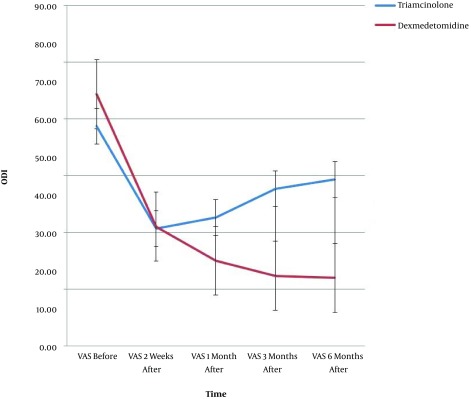
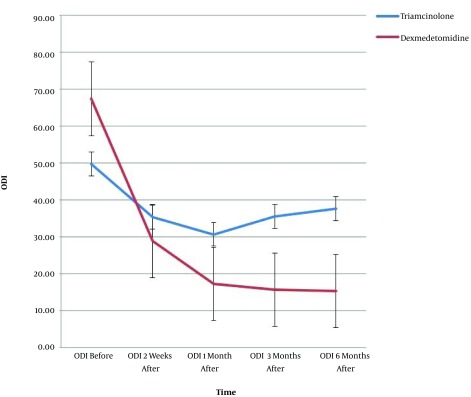
Significant differences were found in the VAS and ODI during the measurement times within each group. The VAS and ODI were remarkably different between the dexmedetomidine group and the triamcinolone group. In addition, there were considerable differences in the increased FBS and reduced calcium and vitamin D levels in the triamcinolone group from changes in the dexmedetomidine group.
The lumbar transforaminal block with triamcinolone or dexmedetomidine attenuates the lumbar radicular pain. Further, dexmedetomidine exerts a more potent pain relief effect than triamcinolone.
尽管腰椎椎间孔阻滞使用类固醇治疗腰椎神经根性疼痛存在一些并发症,但仍被认为是首选治疗方法之一。
本研究旨在探讨曲安奈德和右美托咪定在腰椎椎间孔阻滞中的疗效及副作用。
本研究纳入30例年龄在40至70岁之间、因腰椎间盘突出引起腰椎神经根性疼痛的患者,将其平均分为曲安奈德组(T组)和右美托咪定组(D组)。两组患者均接受腰椎椎间孔阻滞。曲安奈德组注射曲安奈德(20 mg)加罗哌卡因(0.2%),右美托咪定组注射右美托咪定(50 μg)加罗哌卡因(0.2%)。分别于术后0、2周、1、3和6个月测量视觉模拟评分(VAS)、Oswestry功能障碍指数(ODI)、直腿抬高试验(SLR)和空腹血糖(FBS)。同时评估血钙、血镁、维生素D水平以及潜在并发症。
每组测量期间VAS和ODI均有显著差异。右美托咪定组与曲安奈德组的VAS和ODI存在显著差异。此外,曲安奈德组FBS升高以及钙和维生素D水平降低的变化与右美托咪定组存在显著差异。
曲安奈德或右美托咪定腰椎椎间孔阻滞可减轻腰椎神经根性疼痛。此外,右美托咪定的镇痛效果比曲安奈德更强。