Department of Psychological and Brain Sciences, Indiana University, Bloomington, Indiana.
Cognitive Science Program, Indiana University, Bloomington, Indiana.
Hum Brain Mapp. 2020 Apr 1;41(5):1334-1350. doi: 10.1002/hbm.24879. Epub 2020 Jan 9.
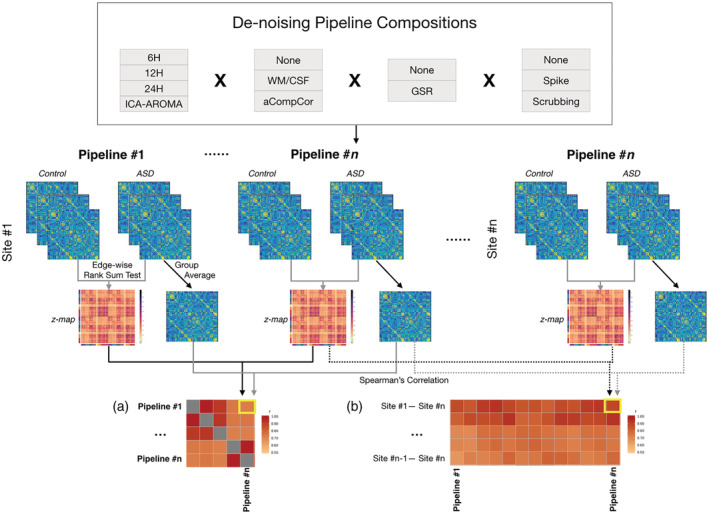
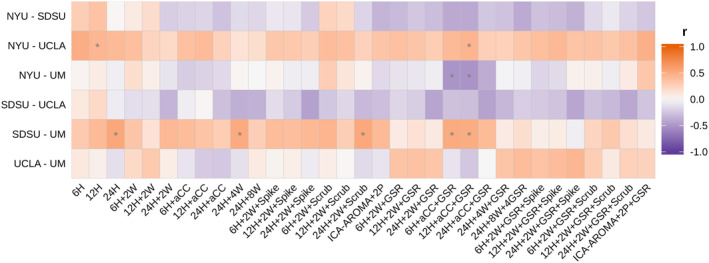
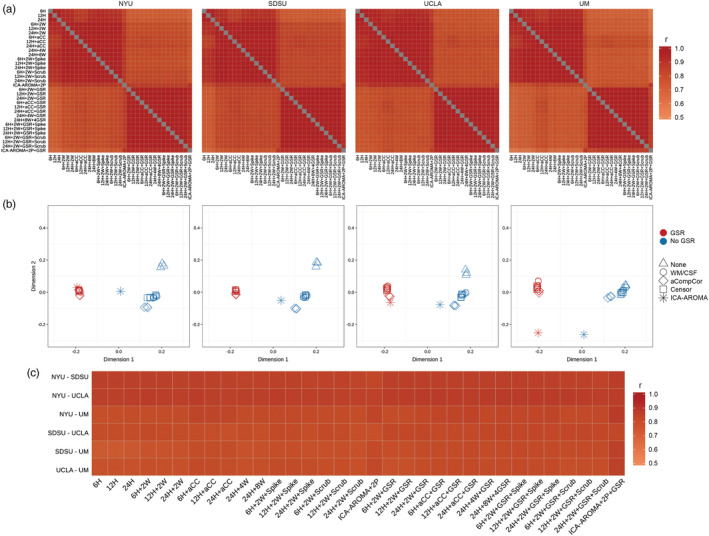
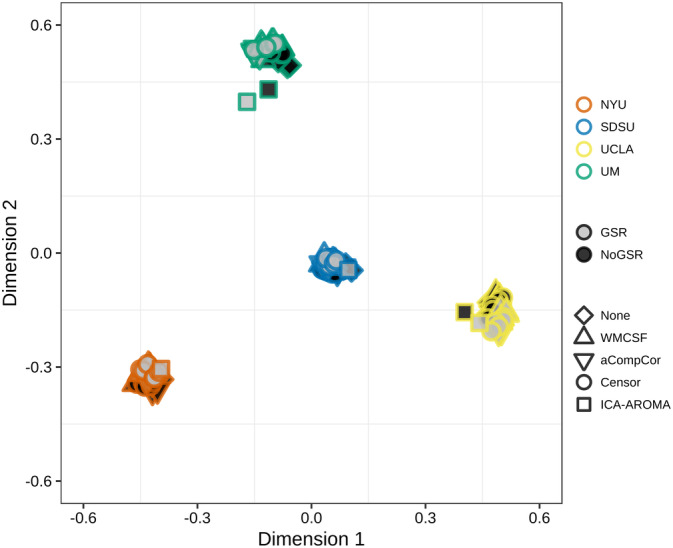
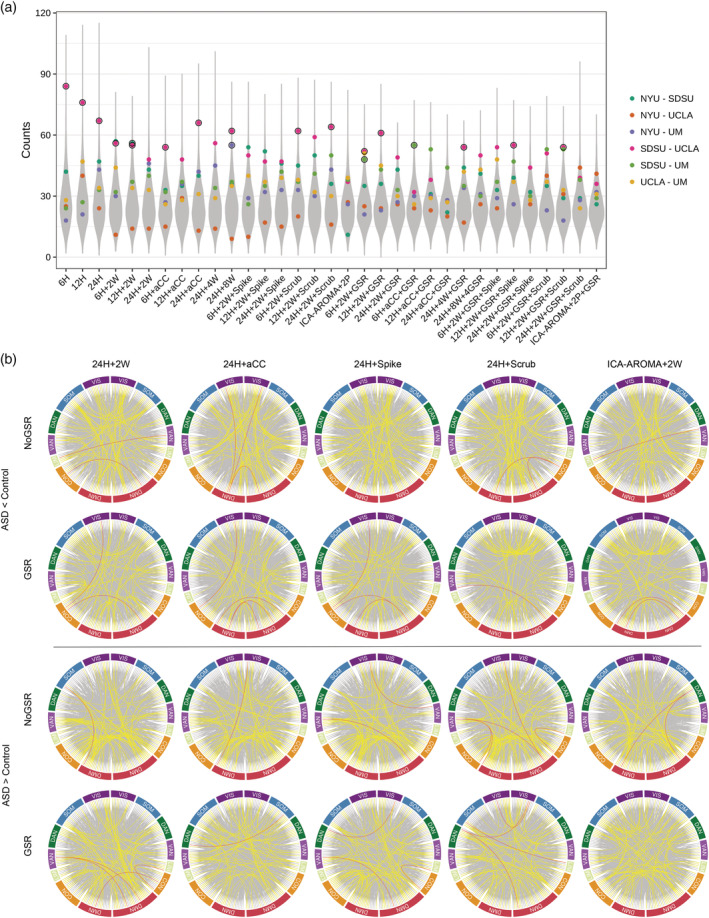
A rapidly growing number of studies on autism spectrum disorder (ASD) have used resting-state fMRI to identify alterations of functional connectivity, with the hope of identifying clinical biomarkers or underlying neural mechanisms. However, results have been largely inconsistent across studies, and there remains a pressing need to determine the primary factors influencing replicability. Here, we used resting-state fMRI data from the Autism Brain Imaging Data Exchange to investigate two potential factors: denoising strategy and data site (which differ in terms of sample, data acquisition, etc.). We examined the similarity of both group-averaged functional connectomes and group-level differences (ASD vs. control) across 33 denoising pipelines and four independently-acquired datasets. The group-averaged connectomes were highly consistent across pipelines (r = 0.92 ± 0.06) and sites (r = 0.88 ± 0.02). However, the group differences, while still consistent within site across pipelines (r = 0.76 ± 0.12), were highly inconsistent across sites regardless of choice of denoising strategies (r = 0.07 ± 0.04), suggesting lack of replication may be strongly influenced by site and/or cohort differences. Across-site similarity remained low even when considering the data at a large-scale network level or when considering only the most significant edges. We further show through an extensive literature survey that the parameters chosen in the current study (i.e., sample size, age range, preprocessing methods) are quite representative of the published literature. These results highlight the importance of examining replicability in future studies of ASD, and, more generally, call for extra caution when interpreting alterations in functional connectivity across groups of individuals.
越来越多的自闭症谱系障碍 (ASD) 研究使用静息态 fMRI 来识别功能连接的改变,以期确定临床生物标志物或潜在的神经机制。然而,研究结果在很大程度上不一致,仍然迫切需要确定影响可重复性的主要因素。在这里,我们使用自闭症脑成像数据交换的静息态 fMRI 数据来研究两个潜在的因素:去噪策略和数据站点(在样本、数据采集等方面有所不同)。我们检查了 33 种去噪管道和四个独立采集的数据集中的组平均功能连接组和组水平差异(ASD 与对照组)的相似性。管道之间的组平均连接组非常一致(r = 0.92 ± 0.06)和站点(r = 0.88 ± 0.02)。然而,尽管在管道内的站点内,组差异仍然一致(r = 0.76 ± 0.12),但无论选择何种去噪策略,站点之间的差异都高度不一致(r = 0.07 ± 0.04),这表明缺乏复制可能受到站点和/或队列差异的强烈影响。即使考虑到大规模网络水平的数据或仅考虑最重要的边缘,跨站点的相似性仍然很低。我们通过广泛的文献调查进一步表明,本研究中选择的参数(即样本量、年龄范围、预处理方法)在很大程度上代表了已发表的文献。这些结果强调了在未来的 ASD 研究中检查可重复性的重要性,并且更普遍地呼吁在解释个体组之间的功能连接改变时要格外小心。