Ahmanson-Lovelace Brain Mapping Center, University of California Los Angeles, Los Angeles, CA.
Interdepartmental Neuroscience Program, University of California Los Angeles, Los Angeles, CA.
Autism Res. 2019 Jan;12(1):53-65. doi: 10.1002/aur.1971. Epub 2018 Oct 30.
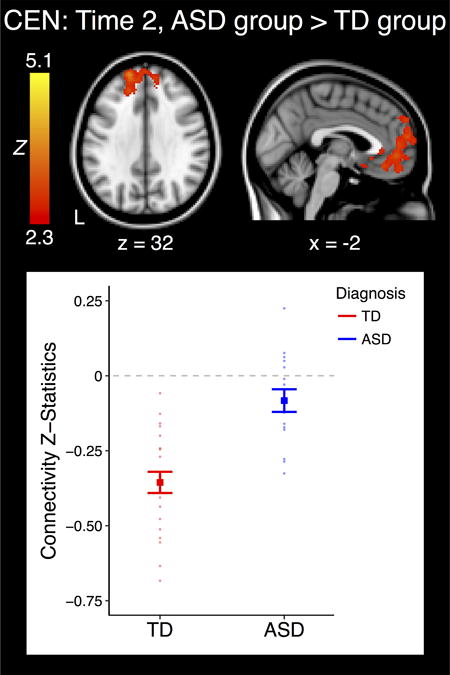
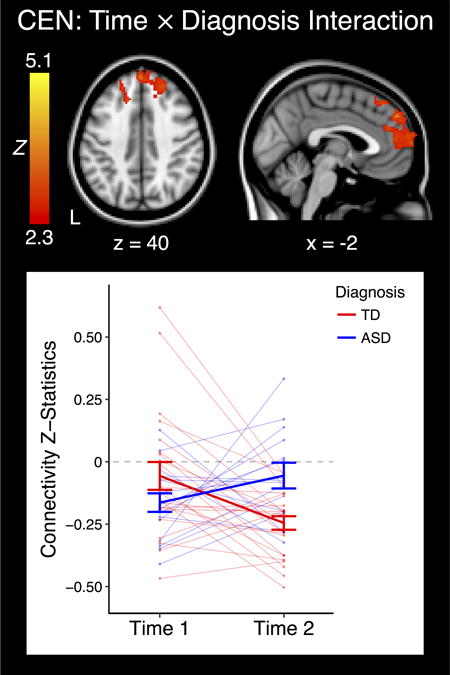
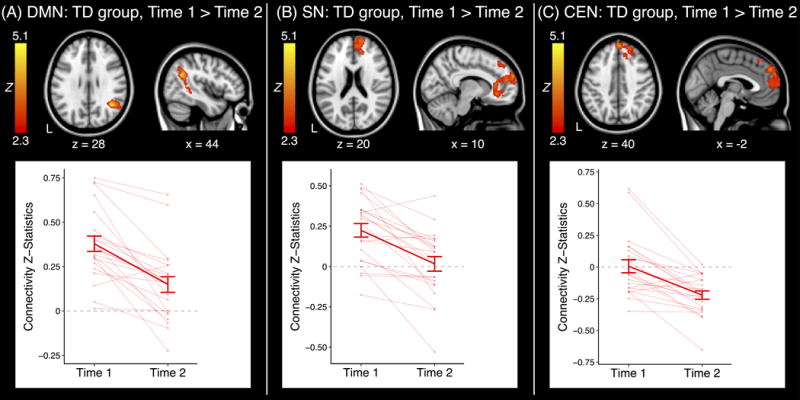
Autism spectrum disorder (ASD) is consistently associated with alterations in brain connectivity, but there are conflicting results as to where and when individuals with ASD display increased or reduced functional connectivity. Such inconsistent findings may be driven by atypical neurodevelopmental trajectories in ASD during adolescence, but no longitudinal studies to date have investigated this hypothesis. We thus examined the functional connectivity of three neurocognitive resting-state networks-the default mode network (DMN), salience network, and central executive network (CEN)-in a longitudinal sample of youth with ASD (n = 16) and without ASD (n = 22) studied during early/mid- and late adolescence. Functional connectivity between the CEN and the DMN displayed significantly altered developmental trajectories in ASD: typically developing (TD) controls-but not youth with ASD-exhibited an increase in negative functional connectivity between these two networks with age. This significant interaction was due to the ASD group displaying less negative functional connectivity than the TD group during late adolescence only, with no significant group differences in early/mid-adolescence. These preliminary findings suggest a localized age-dependency of functional connectivity alterations in ASD and underscore the importance of considering age when examining brain connectivity. Autism Research 2019, 12: 53-65. © 2018 International Society for Autism Research, Wiley Periodicals, Inc. LAY SUMMARY: Brain connectivity may develop differently during adolescence in youth with autism spectrum disorder (ASD). We looked at changes in brain connectivity over time within individuals and found that, for some brain regions, adolescents with ASD did not show the same changes in brain connectivity that typically developing adolescents did. This suggests it is important to consider age when studying brain connectivity in ASD.
自闭症谱系障碍(ASD)与大脑连接的改变密切相关,但对于 ASD 患者何时何地表现出功能连接增加或减少,存在相互矛盾的结果。这种不一致的发现可能是由 ASD 青少年时期非典型的神经发育轨迹驱动的,但迄今为止尚无纵向研究对此假说进行调查。因此,我们在 ASD 青少年(n = 16)和非 ASD 青少年(n = 22)的纵向样本中检查了三个神经认知静息状态网络(默认模式网络(DMN)、突显网络和中央执行网络(CEN)的功能连接)在青少年中期和晚期进行研究。CEN 和 DMN 之间的功能连接在 ASD 中显示出明显改变的发育轨迹:典型发育(TD)对照-但不是 ASD 青少年-随着年龄的增长,这两个网络之间的负功能连接增加。这种显著的相互作用是由于 ASD 组在青春期晚期仅表现出比 TD 组更小的负功能连接,而在青春期中期和早期没有明显的组间差异。这些初步发现表明 ASD 中功能连接改变具有局部年龄依赖性,并强调在检查大脑连接时考虑年龄的重要性。自闭症研究 2019 年,12:53-65。©2018 国际自闭症研究协会,威利期刊,公司。 概述:自闭症谱系障碍(ASD)青少年的大脑连接可能在青春期发育不同。我们观察了个体内部随时间变化的大脑连接变化,发现对于某些大脑区域,ASD 青少年没有表现出与典型发育青少年相同的大脑连接变化。这表明在 ASD 中研究大脑连接时,考虑年龄很重要。