Medical Research Institute of New Zealand, Private Bag 7902, Wellington, 6242, New Zealand.
Capital & Coast District Health Board, Wellington, New Zealand.
BMC Pulm Med. 2020 Jan 9;20(1):7. doi: 10.1186/s12890-019-1007-3.
Pulse oximetry is widely used in the clinical setting. The purpose of this validation study was to investigate the level of agreement between oxygen saturations measured by pulse oximeter (SpO) and arterial blood gas (SaO) in a range of oximeters in clinical use in Australia and New Zealand.
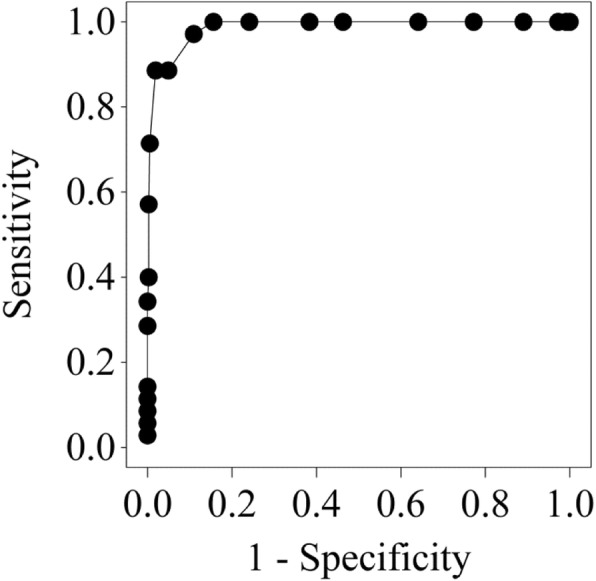
Paired SpO and SaO measurements were collected from 400 patients in one Australian and two New Zealand hospitals. The ages of the patients ranged from 18 to 95 years. Bias and limits of agreement were estimated. Sensitivity and specificity for detecting hypoxaemia, defined as SaO < 90%, were also estimated.
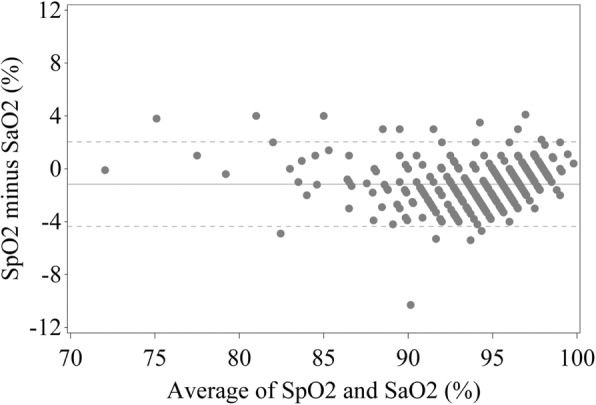
The majority of participants were recruited from the Outpatient, Ward or High Dependency Unit setting. Bias, oximeter-measured minus arterial blood gas-measured oxygen saturation, was - 1.2%, with limits of agreement - 4.4 to 2.0%. SpO was at least 4% lower than SaO for 10 (2.5%) of the participants and SpO was at least 4% higher than the SaO in 3 (0.8%) of the participants. None of the participants with a SpO ≥ 92% were hypoxaemic, defined as SaO < 90%. There were no clinically significant differences in oximetry accuracy in relation to clinical characteristics or oximeter brand.
In the majority of the participants, pulse oximetry was an accurate method to assess SaO and had good performance in detecting hypoxaemia. However, in a small proportion of participants, differences between SaO and SpO could have clinical relevance in terms of patient monitoring and management. A SpO ≥ 92% indicates that hypoxaemia, defined as a SaO < 90%, is not present.
Australian and New Zealand Clinical Trials Registry (ACTRN12614001257651). Date of registration: 2/12/2014.
脉搏血氧饱和度仪在临床环境中被广泛应用。本验证研究的目的是调查在澳大利亚和新西兰临床使用的各种脉搏血氧饱和度仪测量的血氧饱和度(SpO)与动脉血气(SaO)之间的一致性程度。
从澳大利亚的一家医院和新西兰的两家医院共收集了 400 名患者的脉搏血氧饱和度和动脉血气的配对测量值。患者年龄在 18 至 95 岁之间。评估了偏差和一致性界限。还评估了检测低氧血症(定义为 SaO<90%)的敏感性和特异性。
大多数参与者是从门诊、病房或高依赖病房招募的。偏差,即脉搏血氧饱和度仪测量值减去动脉血气测量值的氧饱和度,为-1.2%,一致性界限为-4.4 至 2.0%。对于 10 名(2.5%)参与者,SpO 比 SaO 至少低 4%,而对于 3 名(0.8%)参与者,SpO 比 SaO 至少高 4%。没有一个 SpO≥92%的参与者存在低氧血症(定义为 SaO<90%)。在与临床特征或脉搏血氧仪品牌相关的方面,血氧仪的准确性没有明显的临床差异。
在大多数参与者中,脉搏血氧饱和度仪是评估 SaO 的准确方法,在检测低氧血症方面具有良好的性能。然而,在一小部分参与者中,SaO 和 SpO 之间的差异可能在患者监测和管理方面具有临床意义。SpO≥92%表示不存在低氧血症(定义为 SaO<90%)。
澳大利亚和新西兰临床试验注册中心(ACTRN12614001257651)。注册日期:2014 年 12 月 2 日。