Yang Jing, Guo Xinli, Hao Jianqi, Dong Yiting, Zhang Tao, Ma Xuelei
State Key Laboratory of Biotherapy and Cancer Center, Collaborative Innovation Center for Biotherapy, West China Hospital, Sichuan University, Chengdu, China.
West China School of Medicine, West China Hospital, Sichuan University, Chengdu, China.
Front Oncol. 2019 Dec 10;9:1392. doi: 10.3389/fonc.2019.01392. eCollection 2019.
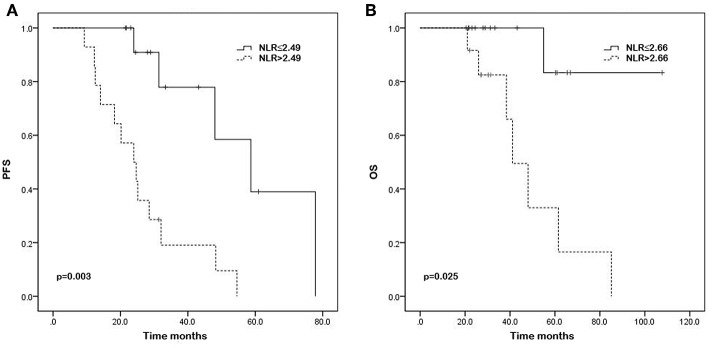
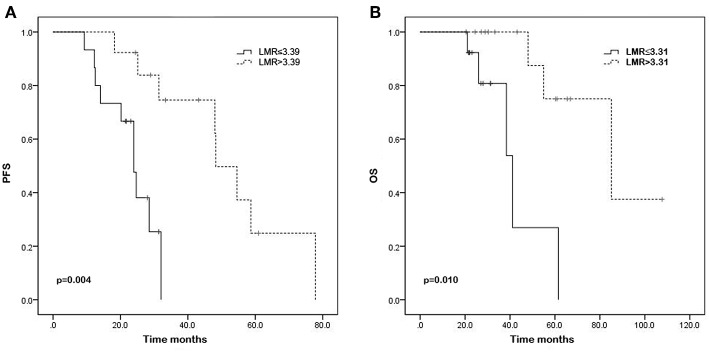
Previous studies have reported the prognostic value of neutrophil/lymphocyte ratio (NLR), platelet/lymphocyte ratio (PLR), lymphocyte/monocyte ratio (LMR), and systemic immune-inflammation index (SII). However, the prognostic performance of these indices in patients with testicular lymphoma has not yet been studied. This study was to systematically evaluate the role of NLR, PLR, LMR, and SII in predicting survival for patients with testicular diffuse large B-cell lymphoma. In this study, 28 patients with testicular diffuse large B-cell lymphoma were enrolled. We performed univariate and multivariate analyses to assess associations of indices incorporating blood cell counts with progression-free survival (PFS) and overall survival (OS). The results of univariate analysis revealed that International Prognostic Index (IPI) score ( = 0.010, = 0.034, respectively), NLR ( = 0.003, = 0.025, respectively), and LMR ( = 0.004, = 0.010, respectively) were significantly associated with PFS and OS. Lactic dehydrogenase (LDH) ( = 0.017), absolute neutrophil counts ( = 0.018), absolute monocyte counts ( = 0.001), and SII ( = 0.005) were significantly associated with the risk of disease progression, while ECOG performance status ( = 0.016) was shown to be related to the risk of death. In the multivariate analysis, NLR (HR 9.069, = 0.001) and absolute monocyte counts (HR 37.076, = 0.001) were shown to be independently associated with risk for disease progression, while LMR (HR 0.077, = 0.028), and ECOG performance status (HR 20.013, = 0.026) were proved to be independent predictors of OS. In conclusion, high absolute monocyte counts, high NLR and low LMR may indicate unfavorable prognosis in testicular diffuse large B-cell lymphoma patients. Since indices incorporating blood cell counts are low cost parameters, they may provide additional prognostic value beyond standard clinicopathological parameters. However, further studies are needed to confirm our findings.
既往研究报道了中性粒细胞/淋巴细胞比值(NLR)、血小板/淋巴细胞比值(PLR)、淋巴细胞/单核细胞比值(LMR)及全身免疫炎症指数(SII)的预后价值。然而,这些指标在睾丸淋巴瘤患者中的预后性能尚未得到研究。本研究旨在系统评估NLR、PLR、LMR及SII在预测睾丸弥漫性大B细胞淋巴瘤患者生存中的作用。在本研究中,纳入了28例睾丸弥漫性大B细胞淋巴瘤患者。我们进行了单因素和多因素分析,以评估包含血细胞计数的指标与无进展生存期(PFS)和总生存期(OS)的相关性。单因素分析结果显示,国际预后指数(IPI)评分(分别为P = 0.010,P = 0.034)、NLR(分别为P = 0.003,P = 0.025)和LMR(分别为P = 0.004,P = 0.010)与PFS和OS显著相关。乳酸脱氢酶(LDH)(P = 0.017)、绝对中性粒细胞计数(P = 0.018)、绝对单核细胞计数(P = 0.001)和SII(P = 0.005)与疾病进展风险显著相关,而东部肿瘤协作组(ECOG)体能状态(P = 0.016)与死亡风险相关。在多因素分析中,NLR(风险比[HR] 9.069,P = 0.001)和绝对单核细胞计数(HR 37.076,P = 0.001)被证明与疾病进展风险独立相关,而LMR(HR 0.哦77,P = 0.028)和ECOG体能状态(HR 20.013,P = 0.026)被证明是OS的独立预测因素。总之,高绝对单核细胞计数、高NLR和低LMR可能提示睾丸弥漫性大B细胞淋巴瘤患者预后不良。由于包含血细胞计数的指标是低成本参数,它们可能在标准临床病理参数之外提供额外的预后价值。然而,需要进一步研究来证实我们的发现。