Department of Epidemiology and Biostatistics, College of Public Health, Zhengzhou University, Zhengzhou, Henan, China.
Department of Orthopaedic Surgery, The Second Affiliated Hospital and Yuying Children's Hospital of Wenzhou Medical University, Wenzhou, Zhejiang, China.
BMJ Open. 2020 Jan 12;10(1):e028593. doi: 10.1136/bmjopen-2018-028593.
The aims of this study were to describe distributions of the prevalence of osteopenia and osteoporosis and identify the potential risk factors by gender in a Chinese rural population.
A cross-sectional survey.
A total of 8475 participants (18-79 years) were obtained from the Henan Rural Cohort Study. Bone mineral density (BMD) of the calcaneus for each individual was measured by ultrasonic bone density apparatus. Logistic regression models were used to evaluate associations of potential risk factors with prevalence of osteopenia and osteoporosis. Furthermore, a meta-analysis of prevalence of osteoporosis which included eight studies was conducted to confirm this study results.
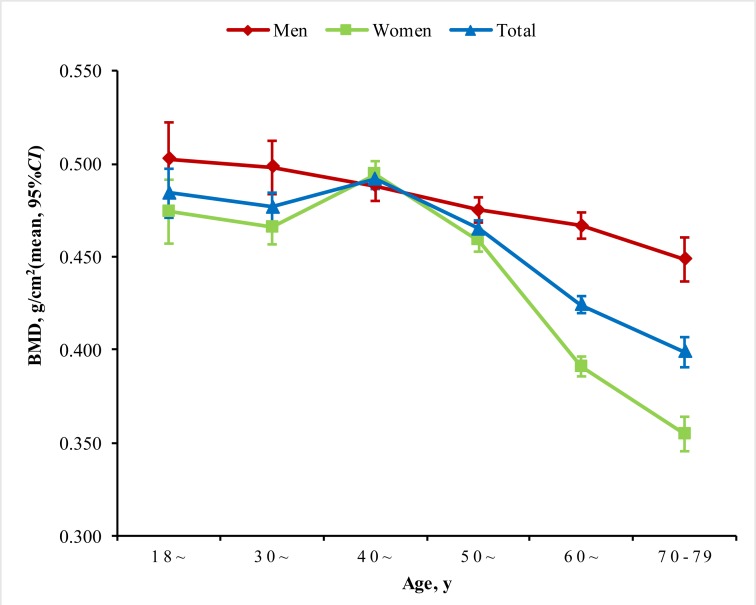
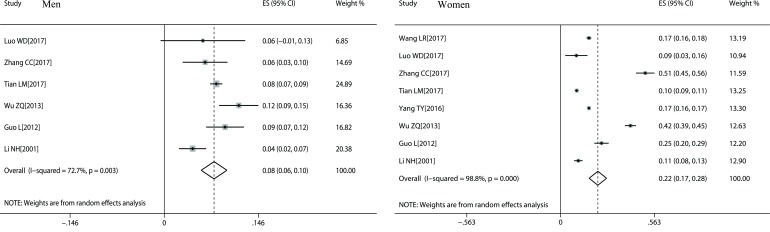
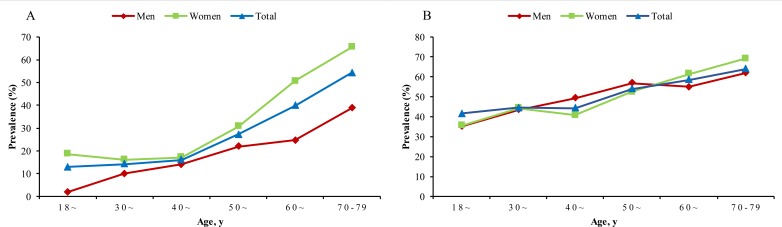
The mean of BMD were 0.42 and 0.32 g/cm for men with osteopenia and osteoporosis (p<0.001), as well as 0.40 and 0.30 g/cm (p<0.001) for women with osteopenia and osteoporosis, respectively. The overall age-standardised prevalence of osteopenia and osteoporosis were 42.09% and 11.76% in all participants. The age-standardised prevalence of osteopenia in men (45.98%) was significantly higher than that in women (39.73%), whereas the age-standardised prevalence of osteoporosis in men (7.82%) was lower than that in women (14.38%). Meta-analysis results displayed pooled prevalence of osteoporosis of 18.0% (10.1%-25.8%) in total sample, 7.7% (5.7%-9.7%) in men and 22.4% (17.1%-27.6%) in women. Multivariable logistic regression models showed that ageing, women, low education level or income, drinking or underweight was related to increased risk for osteopenia or osteoporosis.
About one-sixth of the participants suffered osteoporosis in rural China, and the prevalence in women was higher than men. Although the results were lower than that of meta-analysis, osteoporosis still accounts for huge burden of disease in rural population due to limited medical service and lack of health risk awareness rather than urban area.
Chinese Clinical Trial Registry (ChiCTR-OOC-15006699; Pre-results).
本研究旨在描述中国农村人群中骨量减少和骨质疏松症的流行分布,并按性别确定潜在的危险因素。
横断面调查。
本研究共纳入了来自河南农村队列研究的 8475 名参与者(18-79 岁)。通过超声骨密度仪测量每位个体的跟骨骨密度。使用 logistic 回归模型评估潜在危险因素与骨量减少和骨质疏松症患病率之间的关联。此外,还进行了一项荟萃分析,纳入了八项研究,以确认本研究结果。
骨量减少和骨质疏松症男性的平均骨密度分别为 0.42 和 0.32 g/cm(p<0.001),女性分别为 0.40 和 0.30 g/cm(p<0.001)。所有参与者的总体年龄标准化骨量减少和骨质疏松症患病率分别为 42.09%和 11.76%。男性的年龄标准化骨量减少患病率(45.98%)明显高于女性(39.73%),而男性的年龄标准化骨质疏松症患病率(7.82%)则低于女性(14.38%)。荟萃分析结果显示,总体样本的骨质疏松症患病率为 18.0%(10.1%-25.8%),男性为 7.7%(5.7%-9.7%),女性为 22.4%(17.1%-27.6%)。多变量 logistic 回归模型显示,年龄增长、女性、低教育水平或收入、饮酒或体重不足与骨量减少或骨质疏松症的风险增加有关。
在中国农村地区,约有六分之一的参与者患有骨质疏松症,女性的患病率高于男性。尽管结果低于荟萃分析,但由于农村地区医疗服务有限且缺乏健康风险意识,骨质疏松症仍给农村人群带来了巨大的疾病负担,而不是城市地区。
中国临床试验注册中心(ChiCTR-OOC-15006699;预注册)。