Titov Aleksei, Valiullina Aygul, Zmievskaya Ekaterina, Zaikova Ekaterina, Petukhov Alexey, Miftakhova Regina, Bulatov Emil, Rizvanov Albert
Institute of Fundamental Medicine and Biology, Kazan Federal University, 420008 Kazan, Russia.
Laboratory of Transplantation Immunology, National Hematology Research Centre, 125167 Moscow, Russia.
Cancers (Basel). 2020 Jan 3;12(1):125. doi: 10.3390/cancers12010125.
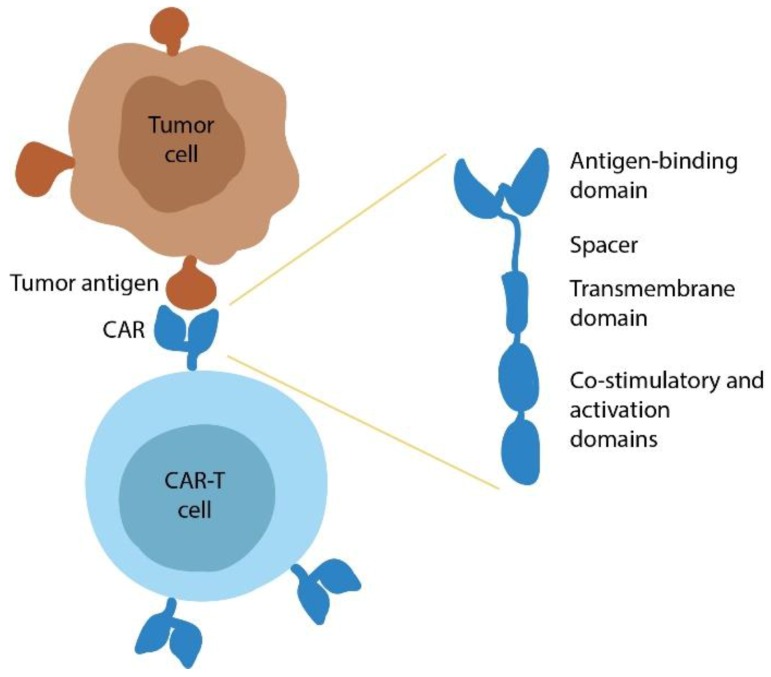
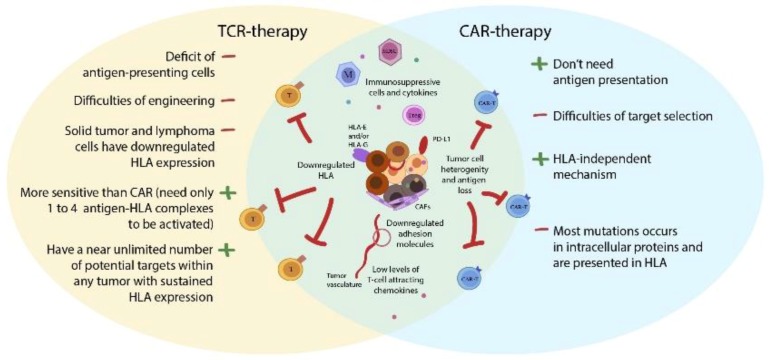
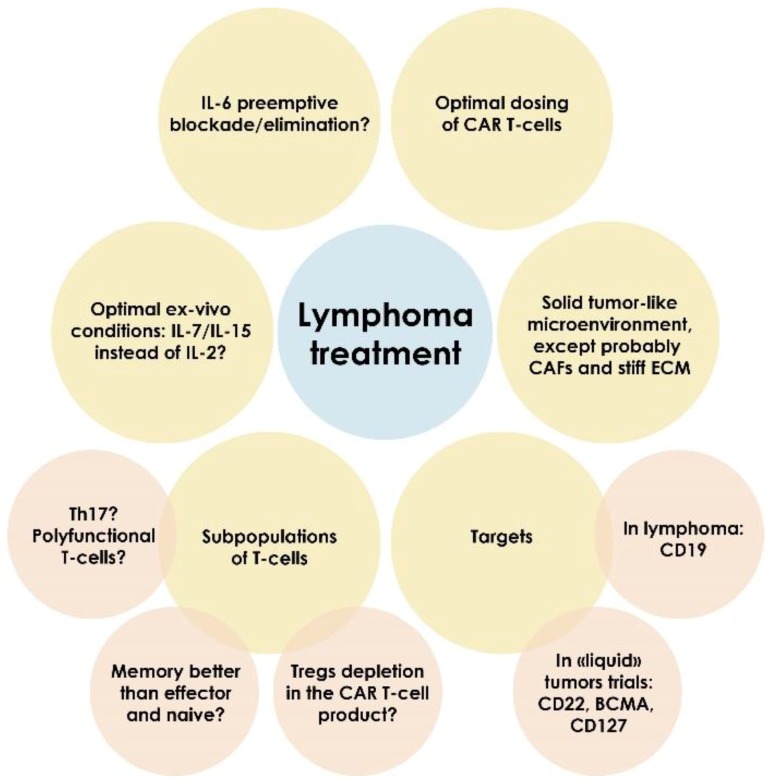
Chimeric antigen receptor (CAR) immunotherapy is one of the most promising modern approaches for the treatment of cancer. To date only two CAR T-cell products, Kymriah and Yescarta, have been approved by the Food and Drug Administration (FDA) for the treatment of lymphoblastic leukemia and B-cell lymphoma. Administration of CAR T-cells to control solid tumors has long been envisaged as one of the most difficult therapeutic tasks. The first two clinical trials conducted in sarcoma and neuroblastoma patients showed clinical benefits of CAR T-cells, yet multiple obstacles still hold us back from having accessible and efficient therapy. Why did such an effective treatment for relapsed and refractory hematological malignancies demonstrate only relatively modest efficiency in the context of solid tumors? Is it due to the lucky selection of the "magic" CD19 antigen, which might be one of a kind? Or do lymphomas lack the immunosuppressive features of solid tumors? Here we review the existing knowledge in the field of CAR T-cell therapy and address the heterogeneity of solid tumors and their diverse strategies of immunoevasion. We also provide an insight into prospective developments of CAR T-cell technologies against solid tumors.
嵌合抗原受体(CAR)免疫疗法是治疗癌症最具前景的现代方法之一。迄今为止,只有两种CAR T细胞产品,即Kymriah和Yescarta,已获得美国食品药品监督管理局(FDA)批准用于治疗淋巴细胞白血病和B细胞淋巴瘤。长期以来,施用CAR T细胞以控制实体瘤一直被视为最艰巨的治疗任务之一。在肉瘤和神经母细胞瘤患者中进行的前两项临床试验显示了CAR T细胞的临床益处,但多个障碍仍阻碍我们获得可及且有效的治疗方法。为什么这种对复发和难治性血液系统恶性肿瘤有效的治疗方法在实体瘤中仅显示出相对有限的疗效?这是由于幸运地选择了可能独一无二的“神奇”CD19抗原吗?还是淋巴瘤缺乏实体瘤的免疫抑制特征?在此,我们回顾CAR T细胞疗法领域的现有知识,并探讨实体瘤的异质性及其多样的免疫逃逸策略。我们还深入了解了针对实体瘤的CAR T细胞技术的未来发展。