Ozawa Patricia M M, Vieira Evelyn, Lemos Débora S, Souza Ingrid L Melo, Zanata Silvio M, Pankievicz Vânia C, Tuleski Thalita R, Souza Emanuel M, Wowk Pryscilla F, Urban Cícero de Andrade, Kuroda Flavia, Lima Rubens S, Almeida Rodrigo C, Gradia Daniela F, Cavalli Iglenir J, Cavalli Luciane R, Malheiros Danielle, Ribeiro Enilze M S F
Department of Genetics, Federal University of Paraná, Curitiba 81531-980, Brazil.
Department of Cell and Molecular Biology, Federal University of Paraná, Curitiba 81531-980, Brazil.
Biomolecules. 2020 Jan 16;10(1):150. doi: 10.3390/biom10010150.
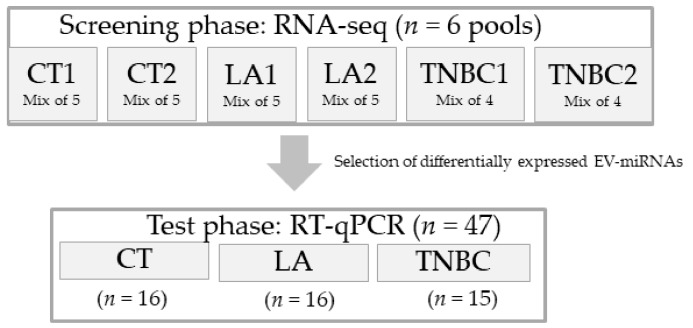
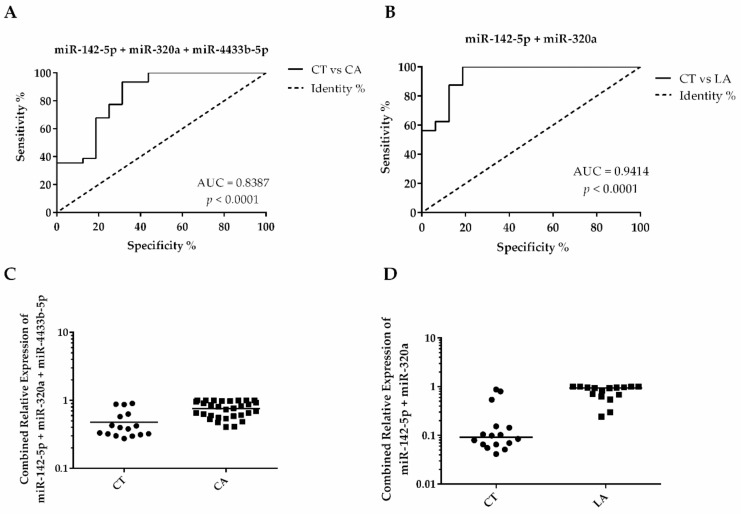
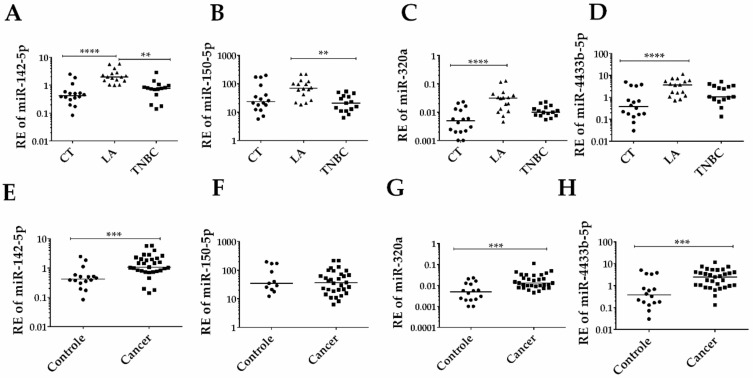
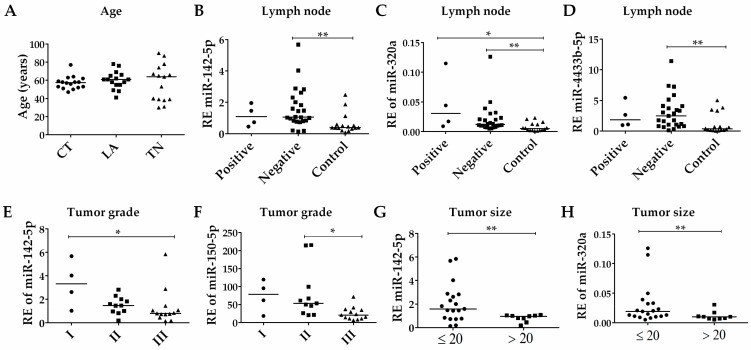
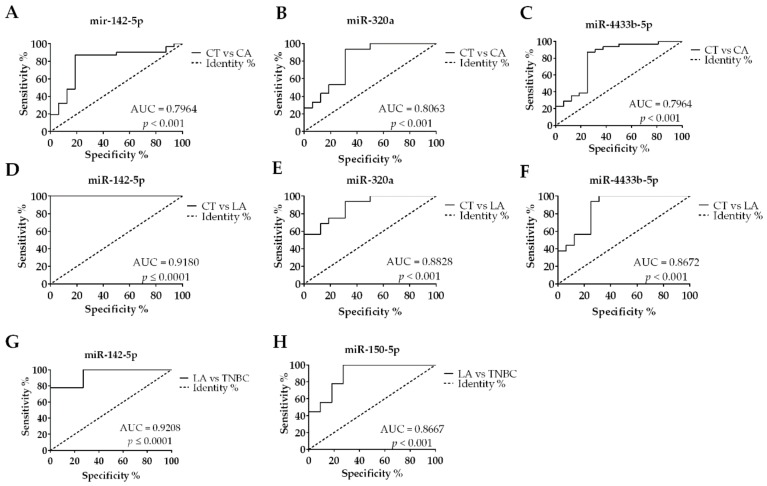
MicroRNAs derived from extracellular vesicles (EV-miRNAs) are circulating miRNAs considered as potential new diagnostic markers for cancer that can be easily detected in liquid biopsies. In this study, we performed RNA sequencing analysis as a screening strategy to identify EV-miRNAs derived from serum of clinically well-annotated breast cancer (BC) patients from the south of Brazil. EVs from three groups of samples (healthy controls (CT), luminal A (LA), and triple-negative (TNBC)) were isolated from serum using a precipitation method and analyzed by RNA-seq (screening phase). Subsequently, four EV-miRNAs (miR-142-5p, miR-150-5p, miR-320a, and miR-4433b-5p) were selected to be quantified by quantitative real-time PCR (RT-qPCR) in individual samples (test phase). A panel composed of miR-142-5p, miR-320a, and miR-4433b-5p distinguished BC patients from CT with an area under the curve (AUC) of 0.8387 (93.33% sensitivity, 68.75% specificity). The combination of miR-142-5p and miR-320a distinguished LA patients from CT with an AUC of 0.9410 (100% sensitivity, 93.80% specificity). Interestingly, decreased expression of miR-142-5p and miR-150-5p were significantly associated with more advanced tumor grades (grade III), while the decreased expression of miR-142-5p and miR-320a was associated with a larger tumor size. These results provide insights into the potential application of EVs-miRNAs from serum as novel specific markers for early diagnosis of BC.
源自细胞外囊泡的微小RNA(EV-miRNAs)是循环微小RNA,被认为是癌症潜在的新型诊断标志物,可在液体活检中轻松检测到。在本研究中,我们进行了RNA测序分析作为筛选策略,以鉴定来自巴西南部临床注释良好的乳腺癌(BC)患者血清中的EV-miRNAs。使用沉淀法从三组样本(健康对照(CT)、腔面A型(LA)和三阴性(TNBC))的血清中分离出细胞外囊泡,并通过RNA测序进行分析(筛选阶段)。随后,选择了四种EV-miRNAs(miR-142-5p、miR-150-5p、miR-320a和miR-4433b-5p)通过定量实时PCR(RT-qPCR)在个体样本中进行定量(测试阶段)。由miR-142-5p、miR-320a和miR-4433b-5p组成的检测组区分BC患者和CT的曲线下面积(AUC)为0.8387(灵敏度93.33%,特异性68.75%)。miR-142-5p和miR-320a的组合区分LA患者和CT的AUC为0.9410(灵敏度100%,特异性93.80%)。有趣的是,miR-142-5p和miR-150-5p的表达降低与更高级别的肿瘤分级(III级)显著相关,而miR-142-5p和miR-320a的表达降低与更大的肿瘤大小相关。这些结果为血清中EVs-miRNAs作为BC早期诊断的新型特异性标志物的潜在应用提供了见解。