Unit of Measurement and Biomedical Instrumentation, Università Campus Bio-Medico di Roma, Via Alvaro del Portillo, 00128 Rome, Italy.
Department of Orthopaedic and Trauma Surgery, Università Campus Bio-Medico di Roma, Via Alvaro del Portillo, 00128 Rome, Italy.
Sensors (Basel). 2020 Jan 18;20(2):536. doi: 10.3390/s20020536.
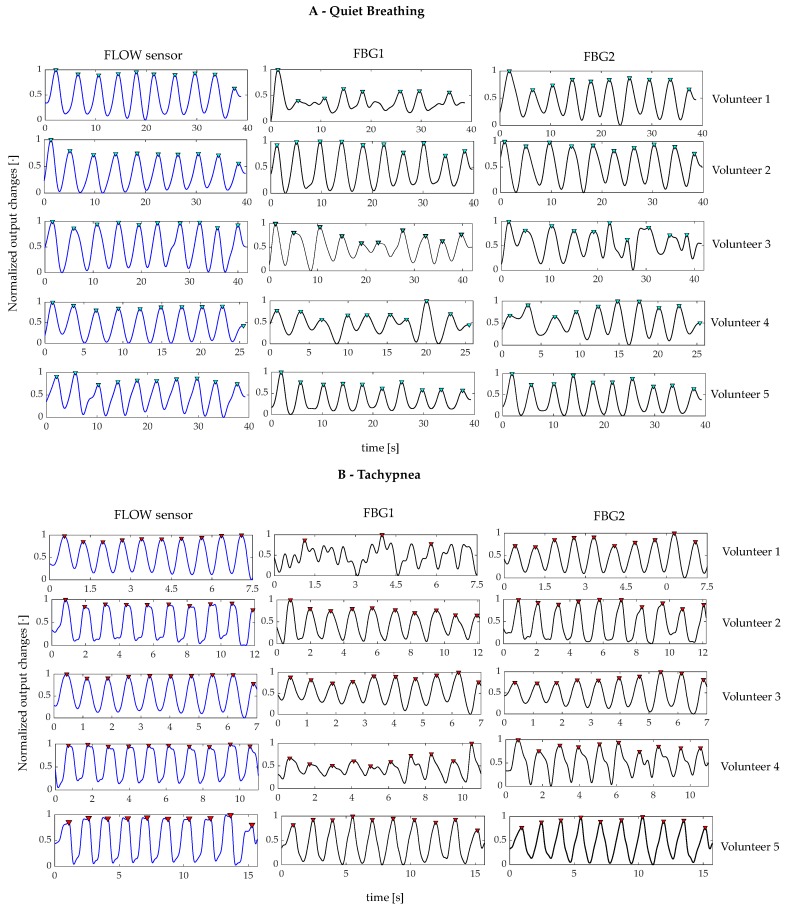
Musculoskeletal disorders are the most common form of occupational ill-health. Neck pain is one of the most prevalent musculoskeletal disorders experienced by computer workers. Wrong postural habits and non-compliance of the workstation to ergonomics guidelines are the leading causes of neck pain. These factors may also alter respiratory functions. Health and safety interventions can reduce neck pain and, more generally, the symptoms of musculoskeletal disorders and reduce the consequent economic burden. In this work, a multi-parametric wearable system based on two fiber Bragg grating sensors is proposed for monitoring neck movements and breathing activity of computer workers. The sensing elements were positioned on the neck, in the frontal and sagittal planes, to monitor: (i) flexion-extension and axial rotation repetitions, and (ii) respiratory frequency. In this pilot study, five volunteers were enrolled and performed five repetitions of both flexion-extension and axial rotation, and ten breaths of both quite breathing and tachypnea. Results showed the good performances of the proposed system in monitoring the aforementioned parameters when compared to optical reference systems. The wearable system is able to well-match the trend in time of the neck movements (both flexion-extension and axial rotation) and to estimate mean and breath-by-breath respiratory frequency values with percentage errors ≤6.09% and ≤1.90%, during quiet breathing and tachypnea, respectively.
肌肉骨骼疾病是最常见的职业健康问题。颈部疼痛是计算机工作者最常见的肌肉骨骼疾病之一。不正确的姿势习惯和不符合人体工程学准则的工作场所是导致颈部疼痛的主要原因。这些因素还可能改变呼吸功能。健康和安全干预措施可以减轻颈部疼痛,更普遍地减轻肌肉骨骼疾病的症状,并减轻由此带来的经济负担。在这项工作中,提出了一种基于两个光纤布拉格光栅传感器的多参数可穿戴系统,用于监测计算机工作者的颈部运动和呼吸活动。传感元件被放置在颈部,在前额和矢状平面上,以监测:(i)屈伸和轴向旋转重复次数,以及(ii)呼吸频率。在这项初步研究中,招募了五名志愿者,让他们进行五次屈伸和轴向旋转的重复,以及十次安静呼吸和快速呼吸的呼吸。结果表明,与光学参考系统相比,所提出的系统在监测上述参数方面表现良好。可穿戴系统能够很好地匹配颈部运动(屈伸和轴向旋转)的时间趋势,并在安静呼吸和快速呼吸时,分别以小于 6.09%和小于 1.90%的百分比误差估计平均呼吸频率和逐次呼吸频率值。