Riegger Jana, Rehm Martin, Büchele Gisela, Brenner Hermann, Günther Klaus-Peter, Rothenbacher Dietrich, Brenner Rolf E
Department of Orthopedics, Division for Biochemistry of Joint and Connective Tissue Diseases, University of Ulm, 89081 Ulm, Germany.
Institute of Epidemiology and Medical Biometry, Ulm University, Helmholtzstraße 22, 89081 Ulm, Germany.
J Clin Med. 2020 Jan 18;9(1):268. doi: 10.3390/jcm9010268.
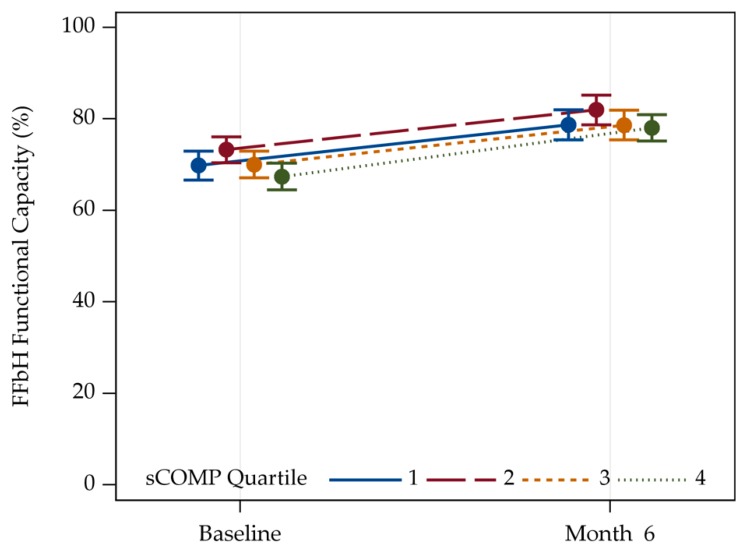
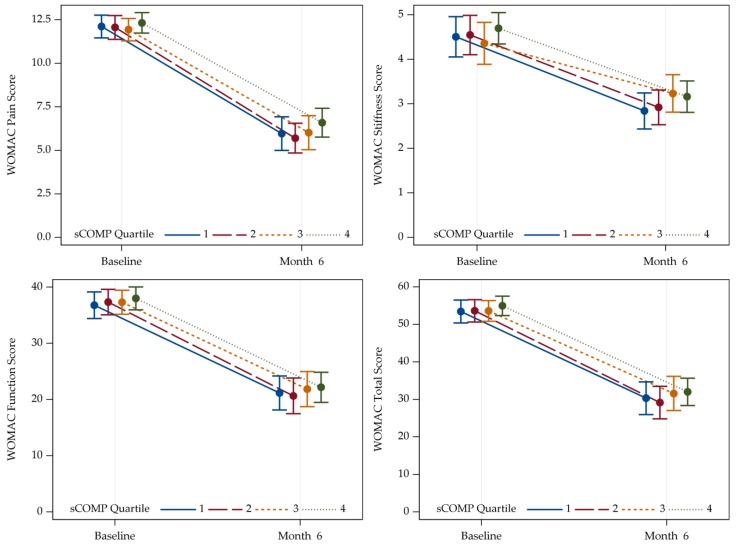
This study aimed to assess associations between serum cartilage oligomeric matrix protein (sCOMP) and phenotypic characteristics in late-stage hip and knee Osteoarthritis (OA) as well as its correlation with further serum markers of possible comorbidities in the Ulm Osteoarthritis Study. Moreover, the prognostic relevance of preoperative sCOMP concentrations for short-term functionality and pain outcomes after hip or knee joint replacement was explored. Preoperative serum samples and detailed information about the health status (i.e., WOMAC scores, Hannover Functionality Status (FFbH)) of 754 OA patients undergoing total joint replacement were included. Spearman rank-correlation coefficients and multiple linear regression models were used to evaluate the relationships between sCOMP, other serum markers, and health outcomes. There was a significant positive association between sCOMP and markers of renal (cystatin C, creatinine, and eGFR) and cardiac (e.g., NT-proBNP) impairment. Since renal failure might cause accumulation of sCOMP, additional adjustment with eGFR was performed. Preoperative sCOMP levels in knee OA but not hip OA patients were positively associated with FFbH, WOMAC function sub-scale and total WOMAC scale as well as the post-operative WOMAC stiffness sub-scale six months after surgery. Our data clearly demonstrate an association between sCOMP and renal function as well as other confounding factors, which should be considered in future biomarker studies.
在乌尔姆骨关节炎研究中,本研究旨在评估晚期髋膝关节骨关节炎(OA)患者血清软骨寡聚基质蛋白(sCOMP)与表型特征之间的关联,以及其与可能合并症的其他血清标志物的相关性。此外,还探讨了术前sCOMP浓度对髋关节或膝关节置换术后短期功能和疼痛结局的预后相关性。纳入了754例行全关节置换术的OA患者的术前血清样本以及有关健康状况的详细信息(即WOMAC评分、汉诺威功能状态(FFbH))。采用Spearman等级相关系数和多元线性回归模型来评估sCOMP、其他血清标志物与健康结局之间的关系。sCOMP与肾脏(胱抑素C、肌酐和估算肾小球滤过率(eGFR))和心脏(如N末端脑钠肽前体(NT-proBNP))损害的标志物之间存在显著正相关。由于肾衰竭可能导致sCOMP蓄积,因此对eGFR进行了额外校正。膝关节OA患者而非髋关节OA患者的术前sCOMP水平与FFbH、WOMAC功能子量表和总WOMAC量表以及术后6个月的WOMAC僵硬子量表呈正相关。我们的数据清楚地表明sCOMP与肾功能以及其他混杂因素之间存在关联,这在未来的生物标志物研究中应予以考虑。