Dyer J, Davison G, Marcora S M, Mauger A R
Dr. Alexis R. Mauger, School of Sport and Exercise Sciences, The Medway Campus, University of Kent, KENT, ME4 4AG, United Kingdom, Telephone: +44 (0)1634 888997, Fax: +44 (0)1634 888890, Email:
J Nutr Health Aging. 2017;21(5):562-566. doi: 10.1007/s12603-016-0806-y.
To investigate the effects of a Mediterranean type diet on patients with osteoarthritis (OA).
Ninety-nine volunteers with OA (aged 31 - 90 years) completed the study (83% female).
Southeast of England, UK.
Participants were randomly allocated to the dietary intervention (DIET, n = 50) or control (CON, n = 49). The DIET group were asked to follow a Mediterranean type diet for 16 weeks whereas the CON group were asked to follow their normal diet.
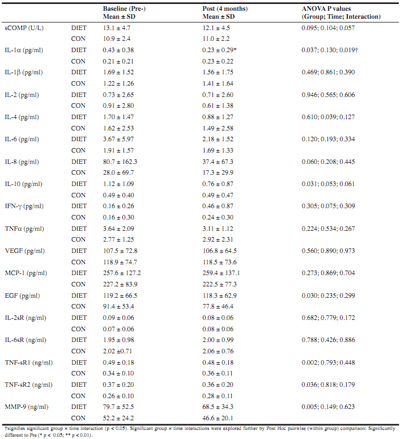
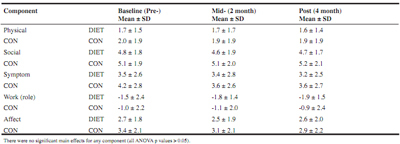
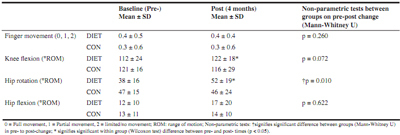
All participants completed an Arthritis Impact Measurement Scale (AIMS2) pre-, mid- and post- study period. A subset of participants attended a clinic at the start and end of the study for assessment of joint range of motion, ROM (DIET = 33, CON = 28), and to provide blood samples (DIET = 29, CON = 25) for biomarker analysis (including serum cartilage oligomeric matrix protein (sCOMP) (a marker of cartilage degradation) and a panel of other relevant biomarkers including pro- and anti-inflammatory cytokines).
There were no differences between groups in the response of any AIMS2 components and most biomarkers (p > 0.05), except the pro-inflammatory cytokine IL-1α, which decreased in the DIET group (47%, p = 0.010). sCOMP decreased in the DIET group by 1 U/L (8%, p = 0.014). There was a significant improvement in knee flexion and hip rotation ROM in the DIET group (p < 0.05).
The average reduction in sCOMP in the DIET group (1 U/L) represents a meaningful change, but the longer term effects require further study.
研究地中海式饮食对骨关节炎(OA)患者的影响。
99名OA志愿者(年龄31 - 90岁)完成了该研究(83%为女性)。
英国英格兰东南部。
参与者被随机分配到饮食干预组(DIET,n = 50)或对照组(CON,n = 49)。DIET组被要求遵循地中海式饮食16周,而CON组被要求遵循其正常饮食。
所有参与者在研究前、中、后期均完成了关节炎影响测量量表(AIMS2)。一部分参与者在研究开始和结束时到诊所评估关节活动范围(ROM)(DIET组 = 33人,CON组 = 28人),并提供血样(DIET组 = 29人,CON组 = 25人)用于生物标志物分析(包括血清软骨寡聚基质蛋白(sCOMP)(软骨降解标志物)以及一组其他相关生物标志物,包括促炎和抗炎细胞因子)。
除促炎细胞因子IL - 1α外,各AIMS2组分和大多数生物标志物在两组间的反应无差异(p > 0.05),DIET组中IL - 1α下降了约47%(p = 0.010)。DIET组中sCOMP下降了1 U/L(约8%,p = 0.014)。DIET组的膝关节屈曲和髋关节旋转ROM有显著改善(p < 0.05)。
DIET组中sCOMP平均下降1 U/L代表了一个有意义的变化,但长期影响需要进一步研究。